Are AI Detectors Accurate? What the Research Shows (2026)
Are AI detectors accurate in 2026? What Turnitin really claims, why they flag human writing, and why honest AI use is riskier than hiding it.

Researched with AI assistance, reviewed and edited by Tapabrata Biswas.
In this article
- 01The short answer: are AI detectors accurate?
- 02How AI detectors actually work
- 03What the accuracy numbers really say
- 04Does Turnitin detect AI, and is it accurate?
- 05The false-positive problem is the real danger
- 06And they miss real AI text, too
- 07Why honest AI use is riskier than hiding it
- 08What a detector score actually means
- 09What to do if you're wrongly flagged
- 10Should teachers and editors use AI detectors at all?
- 11What this post does not cover
- 12Sources
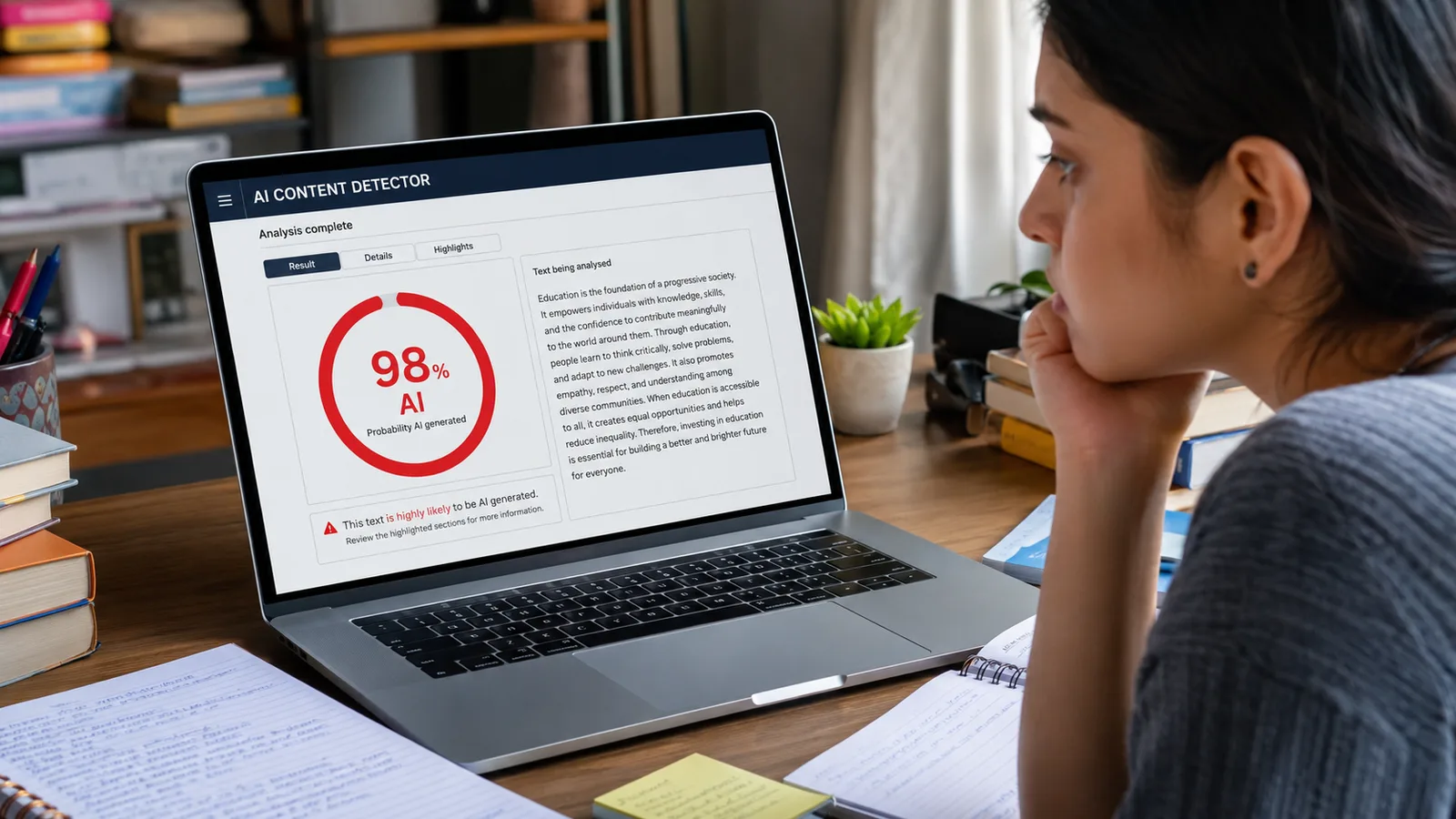
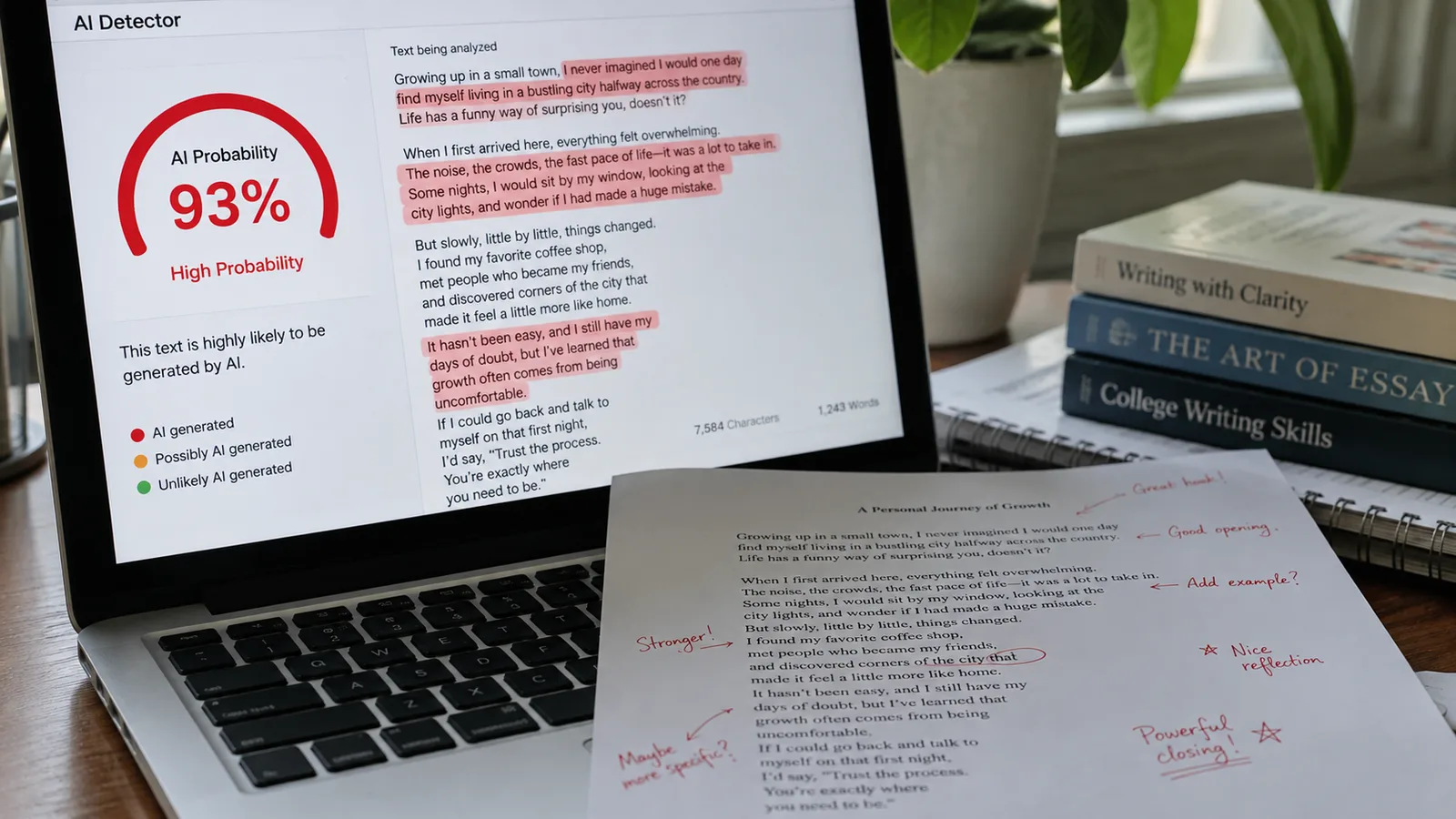
Imagine handing in an essay you wrote yourself, word by word, and a tool announces it is "98% AI-generated." It happens every day, and it happens most to the people least able to argue back: students writing in English as a second language, careful writers, anyone whose prose is plain and tidy. So the real question isn't just whether AI detectors work. It's whether they are accurate enough to base a decision on, and the honest answer is no.
This is a plain-English look at what the research actually shows: how these tools work, what their accuracy numbers really mean, why they flag human writing, why they miss AI writing, and what a score is and isn't worth. It leans on independent testing and academic studies, cited by name, not on any detector vendor's own marketing.
The short answer: are AI detectors accurate?
Accurate enough to be interesting, not accurate enough to be evidence. In controlled benchmarks the best tools catch most AI-generated text, and a few keep their error rates genuinely low. But every serious independent study lands on the same caveat: no detector can reliably prove that a specific piece of writing was made by AI, because the same tools produce false positives on real human writing and can be beaten by a quick paraphrase.
That is why the useful way to hold a detector result is as a signal, not a verdict. A high score is a reason to look closer, ask a question, or start a conversation. It is not, on its own, proof of anything, and treating it as proof is where the real harm starts.
How AI detectors actually work
The key thing to understand is that a detector does not detect AI. It detects a style, and then guesses. There is no database of AI writing it checks against and no hidden watermark it reads. It measures the texture of the prose.
Most tools fall into one of two families. The first looks at statistical smoothness, how predictable each word is and how evenly the sentence lengths flow, because AI text tends to be fluent, average, and low in surprise. GPTZero's original approach worked this way. The second family is a trained classifier, a model shown millions of human and AI texts until it learns the subtler patterns, which is how the more accurate tools like Pangram and Originality.ai work now. The second family is harder to fool, but neither one is reading meaning or intent. Both are pattern-matching on the surface, which is exactly why clean human writing and AI writing can look identical to them.
What the accuracy numbers really say
Here is where the marketing and the research part ways. Detector companies advertise numbers like 99% or 99.98%, and independent testing keeps finding something lower and messier. The table pulls together what third-party tests actually report, and how far it sits from the claims.
| Detector | Claimed | Independent tests found | False-positive risk | Rough price |
|---|---|---|---|---|
| Pangram | Very high | Among the lowest false-positive rates in independent testing, and held up best when text was paraphrased | Lowest measured | Paid, aimed at businesses |
| Originality.ai | About 97% | Around 97% in an independent study, and strong on paraphrased text | Higher on ESL and creative writing | About $15/mo |
| GPTZero | About 99% | 95.7% on the RAID benchmark, far lower in some head-to-heads, and drops sharply after paraphrasing | Notable on formal and ESL writing | About $13/mo, free tier |
| Turnitin | Under 1% at document level | A Washington Post test found far higher on a small sample, and it misses roughly 15% of AI text | About 4% at sentence level, and Turnitin says false positives are more common below its 20% threshold | Institutions only |
| Copyleaks | High | Ranked among the more accurate in a Cornell-hosted study | Real-world false positives reported | About $14/mo |
| Winston AI | About 99.98% | Around 75 to 85% in real-world testing | Not clearly published | About $18/mo |
| ZeroGPT | None published | Unreliable in independent checks | High | About $10/mo, large free tier |
Claimed
- Pangram
- Very high
- Originality.ai
- About 97%
- GPTZero
- About 99%
- Turnitin
- Under 1% at document level
- Copyleaks
- High
- Winston AI
- About 99.98%
- ZeroGPT
- None published
Independent tests found
- Pangram
- Among the lowest false-positive rates in independent testing, and held up best when text was paraphrased
- Originality.ai
- Around 97% in an independent study, and strong on paraphrased text
- GPTZero
- 95.7% on the RAID benchmark, far lower in some head-to-heads, and drops sharply after paraphrasing
- Turnitin
- A Washington Post test found far higher on a small sample, and it misses roughly 15% of AI text
- Copyleaks
- Ranked among the more accurate in a Cornell-hosted study
- Winston AI
- Around 75 to 85% in real-world testing
- ZeroGPT
- Unreliable in independent checks
False-positive risk
- Pangram
- Lowest measured
- Originality.ai
- Higher on ESL and creative writing
- GPTZero
- Notable on formal and ESL writing
- Turnitin
- About 4% at sentence level, and Turnitin says false positives are more common below its 20% threshold
- Copyleaks
- Real-world false positives reported
- Winston AI
- Not clearly published
- ZeroGPT
- High
Rough price
- Pangram
- Paid, aimed at businesses
- Originality.ai
- About $15/mo
- GPTZero
- About $13/mo, free tier
- Turnitin
- Institutions only
- Copyleaks
- About $14/mo
- Winston AI
- About $18/mo
- ZeroGPT
- About $10/mo, large free tier
A few patterns matter more than any single figure. The advertised accuracy is almost always measured under ideal conditions, on raw AI text that nobody tried to disguise. The moment text is paraphrased, the numbers fall off a cliff for most tools, GPTZero has been measured dropping to around 18% after a few paraphrase passes, while a couple of trained classifiers hold up. And a headline "99% accurate" tells you nothing about the number that actually hurts people, the false-positive rate, which is a completely separate measurement most vendors are quieter about.
Does Turnitin detect AI, and is it accurate?
Turnitin is the AI detector most students are actually judged by, and its published accuracy carries a condition that rarely travels with the headline number. The company reports a document-level false-positive rate under 1%, which is the figure almost everyone quotes. That figure applies to documents where 20% or more of the text is flagged. At sentence level, which is what a student actually sees highlighted on their own work, Turnitin puts the rate nearer 4%. Below the 20% threshold the company has said false positives are more common, marks those scores with an asterisk, and has not published a rate for that band at all.
That gap matters because the low band is where ordinary students live. Someone who used AI to tidy two paragraphs produces a low percentage, which is precisely the range Turnitin itself describes as least reliable and declines to quantify.
Vanderbilt did the arithmetic in public and then switched the tool off. Writing in August 2023, it pointed out that Turnitin's claimed 1% applied to the 75,000 papers Vanderbilt submitted in 2022 would mean roughly 750 papers wrongly flagged. The university disabled AI detection "for the foreseeable future", citing the fact that Turnitin enabled the feature with less than 24 hours' notice and no opt-out, gave no detail on how it decides what is AI, and that detectors may be biased against non-native English speakers. Its conclusion was blunt, that it does not believe AI detection software is an effective tool that should be used.
One correction is worth making because the claim travels so widely. Turnitin was not one of the tools in the Stanford study, so the 61% non-native-speaker figure below does not belong to Turnitin and should not be quoted against it.
The false-positive problem is the real danger
A false positive is a detector flagging genuine human writing as AI, and it is the part that ruins lives rather than just annoying content teams. It is not random noise either. It falls hardest on specific groups.
The most cited finding, from a Stanford study, is that detectors wrongly flagged around 61% of essays written by non-native English speakers as AI, while barely misfiring on native speakers. It is also the most disputed. Turnitin's own critique notes the study leaned on 91 short works under 150 words, and the detector vendor Originality.ai has published a rebuttal too. Both have an obvious interest in the answer, which is worth holding in mind in both directions.
The evidence on other groups is thinner than it is usually reported, and the honest version is more useful than the alarming one. Common Sense Media surveyed 1,045 teens through Ipsos between March and May 2024, oversampling Black and Latino respondents, and found Black teens were about twice as likely as their white and Latino peers to say a teacher had wrongly flagged their work as AI. That measures accusations students reported rather than any controlled test of a detector, so it establishes a disparity without establishing its cause. The detail that connects the two is that 79% of the teens who were wrongly flagged said the work had also been run through AI detection software. On neurodivergent writers, Chambers and Kelley tested about 60,000 Reddit posts in July 2026 and found significantly more posts from likely-autistic authors were flagged, though under 2% of either group was flagged at all and the detector they used was an older GPT-2-era model. A real effect, then, and a small one on an obsolete tool.
Where the mechanism is clearest, it is the same in every case: these tools equate "smooth, plain, predictable prose" with AI, and a careful second-language writer, or anyone taught to write cleanly and formally, produces exactly that. The detector cannot tell the difference between disciplined human writing and a language model, because on the surface there often isn't one. This is the same low-surprise texture behind the tells that make writing look AI, except here the "tells" are just how a lot of real people write.
And they miss real AI text, too
The false-positive problem has an evil twin. The same detector that wrongly accuses a human will happily clear AI text that has been lightly reworked. Running a passage through a paraphrasing or "humanizer" tool drops most detection scores sharply, and even adding a casual word or changing a few sentences can flip a result. One tester reported bypassing detection most of the time just by nudging the prompt.
So the tool fails in both directions at once. It flags people who wrote their own work and misses people who didn't, which is close to the worst possible combination for something used to make judgments. It is an arms race between generators and detectors with no stable winner, and the detector is usually a step behind. If you want the fuller picture of why AI writing is so slippery to pin down, it connects to why AI sounds confident when it's wrong and what an AI hallucination is: these models produce fluent, average, plausible text by design, and that is precisely what makes it hard to label.
Why honest AI use is riskier than hiding it
The sharpest finding of 2026 is that detectors do not just fail in both directions, they fail asymmetrically, and the asymmetry rewards exactly the wrong behaviour. Karr, Khvatskii, Hua and Chawla tested commercial detectors against published academic abstracts and posted their results in August 2026. Asking a model only to refine an existing abstract, the lightest possible assistance, produced flag rates of 38 to 80%. Running fully AI-labelled text through a commercial humanizer dropped detection to under 4%.
Put those two numbers next to each other and the incentive inverts. A student who used AI lightly and did not try to hide it is far more likely to be flagged than one who used it heavily and deliberately covered the traces. The authors say so directly, that honest AI-assisted editing may carry a higher sanction risk than humanizer-assisted evasion.
Two further findings from the same paper are worth knowing. Unmodified human abstracts from 2023 to 2025 were flagged 9 to 15% of the time, with non-STEM fields significantly worse than STEM. And scores rose with long words and dense academic vocabulary rather than with authorship, which is a measurable mechanism for the bias described above. The thing being detected is partly just formal register.
What a detector score actually means
Put the two problems together and a score resolves into something modest. A percentage from an AI detector is a probability estimate about the style of the text, generated by a tool that is wrong in both directions and easily gamed. It is a weak signal, not a measurement.
That doesn't make it useless. A high score on a piece that also reads oddly, or arrived suspiciously fast, is a fair reason to ask a question or have a conversation. What it cannot do is stand alone as evidence, decide a grade, or justify an accusation. The instant a single percentage becomes the deciding factor, you have handed a life-affecting decision to a tool its own field says is not accurate enough for the job.
What to do if you're wrongly flagged
If a detector has flagged your genuine work, the way through is evidence the detector can't produce and a calm challenge to its authority.
- Keep and show your process. Drafts, notes, outlines, and version history all demonstrate the work being built over time. Google Docs and Microsoft Word both keep an edit history, and writing in a tool that tracks changes is the single best protection you have.
- Ask what evidence exists beyond the score. A detector percentage is one weak signal; a fair process should not rest on it alone.
- Name the unreliability plainly. These tools are documented to misfire on second-language and formal writing, and major universities, including UC Berkeley, Vanderbilt, and Johns Hopkins, disabled AI detection for that reason. That context matters.
- Stay factual, not defensive. You are not disproving a fact, you are pointing out that no fact was ever established.
Should teachers and editors use AI detectors at all?
They can, but only in one narrow way: as a private prompt to look closer, never as a public verdict. Run quietly, a detector might flag something worth a genuine conversation, the kind a good teacher or editor would have anyway. Used as proof, it does real damage, both to the people wrongly accused and to the trust between a teacher and a class, which is why an academic guide from the University of San Diego concludes plainly that AI detectors are "not recommended as a sole indicator of academic misconduct." The tool can start a conversation. It cannot end one.
What this post does not cover
This is an honest look at whether AI detectors are accurate and how to read a score, not a guide to evading detection, which we don't provide, and not a tool-by-tool buying guide. Accuracy figures, tool rankings, and false-positive rates shift constantly as both the generators and the detectors change, so treat the specifics here as current to October 2026 and independently reported rather than tested by us. Nothing here is legal advice; if a detector result has led to a formal accusation, follow your institution's appeal process and ask how the decision was reached.
Sources
- Why AI Detection Fails for Academic Integrity, Karr, Khvatskii, Hua and Chawla, arXiv, 6 August 2026 (light AI edits flagged 38 to 80 percent, humanized text under 4 percent, unmodified human abstracts 9 to 15 percent, and scores rising with academic vocabulary density)
- Guidance on AI Detection and Why We're Disabling Turnitin's AI Detector, Vanderbilt University, 16 August 2023 (the 1 percent claim applied to 75,000 papers, and the stated reasons for switching it off)
- Understanding false positives within our AI writing detection capabilities, Turnitin (the company's own document-level and sentence-level false-positive figures, and the 20 percent threshold caveat)
- GPT detectors are biased against non-native English writers, Liang et al., Stanford (the study behind the non-native-speaker false-positive finding)
- The Dawn of the AI Era: Teens, Parents, and the Adoption of Generative AI at Home and School, Common Sense Media, September 2024 (1,045 teens surveyed by Ipsos, the disparity in wrongly flagged work, and the 79 percent figure)
- The Misclassification of Autistic Writing as AI-Generated, Chambers and Kelley, arXiv, 16 July 2026 (about 60,000 Reddit posts, significantly more likely-autistic texts flagged, under 2 percent of either group)
- The problems with AI detectors: false positives and false negatives, University of San Diego Legal Research Center (academic overview and the "not a sole indicator" conclusion)
Frequently asked questions

Written by
Tapabrata Biswas
Tech Researcher
I test AI productivity tools and research home-automation gear the way most people use them. Not in a lab, but on an ordinary desk with an ordinary internet connection. The only test that matters: does it save you time?
Share the Post with Your Besties
Get the plain-English tech brief
One email a week on AI tools and smart-home tech. No jargon, no hype.