

The Best AI Trip Planner in 2026 (I Tested 6 on One Trip)
I ran the same 5-day Lisbon trip through six AI trip planners. Which is best, which are actually free, and where every one of them still slips.

Researched with AI assistance, reviewed and edited by Tapabrata Biswas.

In this article
- 01How I tested each AI trip planner
- 02The best AI trip planner overall: Mindtrip
- 03The best free AI trip planners are the chatbots
- 04The "free AI trip planner" tools with a catch
- 05How the six compare at a glance
- 06Where every AI trip planner still needs you
- 07Which AI trip planner should you use?
- 08What this guide does not cover
- 09Sources
I gave six AI trip planners the exact same job: plan five days in Lisbon for two adults in October, mid-budget, food and history and a lot of walking, staying central. Same prompt, same trip, one afternoon. Then I checked what each one actually produced against Google Maps and real prices.
I expected the story to be hallucinations: AI confidently sending me to restaurants that don't exist. That is the warning every travel article repeats. It turned out to be the wrong worry. The made-up places barely showed up. The real problem was simpler and more annoying: half the tools that call themselves "free AI trip planners" would not give me a free plan, and one could not produce a plan at all.
This is a real hands-on test, not a roundup of marketing pages. I ran every tool myself in June 2026, screenshotted the output, and verified the specifics. I earn no commission on any of them, so there is nothing here trying to push you toward a paid plan. Prices and features change fast, so check each official page before you sign up for anything.
How I tested each AI trip planner
The method was deliberately boring, because that is what makes a comparison fair. Every tool got the identical brief, phrased the same way: a 5-day Lisbon trip for two adults in October, mid-budget, interested in food, history, and walking, relaxed pace, central stay. Same words, same order, no second tries to fish for a better answer.
For each one I noted four things. Did it need a signup or payment to produce the plan? How good and how specific was the itinerary, out of five? Did it show real costs, and were they right? And the part most lists skip entirely: I picked three named places from each plan, usually a restaurant, a hotel, and an attraction, and checked every one on Google Maps. Real? Open? Where it claimed to be?
That last step is where the honesty lives. A pretty itinerary full of plausible-sounding places is worthless if the places are wrong. So I went looking for the wrongness.
The best AI trip planner overall: Mindtrip
Mindtrip is a dedicated AI travel planner that builds an itinerary, plots it on a live map, and lets you book parts of it without leaving the page. It was the only tool in the test that felt like a finished product rather than a demo.
It asked for no signup and no payment. About a minute after I pasted the prompt, it gave me a five-day plan with morning, afternoon, and evening for each day, a food pick, and a cost breakdown split into lodging, food, and transport with a daily total. Every stop was pinned on an interactive map down the right side, which is genuinely useful for seeing whether a day's plan is walkable or scattered across the city.
Two details sold me. First, it flagged the Gloria Funicular with a note to check its operating status "day-of due to a past incident," which is the kind of current, careful awareness most tools don't have. Second, when I clicked one of its suggested central hotels, it let me actually book it with live October availability. No other tool did that. All three places I spot-checked were real and correctly located. On brief, specificity, and accuracy, it scored a clean five out of five.
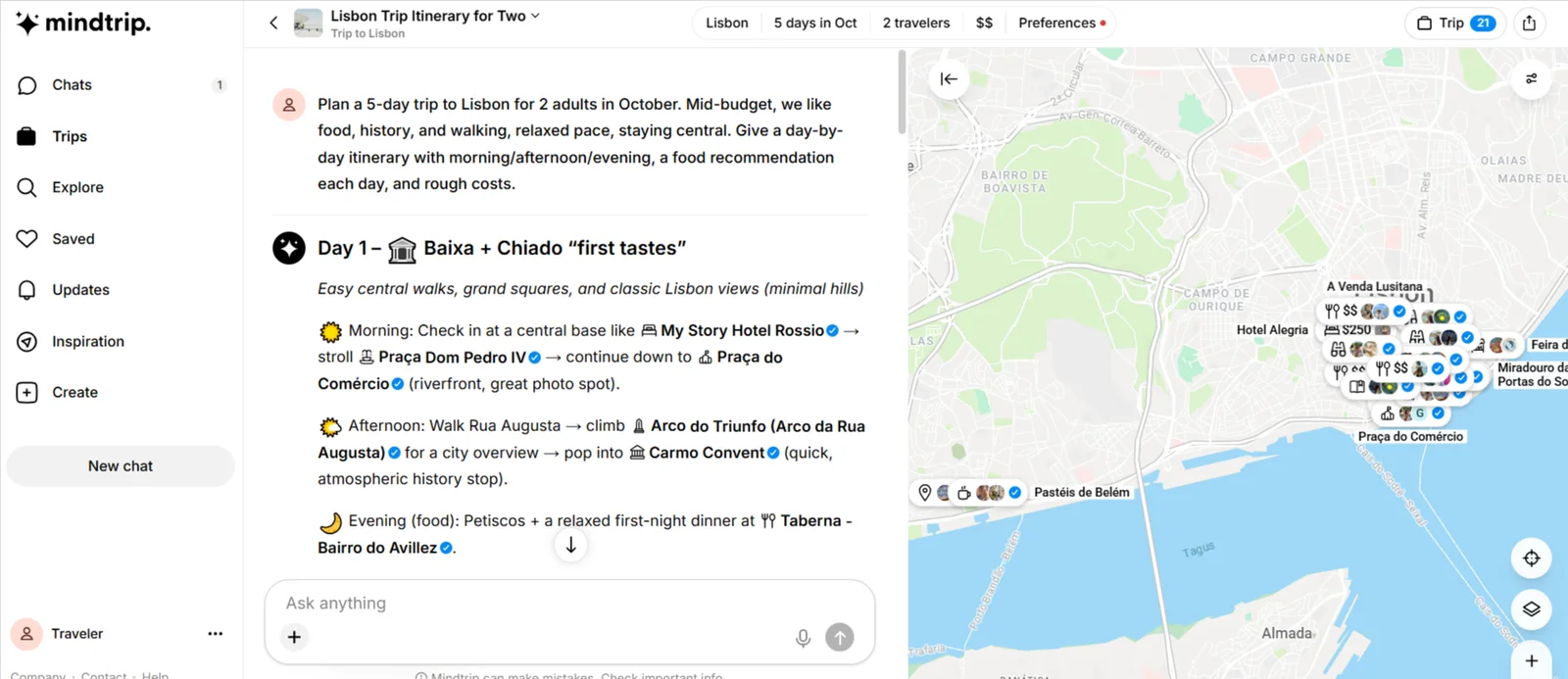
Mindtrip's actual output for the test trip: the plan on the left, every stop pinned on the map.
The catch worth knowing: Mindtrip is a commercial platform that earns money when you book through it, so its recommendations lean toward bookable inventory. That is a fair trade for what you get, but it is not a neutral oracle.
The best free AI trip planners are the chatbots
Here is the result I did not expect. Free ChatGPT and free Google Gemini out-planned almost every dedicated travel tool, and neither asked me for an account.
ChatGPT produced the cleanest plan of the lot in about two seconds: a summary table, then a detailed day-by-day with costs and budget tips. When I checked its prices, they held up. It estimated a Pena Palace ticket near forty euros for two, which matched what I found. Its named restaurants were all real. One quirk is worth flagging. Run the same prompt logged in and logged out and you get different answers, different restaurants, even a different day four, plus a restaurant map that appeared only when I was logged out. Same tool, same prompt, two plans. For how to get the most out of it, our guide on how to use ChatGPT to plan a trip walks through the prompts that work.
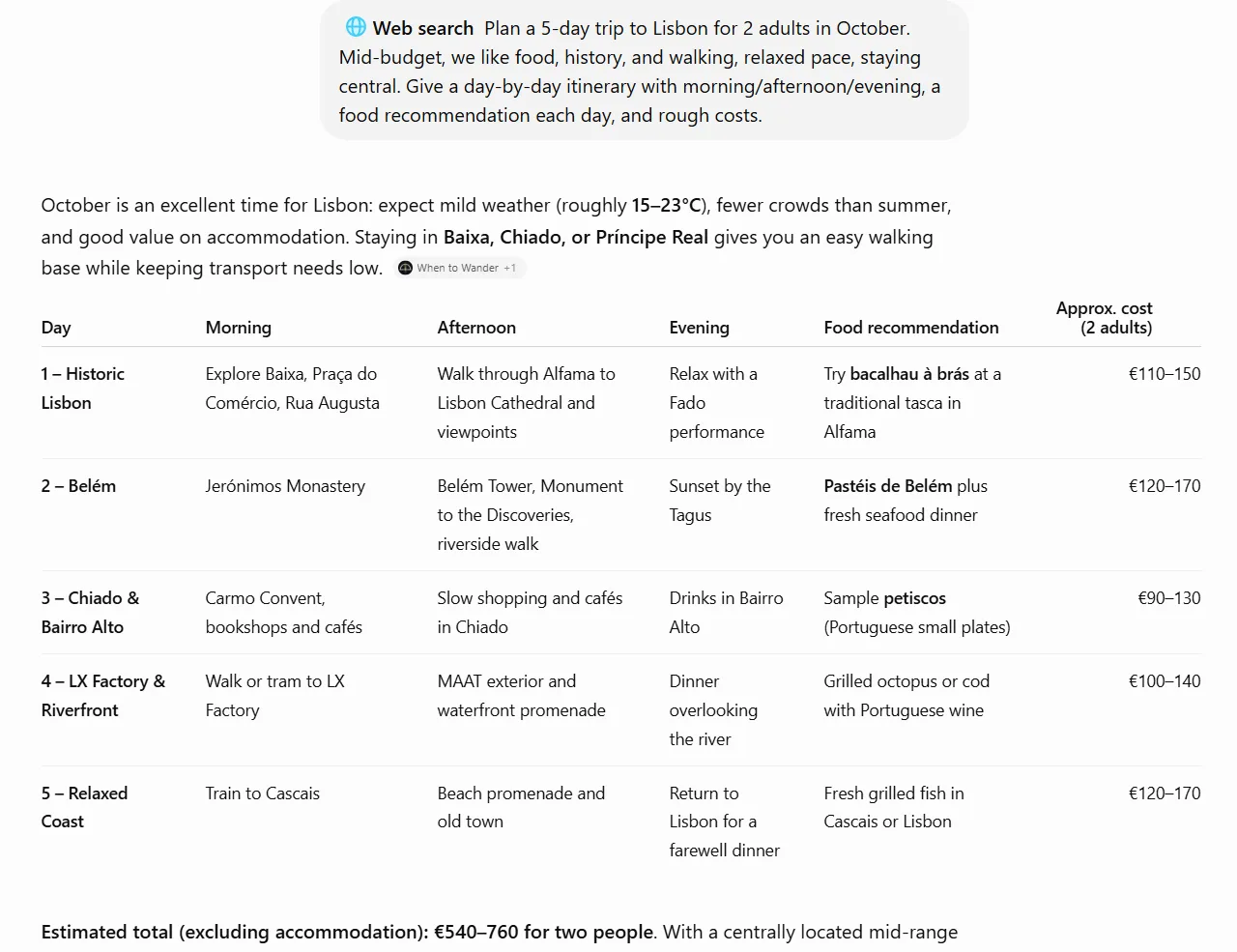
ChatGPT's free plan: a clean summary table, and the prices checked out.
Gemini went deeper than anyone. It cited its sources, added local touches like the bread-and-olives "couvert" charge that catches tourists, and even produced a table of named, real boutique hotels with neighborhoods. The detail was the best in the test. Its weak spot was money. It priced the Jeronimos Monastery at about twelve euros when the October ticket is nineteen, and its hotel estimates ran low against what those hotels actually charge. Brilliant for research, less reliable on the bill.
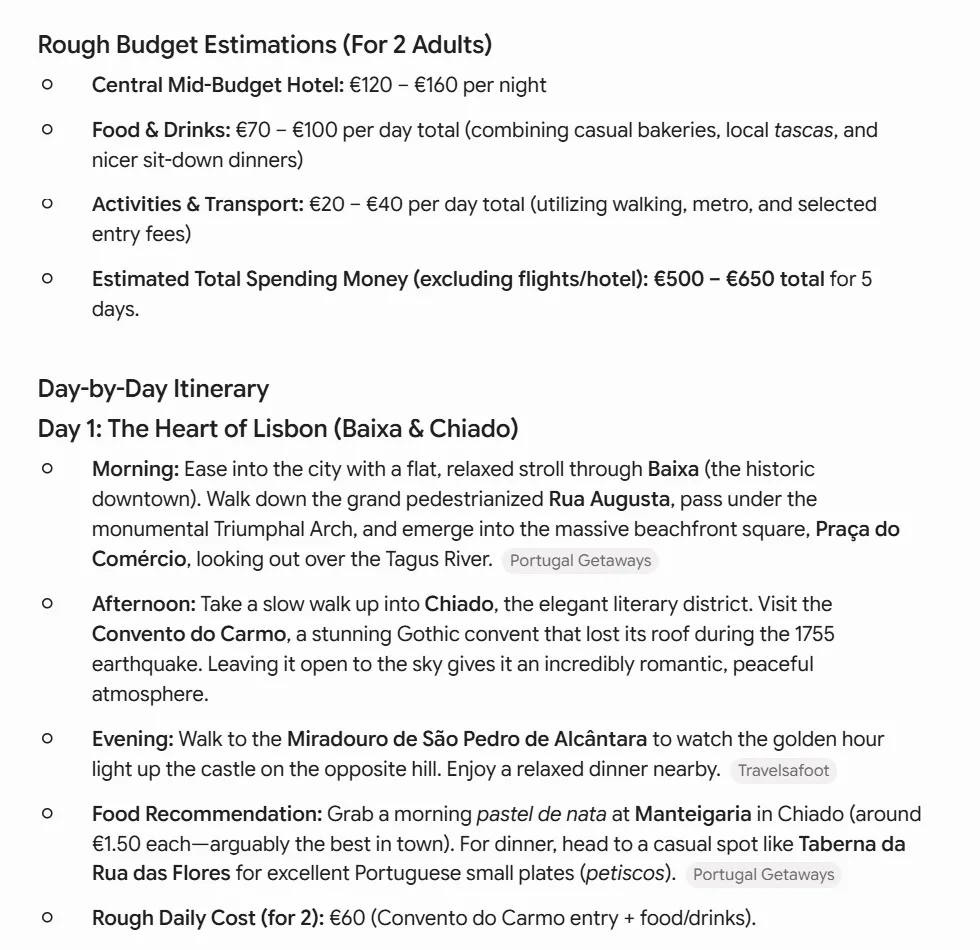
Gemini was the only tool that cited its sources, the grey chips under each suggestion.
Neither chatbot books anything or draws you a map. But for a free, flexible plan you refine in plain language, they beat most of the paid field.
The "free AI trip planner" tools with a catch
This is where the marketing and the reality part ways. Three tools sell themselves on being free and easy. None of them quite delivered that.
Roam Around made the prettiest plan after ChatGPT and Gemini: a visual, photo-rich itinerary with real, accurately-rated restaurants like A Cevicheria and Tasca do Chico. Then the catch arrived. You get two free tokens at signup, one plan costs one token, and after that you either share the tool to earn more or pay. The pricing is thirty tokens for five dollars, eighty for ten, a hundred and fifty for fifteen. It also showed no costs anywhere, and two of the three "website" links on its place cards were dead. Accurate places, rotting links, and not actually free.
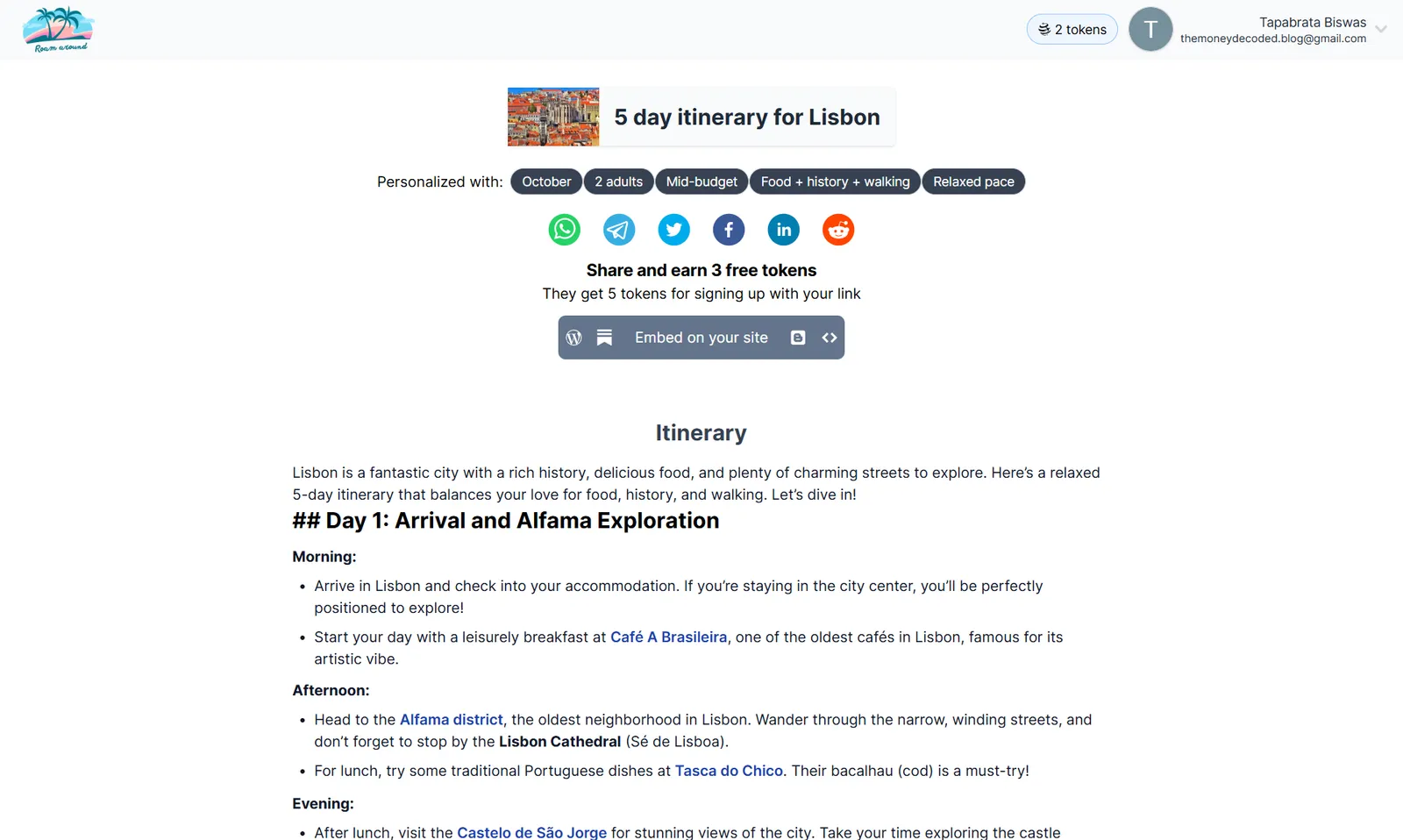
Roam Around looks generous, then the token meter and the share-to-earn nudge appear.
Layla was the most aggressive about money. Its chat will hold a conversation and even spit out a basic itinerary, but the polished, structured plan it advertises is locked behind a three-day trial that demands your card before it shows you anything. The free chat plan I did get was the thinnest of every tool that worked: shorter, vaguer, with costs quoted per person in dollars. The places were real, the personality was warm, but it is built to sell you a booking, not to give you the best free plan.
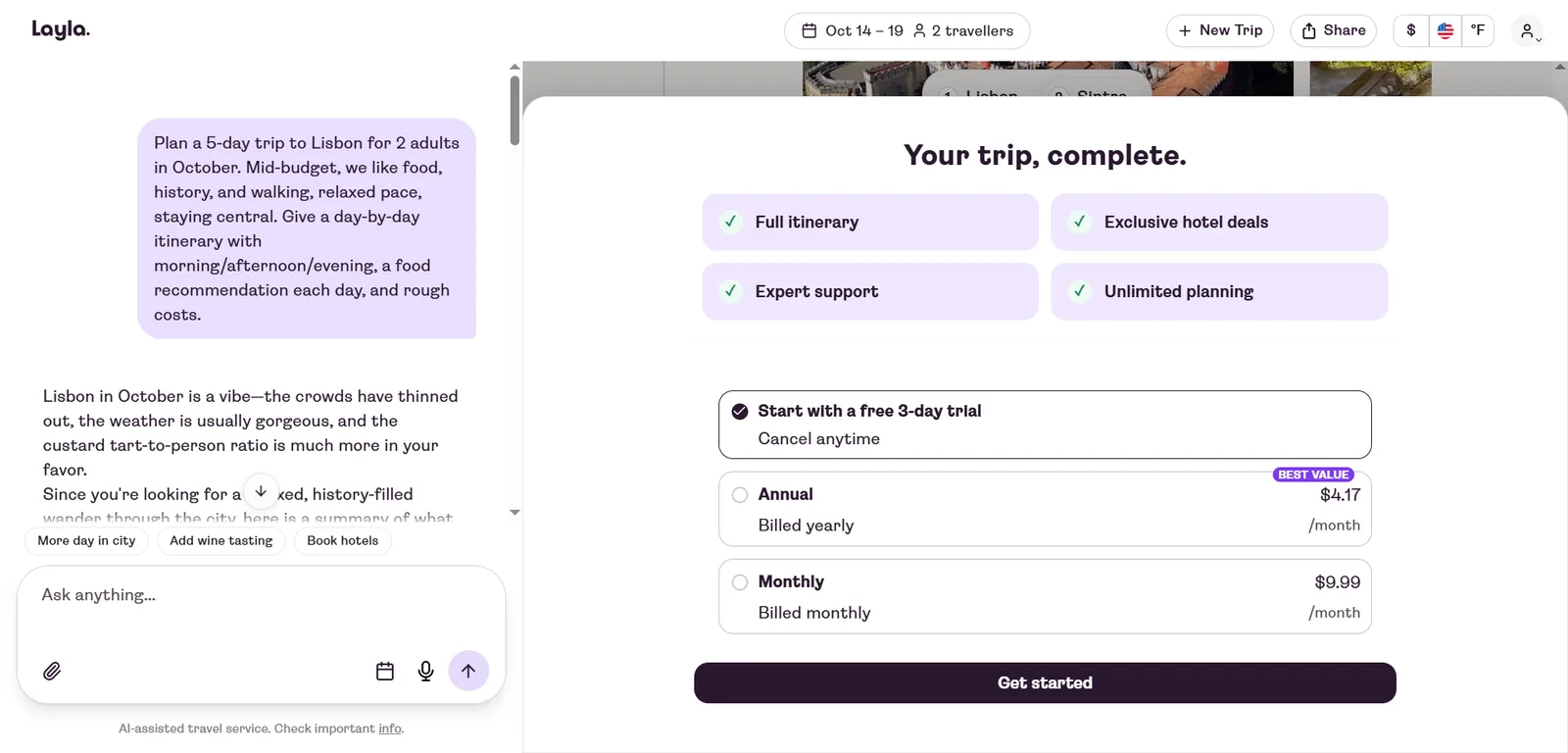
Layla puts a three-day trial and a paywall between you and the full itinerary.
Wonderplan is the one that ranks at the very top of Google for "best AI trip planner," and it could not plan my trip. Its "Generate with AI" button filled in every field except the destination, and the destination selector returned "No options" no matter what I typed. With no destination, the form would not submit. A polished landing page is not the same as a working tool, and on the day I tested, this one did not work at all.
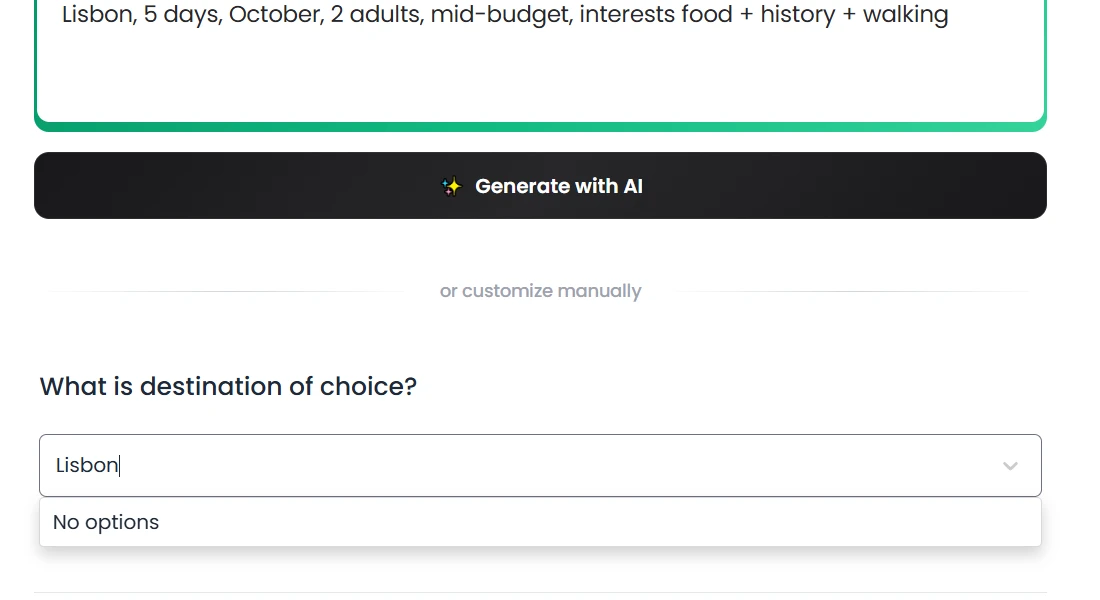
Wonderplan during the test: type Lisbon, get "No options," and the form will not submit.
How the six compare at a glance
This is the whole test in one view. Scores are out of five for how usable and specific the plan was.
| Tool | Free, no signup? | Plan quality | Made-up places | Books in-tool? |
|---|---|---|---|---|
| Mindtrip | Yes | 5/5 | 0 of 3 | Yes, hotels |
| ChatGPT | Yes | 5/5 | 0 of 3 | No |
| Gemini | Yes | 4/5 | 0 of 3 | No |
| Roam Around | 2 free plans, then paid | 4/5 | 0 of 3 | No, links out |
| Layla | No, card-gated trial | 3/5 | 0 of 3 | Paywalled |
| Wonderplan | Did not generate a plan | N/A | N/A | N/A |
Where every AI trip planner still needs you
The reassuring finding: across all five tools that produced a plan, every place I checked was real. Fifteen spot-checks, zero invented restaurants. The fear that AI will send you to a fictional cafe was, in this test, overblown.
The errors were quieter and easier to miss. Prices drifted, sometimes badly, as with Gemini's twelve-euro museum that costs nineteen. Links died. A restaurant ChatGPT recommended, Floresta das Escadinhas, is a real place, but it was closed when I looked, opening only on Monday. None of that is a hallucination in the dramatic sense. All of it will still ruin an afternoon if you show up trusting the plan blindly. If you want the longer version of why these systems get confident about wrong details, I wrote about why AI invents things separately.
So treat any AI itinerary as a strong first draft, not a booking confirmation. Check opening hours. Confirm prices on the official site. Make sure the place is open the day you plan to go. Ten minutes of verifying turns a good draft into a trip that actually works.
Which AI trip planner should you use?
For most people, start with Mindtrip. It is free, needs no account, maps everything, shows real costs, and can book a hotel, which makes it the most complete tool I tested. Just remember it earns from your bookings.
If you would rather think out loud and shape the plan yourself, use ChatGPT for the most accurate free itinerary, or Gemini when you want the deepest research and do not mind double-checking its prices. Both are free and surprisingly hard to beat.
Roam Around is worth one of its two free plans if you like a visual, photo-led layout. Layla only makes sense if you are ready to pay for its booking flow. And Wonderplan I cannot recommend at all until the form works, however high it ranks. If you are weighing AI tools more broadly, our roundup of the best AI tools this year covers the assistants behind several of these planners.
What this guide does not cover
This is a hands-on test of six AI trip planners on a single European city trip, run in June 2026. It is not a ranking of every travel app, and a tool's result on a Lisbon itinerary may differ for a road trip, a multi-country route, or a destination with thinner online data. Pricing, free tiers, and features change quickly, and the Wonderplan fault may be fixed by the time you read this, so confirm current details on each official page. Nothing here is financial or booking advice, and it's worth verifying prices, availability, and opening hours yourself before you commit money. For the prompt-craft side of planning with a chatbot, start with getting started with ChatGPT.
Sources
Frequently asked questions

Written by
Tapabrata Biswas
Tech Researcher
I test AI productivity tools and research home-automation gear the way most people use them. Not in a lab, but on an ordinary desk with an ordinary internet connection. The only test that matters: does it save you time?
Share the Post with Your Besties
Get the plain-English tech brief
One email a week on AI tools and smart-home tech. No jargon, no hype.