

AI Hallucinations Explained: What They Are, Why, and Examples
What AI hallucinations are in plain English: why models make things up, the types, famous real examples, how often they happen, and how to avoid them.

Researched with AI assistance, reviewed and edited by Tapabrata Biswas.
In this article
700 court cases and counting have involved a lawyer citing a legal case that an AI completely made up: invented judges, fake quotes, docket numbers for rulings that never happened. The lawyers got sanctioned, and the AI got the blame, but it wasn't lying or malfunctioning. It was doing exactly what it's built to do: produce text that sounds right. That gap, between sounding right and being right, is what people mean by an AI hallucination, and understanding it changes how much you trust the answers on your screen.
This is a plain-English guide to what hallucinations are, why they happen, the different forms they take, the famous times they've gone badly wrong, how often they actually occur, and the handful of habits that keep them from catching you out.
What is an AI hallucination?
An AI hallucination is when an AI system states false or fabricated information as if it were true: a made-up fact, a misquoted source, or a citation to a study, case, or person that doesn't exist. The term covers any confident output that isn't grounded in real evidence, and you'll also see it called confabulation, or written as an artificial intelligence hallucination.
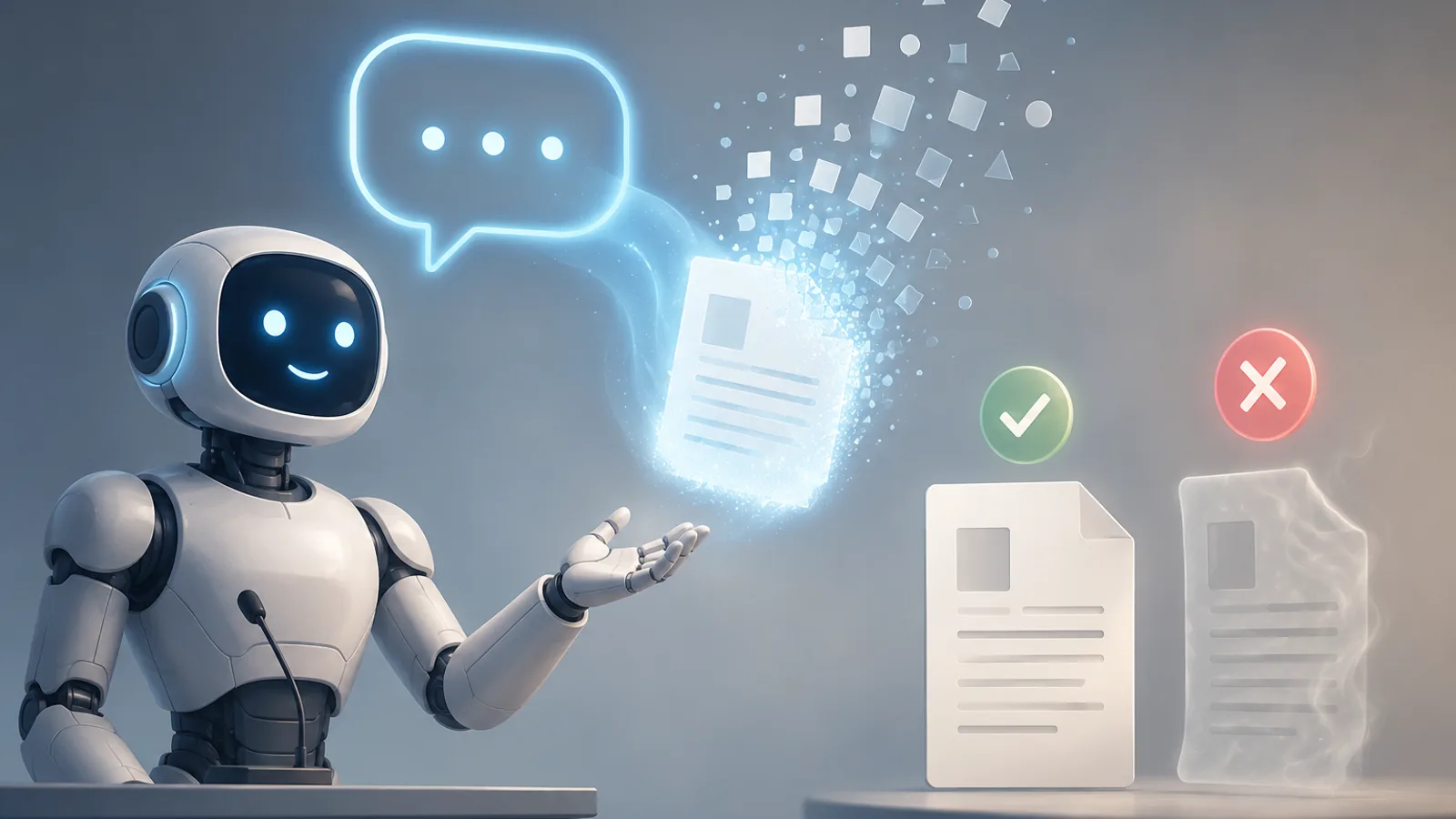
The word is a little misleading, because it suggests the AI is seeing things or breaking down. It isn't. The model isn't lying either, since lying needs intent and a sense of the truth, and it has neither. It generates the most plausible next words based on patterns it learned, and sometimes the most plausible words just aren't true. A hallucination is that mismatch surfacing: fluent, confident, and wrong.
Why does AI hallucinate?
The root cause is that language models predict text, they don't look facts up. Ask one a question and it generates the sequence of words most likely to follow, based on its training. When the true answer is well represented in that training, the likely words and the true words line up. When it isn't, the model still produces confident-sounding words, and those are a guess dressed as a fact.
There's a second, subtler reason, and OpenAI's own researchers spelled it out in 2025. Models are trained and graded in a way that rewards guessing over honesty. Think of a multiple-choice test: if you don't know the answer, a wild guess might score a point, while leaving it blank guarantees zero. Graded only on how often they're exactly right, models learn the same lesson, to always produce an answer rather than admit uncertainty. So the behaviour isn't a glitch that better engineering will casually remove; it's baked into how the systems are built and measured.
Types of AI hallucinations
Not all hallucinations look the same, and naming the kinds helps you spot them. Researchers group them into two broad families.
- Factual hallucinations clash with reality. Sometimes the model contradicts a known fact, like getting a date or a figure wrong. Other times it fabricates something that doesn't exist at all: a fake legal case, an invented study, a quote nobody said. Fabrication is the more dangerous kind, because there's no real thing to check it against until you go looking.
- Faithfulness hallucinations clash with what you gave it. You ask the model to summarise a document and it adds a claim that wasn't in the text, or it ignores part of your instructions and answers a slightly different question. The output can be internally fluent while drifting from your actual source.
Image and video tools add a third kind, visual hallucinations: the famous extra fingers, garbled text on a sign, a clock showing a time that can't exist, or invented details in a generated photo. Same underlying cause, a model producing what looks plausible, in a different medium.
Famous AI hallucination examples
The clearest way to understand hallucinations is to see what they've done in the real world.
The lawyer who cited six fake cases. In 2023, a New York lawyer used ChatGPT to find legal precedents for a case against the airline Avianca. It produced six citations that looked completely real, with judges, docket numbers, and quotations. They were all invented. When the lawyer asked ChatGPT whether the cases were genuine, it confirmed they were and said they could be found on legal databases. The court was not amused, and the lawyers were sanctioned. The case, Mata v. Avianca, became the landmark warning for the whole profession.
The airline that had to honour an invented policy. Air Canada's customer service chatbot told a grieving passenger about a bereavement fare discount that didn't exist. When the airline refused to honour it and argued it wasn't responsible for what its bot said, a tribunal disagreed and made Air Canada pay. A hallucination became a binding promise.
The glue on the pizza. In 2024, Google's AI Overviews told users they could add about an eighth of a cup of non-toxic glue to pizza sauce to help the cheese stick, and that eating rocks could be good for minerals. The glue advice was traced to an eleven-year-old joke comment on Reddit, which the system repeated as cooking guidance because it couldn't tell satire from fact.
The hundred-billion-dollar demo. In its first public demo in 2023, Google's Bard claimed the James Webb Space Telescope took the very first picture of a planet outside our solar system. It didn't; that was done years earlier. The error in a launch ad helped wipe roughly 100 billion dollars off the company's value in a day.
The invented scandal. ChatGPT once fabricated a sexual harassment scandal and named a real law professor as the culprit, citing news articles that were never written. That's the same fabrication problem, except the made-up "fact" was about a real person, which is how a hallucination becomes defamation.
These aren't ancient history, either. A public tracker recorded 7 court decisions involving AI-hallucinated content in 2024, 87 in 2025, and 74 in just the first half of 2026. As more people lean on AI, the problem is growing, not fading.
It isn't only headline cases. Two everyday versions catch people out most. The first is fake academic references: ask a model for studies to back a point and it can return real-looking papers, authors, and journals that were never published, which has tripped up students and researchers the same way it caught those lawyers. The second is health and medical answers, where a confident but wrong dose, drug interaction, or symptom check is the highest-stakes kind of hallucination there is, and the reason health questions sit at the top of the always-verify list. Customer-facing chatbots carry the business version of the risk, as Air Canada discovered, since a company can be made to honour whatever its bot invents.
How often do AI hallucinations happen?
There's no single hallucination rate, because it depends entirely on whether the answer is grounded in a real source.
When a model summarises a document you hand it, the rate is now low. Vectara's hallucination leaderboard, which tests exactly this, puts the best current models, including OpenAI's, at roughly 0.8 to 2 percent. Give it the source and it mostly stays faithful to it.
Take the source away and the picture changes sharply. Asked open factual questions from memory, models are far less reliable: OpenAI's own testing puts hallucination on short, specific fact questions near 50 percent. This is the single most useful thing to remember. A hallucination is much more likely when you ask for facts with nothing attached, and much less likely when the model is working from a document or a live search. For the ChatGPT-specific version of this, see our guide to why ChatGPT gives wrong answers.
How to spot a hallucination
You won't catch every one, but hallucinations leave tells, and a few are worth committing to memory.
- Suspiciously specific sources. A precise citation, a named study, or an exact quote, especially on an obscure or recent topic, is exactly where fabrication hides. The more confident and detailed the reference, the more it earns a check.
- Certainty about something obscure. Models are thinnest on niche, specialist, or very recent facts, so a smooth, sure answer there deserves more suspicion, not less.
- Clean numbers with nothing behind them. A statistic that's suspiciously round, or quoted with no source attached, is often invented to fill a gap.
- Details that aren't in your document. If you asked for a summary and a fact shows up that you can't find in the original, treat it as added, not found.
- It can't stand behind it. Ask where a claim came from. A dead link, a source that doesn't actually say it, or a quick backpedal when you push is your answer.
Can AI hallucinations be fixed?
Not completely, and it's worth being honest about that. Because hallucination comes from how these models fundamentally work, no current technique removes it entirely, and claims that it's about to be solved tend to overpromise.
What does work is reducing it, sometimes dramatically. The biggest lever is grounding: connecting the model to real sources so it summarises retrieved evidence instead of guessing from memory. That approach, often called retrieval-augmented generation or RAG, can cut hallucination by around 80 percent, which is why answers with web search and citations are so much more trustworthy than answers without. Fine-tuning on verified data and layered checks help further. The realistic goal in 2026 is to manage hallucination down to an acceptable level, not to wait for a version that never makes things up.
How to protect yourself
You don't need to understand the maths to stay out of trouble. A few habits do most of the work.
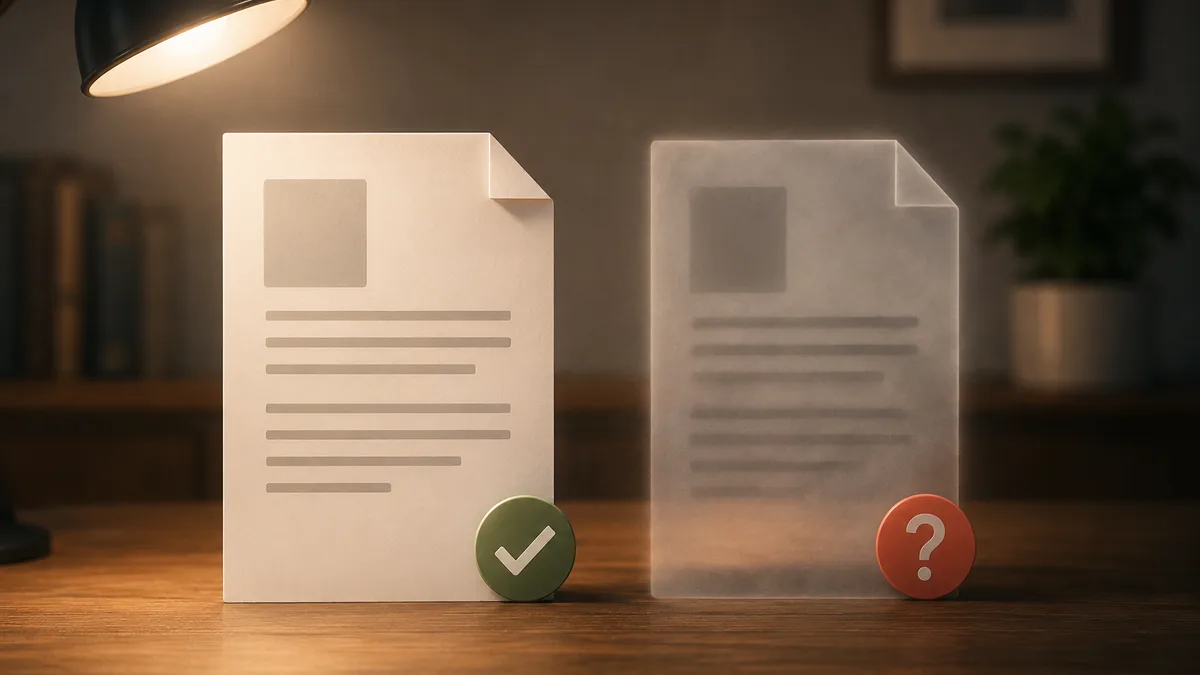
The single biggest one is to keep answers grounded. Turn on web search for anything factual, or paste in the source document and ask the model to answer only from it. The same question can hallucinate from memory and stay accurate from a source. Compare a prompt that invites invention:
Give me five studies that prove this point, with citations.
With one that pushes back against it, on a model like GPT-5.5:
Using web search, find real studies on this topic and give me a working link for each. Only include sources you can actually open. If you can't find solid support for a claim, tell me instead of inventing one.
Beyond that: ask for sources and actually open them, since a fabricated citation looks identical to a real one until you click. Be wary of obscure, recent, or specialist facts, which is exactly where models are thinnest and most likely to fill the gap. Writing a clearer prompt leaves less room for invention. And treat anything that matters, like health, legal, money, names, dates, and numbers, as a claim to verify against a trusted source rather than a fact to trust. If you're new to ChatGPT, that one verify-the-important-stuff habit is most of what keeps AI useful instead of risky. The same caution sits at the heart of prompt engineering basics: plausible is not the same as true.
What this post does not cover
This is a general explainer about why AI systems hallucinate and how to handle it, not a technical guide to building hallucination detection into your own software, which involves retrieval pipelines and evaluation tooling beyond everyday use. Hallucination rates and model behaviour change with each release, and the figures here are accurate as of June 2026, so check current benchmarks before relying on a specific number. The behaviour applies across assistants, ChatGPT, Gemini, Claude, and image tools alike, so the habits here carry over to whichever you use.
Sources
Frequently asked questions

Written by
Tapabrata Biswas
Tech Researcher
I test AI productivity tools and research home-automation gear the way most people use them. Not in a lab, but on an ordinary desk with an ordinary internet connection. The only test that matters: does it save you time?
Share the Post with Your Besties
Get the plain-English tech brief
One email a week on AI tools and smart-home tech. No jargon, no hype.