
30 Gemini Prompts for Medical Students (2026 Guide)
30 Gemini prompts for anatomy, physiology and pharmacology revision, plus the peer-reviewed evidence on where Gemini stops being reliable for medicine.

Researched with AI assistance, reviewed and edited by Tapabrata Biswas.
In this article
- 01What the research actually says about Gemini in medicine
- 02How to get a usable answer
- 03Anatomy and recall
- 04Physiology and mechanisms
- 05Pharmacology
- 06Clinical reasoning, with the caveat attached
- 07Exam preparation
- 08Lectures, papers and notes
- 09The rule for anything that touches a patient
- 10What this post does not cover
- 11Sources
Medical revision has a volume problem that no other degree quite matches, and that is exactly the kind of problem a language model looks built for. It will explain the renin-angiotensin system at whatever depth you ask, generate a hundred recall questions before breakfast, and never get bored of being asked the same thing again.
The catch is that it is confident in places it should not be, and the research on medicine specifically is unusually clear about where those places are. This guide gives you 30 prompts organised by revision job, and it leads with the evidence, because knowing where Gemini stops being reliable is worth more than any individual prompt.
One boundary before anything else. This is about studying medicine, not practising it. Every prompt below assumes you are revising material you will be examined on, and none of them belong anywhere near a decision about a real patient.
What the research actually says about Gemini in medicine
Most prompt guides for medical students skip this, and it is the part that should change your behaviour.
A 2026 study tested seven large language models against 555 anatomy examination questions. Gemini 1.5 Pro answered 78.92 percent correctly, which placed it behind ChatGPT-4o on 83.06 percent and Copilot on 79.46 percent, and ahead of DeepSeek on 76.94 percent. On its own that number reads like a reasonable study partner.
The breakdown is where it gets useful. The models performed best on functional-activity questions, at around 75 percent. They performed worst on multiple-choice questions with more than one correct answer, at 37.7 percent, and the best-performing model in multiple-choice format managed only 54.5 percent overall.
Read those two numbers together and the shape of the tool appears. Gemini is reasonably good at telling you what something is and how it works. It becomes unreliable precisely when a question requires holding several correct facts at once and ruling others out, which is the format your exams are written in.
A second study points the same way from a different angle. Researchers at Qatar University asked 48 medical students in years two to four to evaluate MCQs across six anatomical modules, written by ChatGPT 3.5, Gemini 1, and expert anatomists, judged blind against 17 quality criteria. The most common verdict, at 40.7 percent, was that all three sources were equally effective, which is a genuinely interesting result and not a flattering one for anybody. Where students did express a preference, expert-written questions scored highest for deeper analytical thinking and clinical alignment.
So the honest summary is that AI-generated questions are fine for drilling volume and poor at the reasoning dimension, and that you should not quietly substitute them for the questions your faculty wrote.
Both studies tested older model versions, so treat these as a floor rather than today's reading. The pattern they describe, strong on recall and weak on integration, has been stable across every evaluation so far.
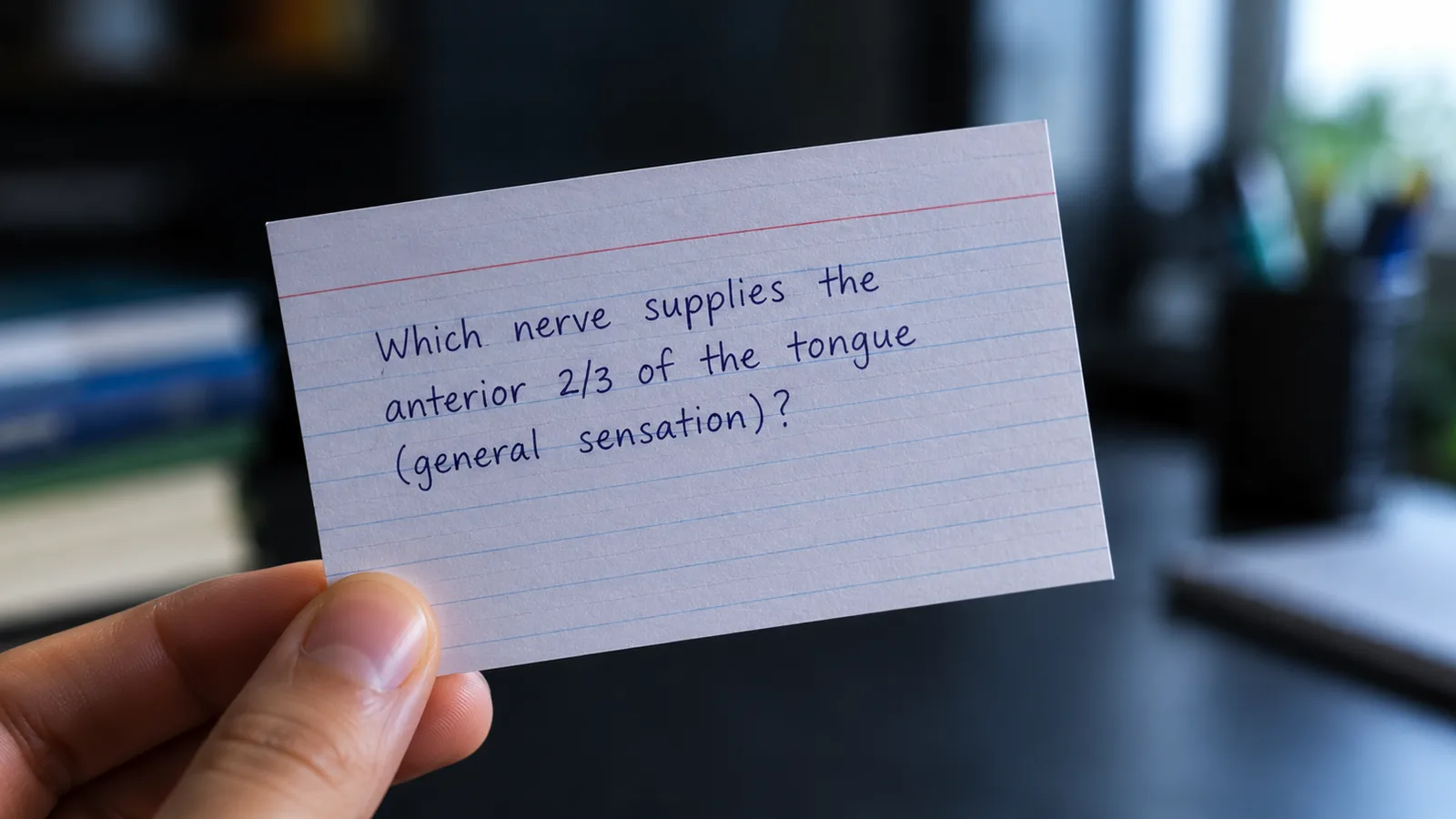
The answer turned away is the whole point. Everything below is built to make Gemini question you rather than tell you.
How to get a usable answer
A medical prompt needs three things a general one does not. It needs your level, because the answer for a first-year differs from the answer for someone sitting finals. It needs the system or module, so the model works inside the right frame. And it needs an instruction about depth, because the default is a summary and a summary is rarely what you want.
The prompts below assume that shape. Fill the brackets with your own specifics, and treat the first answer as something to interrogate rather than something to learn.
Anatomy and recall
The strongest case for the tool, and the one the research supports best.
1. Build a structure-by-structure recall list
I am a [year] medical student revising [region, for example the brachial plexus]. List every structure I need to know for an exam at this level, grouped by category, with a one-line function for each. Mark the three most commonly tested.
2. Turn a region into active recall questions
Generate 15 short-answer recall questions on [region] for a [year] medical student. Ask one at a time, wait for my answer, then tell me what I missed before moving on. Do not give me the answers up front.
3. Explain a relationship rather than a list
Explain the anatomical relationships around [structure] as if you were walking a student through a dissection. Describe what lies anterior, posterior, medial and lateral, and why each relationship matters clinically.
4. Build a mnemonic that actually holds
I keep forgetting [list or sequence]. Give me three mnemonics for it, an acronym, a vivid sentence, and an image-based one, then tell me which type usually works best for anatomical sequences and why.
5. Find the thing you keep confusing
I confuse [structure A] and [structure B]. Give me the three features that reliably distinguish them in an exam question, and write two questions where getting that distinction wrong would cost me the mark.
Physiology and mechanisms
Where asking for the chain of causation beats asking for a definition.
6. Trace a mechanism end to end
Walk me through [mechanism, for example the renin-angiotensin-aldosterone system] step by step, from the initial trigger to the final effect. At each step, say what would happen if that step failed.
7. Ask for the why behind a value
Explain why [physiological value] changes in [condition]. I want the underlying mechanism, not the association. Assume I am a [year] medical student and I will be asked to justify the answer.
8. Compare two states side by side
Compare [state A] and [state B] across mechanism, typical findings, and what distinguishes them. Put it in a table, and add a row for the single feature most likely to appear in an exam question.
9. Build the flowchart you could not draw
Describe [process] as a flowchart in text, with each decision point labelled. Then tell me the two places students most often go wrong when reproducing it from memory.
10. Stress-test your own explanation
Here is my explanation of [mechanism]: [paste]. Act as an examiner. Tell me what is wrong, what is imprecise, and what I have left out that would be expected at [year] level.
Pharmacology
High-volume, high-detail, and the area where a wrong answer is easiest to spot if you ask it to show its working.
11. Build a drug class summary
Summarise [drug class] for a [year] medical student: mechanism, main indications, the adverse effects I will be examined on, and the contraindications that matter. Keep it to one page and flag anything commonly confused with a neighbouring class.
12. Separate drugs that blur together
I mix up [drug A], [drug B] and [drug C]. Build a table that separates them by mechanism, main side effect, and the clinical situation where you would pick one over the others.
13. Work from the side effect backwards
Give me a list of drugs that cause [adverse effect], grouped by mechanism of that effect. For each, say how you would recognise it in an exam vignette.
14. Drill the numbers you need to know
Quiz me on the doses, half-lives and monitoring requirements for [drug class] that a [year] student is expected to know. One question at a time, and tell me when a number I give is in the right range but not the expected answer.
Clinical reasoning, with the caveat attached
This is the section where the evidence says to be most careful, so the prompts are written to make Gemini show its reasoning rather than deliver a verdict.
15. Build a differential and defend it
Here is a teaching vignette from my course: [paste]. Give me a differential diagnosis ranked by likelihood for a student at [year] level. For each, state the single feature in the vignette that supports it and the single feature that argues against it. Do not give a final answer.
16. Make it ask you for the next investigation
Act as a tutor running a case discussion on [presentation]. Give me the history only, then ask me what I would do next. Respond to my choice with the result, and keep going until I reach a diagnosis or run out of sensible steps.
17. Find the discriminating feature
In distinguishing [condition A] from [condition B], what is the single most discriminating clinical feature, and what is the most commonly misused one? Explain why the second misleads students.
18. Turn a guideline into questions
Here is a section of a course guideline: [paste]. Write eight exam-style questions that test whether I have understood it, including two where a plausible-sounding answer is wrong. Mark my answers afterwards.
Exam preparation
Where the 37.7 percent figure matters most, so use these to drill and let your faculty's questions carry the reasoning.
19. Generate a timed paper
Write a [number]-question paper on [module] at [year] level, mixed difficulty, in the style of [exam format]. Present them one at a time, do not reveal answers until the end, then mark me and group my errors by topic.
20. Mark your own answer like an examiner
Here is an exam question and my answer: [paste]. Mark it as an examiner would at [year] level. Give me the marks I earned, the marks I missed and why, and rewrite the answer as a full-mark response.
21. Attack your weakest topic
My weakest areas in [module] are [list]. Build me a five-day revision plan that spends the most time on the weakest high-yield topics, uses spaced repetition so earlier topics return, and ends with a mixed paper.
22. Practise the viva
Act as an examiner for a [length] oral exam on [topic] at [year] level. Ask one question at a time and follow up when an answer is thin. Give no feedback during the exam. Afterwards, tell me where I was vague and what would have cost me marks.
23. Build a one-page high-yield sheet
Condense [module] into a single page of high-yield facts for the night before an exam. Prioritise by what is most commonly examined, not by what is most interesting, and mark anything that is frequently misremembered.
Lectures, papers and notes
The jobs where the model is transforming your material rather than supplying facts of its own, which is the safest use of all.
24. Turn a lecture into questions
Here are my notes from a lecture on [topic]: [paste]. Turn them into 20 active recall questions and a one-page summary. Flag anything in my notes that looks incomplete or contradictory.
25. Make a paper readable
Summarise this paper for a [year] medical student: [paste or attach]. Give me the question it asked, the method in two sentences, the main finding with the numbers, and the limitation that matters most. Then tell me what it does not show.
26. Build flashcards from your own material
Turn these notes into flashcards: [paste]. One fact per card, question on the front, answer on the back, formatted so I can paste them into Anki. Avoid cards that can be answered by recognising the wording.
27. Fill the gap in your notes
Here are my notes on [topic]: [paste]. Compare them against what a [year] student is expected to know and tell me what is missing, what is at the wrong depth, and what I can safely cut.
28. Explain it back and be corrected
I am going to explain [topic] to you as if teaching a junior student. Listen, then tell me exactly where my explanation was wrong, where it was vague, and which part a patient would not have understood. Here is my explanation: [paste].
29. Visualise something you cannot picture
I cannot picture [concept or structure]. Describe what a clear diagram of it would look like, label every part, and tell me the most common misunderstanding and where it shows up in the diagram.
30. Plan the week, not the session
Here are my modules, deadlines and placement days: [paste]. Build a realistic week that protects retrieval practice over rereading, schedules the hardest topics when I am freshest, and leaves two evenings genuinely free.
The rule for anything that touches a patient
Two boundaries matter more than any prompt on this page, and both of them are about what you put in rather than what you get out.
Never enter anything that identifies a patient. Placement notes, ward lists, handover sheets, clinical photographs and anything with a hospital number in it do not belong in a general chatbot, whatever the hour and whatever the deadline. That is a confidentiality question first and a technology question second, and it does not become acceptable because the model is useful.
And do not let it make a clinical call. The research above is consistent that these models are weakest exactly where clinical integration is required, which is the hardest place to notice an error and the most expensive place to make one. Use it to be questioned on material, to find the gap in your own explanation, and to drill recall. Leave the reasoning to your teaching, your seniors and your own developing judgement.
If you want the general-purpose version of this guide, our general Gemini prompts for students covers essays, research and exam technique across any subject, and the prompt engineering basics explainer covers why these prompts are shaped the way they are. For a wider view of the tool itself, see our best prompts for Gemini guide, and why AI invents things is worth ten minutes before you trust any of it with a fact you will be marked on.
What this post does not cover
- Clinical decision-making of any kind, which is outside the scope of a study guide and outside what the evidence supports
- Whether your medical school permits AI in assessed work, which is a question for your own institution's policy
- Specialty-specific or postgraduate revision, since the prompts here assume undergraduate study
- Patient-facing use, documentation, or anything involving real clinical records
Sources
- Performance of Seven Large Language Models on Anatomy Examination Questions, PMC (555 questions; Gemini 1.5 Pro 78.92 percent, ChatGPT-4o 83.06 percent, and the 37.7 percent multiple-correct-answer figure)
- Assessing LLM-generated vs expert-created clinical anatomy MCQs, PMC (48 medical students at Qatar University, 17 quality criteria, the 40.7 percent equal-effectiveness finding)
- Examination of Gemini's ability to answer anatomical questions, PubMed
- Capabilities of Gemini Models in Medicine, arXiv
Frequently asked questions

Written by
Tapabrata Biswas
Tech Researcher
I test AI productivity tools and research home-automation gear the way most people use them. Not in a lab, but on an ordinary desk with an ordinary internet connection. The only test that matters: does it save you time?
Share the Post with Your Besties
Get the plain-English tech brief
One email a week on AI tools and smart-home tech. No jargon, no hype.