
ChatGPT Prompts for HR: 34 for Hiring, Onboarding & Reviews (2026)
34 copy-ready ChatGPT prompts for HR: job descriptions, interviews, onboarding, performance reviews, policies, and where AI shouldn't lead in hiring.

Researched with AI assistance, reviewed and edited by Tapabrata Biswas.
In this article
- 01How to prompt as an HR professional
- 02Recruiting and job descriptions
- 03Interviewing
- 04Candidate communication
- 05Onboarding
- 06Performance management
- 07Policies and handbooks
- 08Engagement and surveys
- 09Learning and development
- 10HR communications and difficult situations
- 11Where not to let ChatGPT lead
- 12What this post does not cover
- 13Sources
Most HR prompt lists hand you "write a job description" and wonder why the output reads like every other posting: a wall of buzzwords and a requirements list so long it scares off half your pool. The trouble is that HR work is judgment, fairness, and communication, and a vague prompt gives you a generic draft you then have to fix. ChatGPT earns its place in an HR week not by making the people decisions, but by taking the drafting off your plate: the job description, the interview guide, the onboarding plan, the review wording, the policy. Adoption backs this up. 43% of organizations now use AI for HR tasks, up from 26% in 2024, with recruiting the top use case, per SHRM.
The prompts below run across the employee lifecycle, from hiring through onboarding, performance, and offboarding, and they work the same in ChatGPT, Claude, or Gemini. One boundary first: this is the employer side of the desk. If you're the one applying for roles, our prompts for the candidate side fit better. And because HR carries real legal and human weight, there's an honest section at the end on where AI has no business leading, including the bias check that most prompt lists skip.
How to prompt as an HR professional
A prompt that saves you time and one that wastes it differ by four things: role, context, task, and format. Tell the model who to be, give it the real details it can't see, state exactly what you want, and specify how the answer should be shaped. Leave the context out and it fills the gap with a generic template, the problem behind writing a clearer prompt in any field. One habit is specific to HR: strip the real names and numbers before you paste anything.
Here is the difference. The vague version:
Write a job description for a marketing manager.
And the version that actually helps, with role, context, task, and format:
Act as an experienced HR business partner. Write a job description for a [level] [role] on a [team] at a [industry, size] company. The three must-have skills are [list]; treat everything else as nice-to-have, not required. Structure it as a short overview, key responsibilities, must-have requirements, nice-to-haves, and what we offer. Keep it under 400 words, avoid buzzwords, and don't inflate the requirements. Then flag any wording that could read as gendered or age-coded so I can fix it.
The first gives you a template. The second gives you a usable, fairer draft. Every prompt below is written in that second style, and the two habits that matter most are pasting your real, non-identifying context and reviewing anything that touches a hiring decision before you use it.
Recruiting and job descriptions
Recruiting is where AI saves the most time and carries the most risk at once, because the same speed that drafts a job post also reproduces whatever bias sits in the training data. Use it to get past the blank page, then bring your judgment to the requirements and a careful eye to the language.
Act as an HR business partner. Write a job description for a [level] [role] at a [industry, size] company. Details: the team is [describe], the three must-have skills are [list], and the tone should be [tone]. Structure it as overview, responsibilities, must-have requirements, nice-to-haves, and what we offer. Keep requirements realistic, avoid buzzwords, and don't turn nice-to-haves into hard requirements.
Review this job description for language that could exclude qualified candidates: [paste]. Flag gendered words, age-coded terms like 'digital native' or 'energetic', ability assumptions, and requirements that aren't truly necessary. For each, suggest a neutral rewrite, and tell me which requirements I could drop to widen the pool without lowering the bar.
Write a short, honest job ad for [role] to post on [LinkedIn / a job board]. Lead with what makes the role and team genuinely interesting, be specific about the work rather than listing perks, and keep it scannable. No hype, no 'rockstar' or 'ninja', and a clear one-line call to apply.
Draft a structured screening scorecard for [role]. Turn the must-have requirements into 5 to 7 criteria a screener can rate consistently, with a short description of what a strong, average, and weak answer looks like for each, so different reviewers score the same candidate the same way.
Help me write a boolean search string to source [role] candidates on [LinkedIn / a database]. The core skills are [list], the nice-to-haves are [list], and I want to include likely alternative job titles. Give me the string plus a short note on which terms to loosen if the results are too narrow.
Interviewing
A good interview is structured, job-related, and the same for every candidate, which is exactly the repeatable design work ChatGPT handles well. Give it the role and the competencies you're hiring for, and let it build the guide, then keep the actual judgment of answers with the humans in the room.
Create a structured interview guide for [role]. For each of these competencies, [list], write two behavioral questions that ask for a real past example, plus what a strong answer would show. Keep the questions job-related and legal to ask, and note any topic I should avoid so the same guide is used for every candidate.
Write 8 behavioral interview questions for [role] focused on [the trait or skill]. Use the 'tell me about a time' format so candidates give real examples rather than hypotheticals, and for each, add a one-line note on the follow-up I should ask to get past a rehearsed answer.
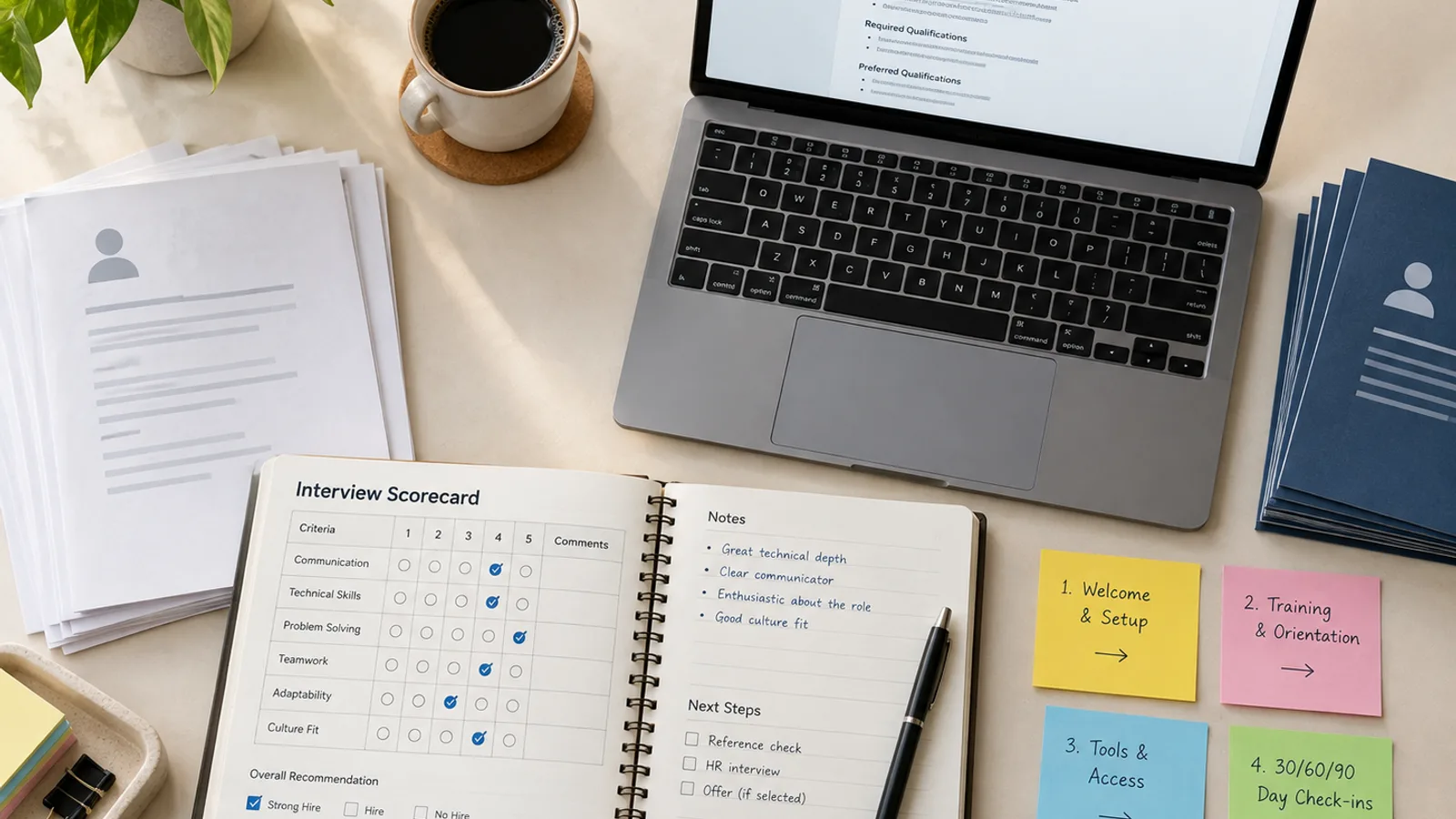
Design a candidate evaluation scorecard for [role] that the whole panel can use. List the criteria that actually predict success in this job, a simple rating scale with described anchors, and a space for evidence, so feedback is grounded in what was said rather than a gut feeling. Keep it to one page.
Help me plan a fair interview process for [role]: [describe the stages you're considering]. Suggest a sensible number of stages, what each should assess so they don't overlap, who should be involved, and where to add a work sample instead of another conversation. Flag anything that adds time without adding signal.
Candidate communication
How you talk to candidates is your employer brand, and the small messages, the outreach, the update, the rejection, are the ones that get rushed or skipped. ChatGPT is good at drafting these so they stay warm and human even at volume.
Write a short, personal outreach message to a passive candidate for [role]. Reference [the specific thing about their background], be honest that it's a cold approach, say briefly why the role might interest them, and keep it under 120 words with a low-pressure ask. No generic 'I came across your profile' opening.
Draft a kind, respectful rejection message for a candidate who [reached the final stage / interviewed once]. Be warm and clear, thank them for their time, avoid false hope and empty feedback, and leave the door open for future roles if that's genuine. Keep it human, not a form letter.
Write an offer message for [role] to [candidate context]. Convey genuine enthusiasm, summarise the key points they'll care about (role, start, next steps), and keep the formal terms for the attached letter. Warm and clear, and end with who to contact with questions.
Onboarding
The first weeks decide whether a new hire feels set up or lost, and onboarding is structured, repeatable work that ChatGPT drafts well. Give it the role and your context, and it will build the plan and the checklists, then you add the specifics only your team knows.
Create a 30-60-90 day onboarding plan for a new [role] on [team]. For each phase, lay out the goals, the people they should meet, what they should be learning, and what 'ramped up' looks like by day 90. Keep it realistic for someone still finding the coffee machine, and mark what needs a manager's input.
Build a first-week onboarding checklist for [role]. Group it into before day one, day one, and the first week, covering accounts and access, introductions, training, and early tasks. Flag anything that has to be ready before they arrive so nothing blocks their start.
Write a warm welcome message to a new hire joining [team] as [role] on [start date]. Make them feel genuinely expected, tell them what to bring or set up, what day one looks like, and who to find. Friendly and clear, and short enough to actually read on a first morning.
Design a simple buddy or mentor program for onboarding new [role] hires. Outline what the buddy does in the first month, how often they check in, the questions they should proactively cover, and how to pick a good buddy. Keep it light enough that people will actually do it.
Performance management
Performance work is where good wording matters most and where managers freeze up, so ChatGPT is genuinely useful for turning rough notes into clear, specific, fair language. It drafts the words; the rating and the message stay yours, since those carry real consequences.
Turn these manager notes into balanced performance-review talking points for [role]: [paste notes]. Structure it as strengths with specific examples, areas to develop framed as growth not blame, and clear goals for next period. Keep it concrete and behavioural, and flag anywhere I'm being vague or unfair so I can sharpen it.
Help me give constructive feedback about [the specific behaviour or issue]. Draft it using clear, specific language that separates the behaviour from the person, states the impact, and moves toward a concrete change. Keep it kind and direct, not a compliment sandwich, and give me an opening line that isn't awkward.
Help me and an employee set SMART goals for the next [period]. Given their role and focus areas [describe], draft 3 to 5 goals that are specific, measurable, and actually within their control, each with what good looks like. Flag any goal that depends on factors they can't influence so we can reword it.
Draft the structure of a performance improvement plan for [describe the performance gap generically]. Lay out clear expectations, the specific support the company will provide, measurable checkpoints, and a fair timeline. Keep it supportive in tone and factual in content, and mark where our HR and legal team must review before this is used.
Policies and handbooks
Policy writing is dense, and ChatGPT is good at turning your intent into clear, readable language and at explaining a policy to employees in plain terms. The one hard rule: it drafts, your HR and legal team confirm it's correct for your jurisdiction before it's real.
Draft a clear, readable [type] policy for a [industry, size] company. The key points we want to cover are [list]. Write it in plain language employees will actually understand, structured with purpose, scope, the policy itself, and what to do with questions. Mark anything that varies by local law as 'confirm with legal' rather than guessing.
Rewrite this policy in plain English so employees can follow it: [paste]. Keep every requirement intact, cut the legalese, use short sentences and examples where they help, and add a one-line summary at the top. Don't change the meaning, just the readability, and flag anything ambiguous that should be clarified.
Write a short employee-facing explainer for this new or changed policy: [describe]. Cover what's changing, why, what it means for them day to day, and when it takes effect. Warm and straightforward, not defensive, and end with where to ask questions. Keep it to a few paragraphs.
Draft an outline for a section of our employee handbook on [topic]. List the subsections it should include, a one-line note on what each covers, and the questions employees most often ask about this topic so we make sure the section answers them. Mark which parts need legal review.
Engagement and surveys
Half of engagement work is asking good questions and then making sense of the answers, and ChatGPT helps with both, drafting survey questions that aren't leading and summarising open-text responses into themes. The judgment on what to do about it stays with you.
Draft an employee engagement survey for a [industry, size] company. Cover [the areas you care about], mixing rating-scale and a few open questions, keep it under [number] questions so people finish it, and make sure the wording is neutral rather than leading. Flag any question that could identify a small team and break anonymity.
Summarise these open-text survey responses into themes: [paste, with identifiers removed]. Group them into the main topics, note roughly how common each is, capture the minority views instead of averaging them away, and pull a few representative quotes. Keep it neutral, and separate what people feel from what they're asking for.
Based on these engagement findings, [paste summary], help me draft a realistic action plan. Suggest two or three changes we could actually make, what to communicate back to employees so they know they were heard, and what to be honest about not being able to change. No vague 'improve communication' actions.
Write a genuine recognition message for [person/team] who [did the specific thing]. Make it specific about what they did and the impact, in a warm and human voice rather than corporate praise, and keep it short. Give me a version for a team channel and a shorter version for a one-to-one note.
Learning and development
Design a training outline on [topic] for [audience and level]. Lay out the learning objectives, the key modules with a one-line description each, a suggested format and length, and a simple way to check people actually learned it. Practical over theoretical, and flag what needs a subject-matter expert rather than a generalist.
Help me build a simple skills-gap framework for [team or role]. Given the skills the role needs now and where it's heading [describe], suggest how to map current versus needed skills, the questions to assess each honestly, and how to turn gaps into a development plan. Keep it usable without a big competency library.
HR communications and difficult situations
Some of the hardest writing in HR is the sensitive announcement or the message no one wants to send, and ChatGPT helps you find clear, humane wording when you're too close to it. You supply the facts and the care; it helps with the structure and the tone.
Help me write a clear internal announcement about [the change, described generically]. Cover what's happening, why, what it means for people, and what happens next, in an honest and calm tone that respects that this affects real people. Avoid corporate euphemisms, and end with where to get support or ask questions.
I need to communicate something sensitive to a team: [describe the situation generically, no names or private details]. Help me structure the message so it's honest without oversharing, respects the privacy of anyone involved, and tells people what they need to know and what they don't need to worry about. Careful and human.
Prep me for a difficult conversation with an employee about [the issue, described generically]. Give me a calm way to open, the facts to stick to, the questions that let them respond, and how to keep it fair and on track. I want to be direct and humane, not scripted or defensive.
Design a respectful offboarding checklist and an exit-interview question set for someone leaving [role]. Cover the practical steps (access, handover, final pay pointers to confirm with payroll) and 6 to 8 exit questions that surface honest, useful feedback rather than box-ticking. Keep the tone gracious regardless of why they're leaving.
Where not to let ChatGPT lead
Here is the honest part, and in HR it matters more than in most jobs, because the work carries legal weight and affects people's livelihoods. ChatGPT is a strong drafter and a poor decision-maker, so the judgment stays with you.
Keep four things in your own hands. The people decisions, who to hire, fire, promote, or how to rate someone, because those are human calls with real consequences, and handing them to a model that can't see the full context or be held accountable is both unfair and legally risky. The bias check, because AI reproduces gendered language, age-coded terms like "digital native", and needless barriers that quietly narrow your pool, so every hiring output gets read for coded language before it goes live. The legal certainty, because it will confidently draft a policy or a requirement that doesn't match your jurisdiction, so HR and legal confirm anything with compliance weight. And confidential employee data, real names, salaries, performance notes, health information, or the details of a complaint, which should never go into a consumer chatbot; strip the identifiers and use an approved tool for anything sensitive. Used inside those lines, ChatGPT clears the drafting so you can spend your time on the people work that actually needs a person. Outside them, it produces polished text that can be biased, wrong, or a breach waiting to happen.
What this post does not cover
This is a working set of prompts and how to use them responsibly, not employment-law advice or a guide to any specific HR system like Workday, Bamboo HR, or Greenhouse. Employment law varies by country and state, so treat anything with legal weight as a draft for your HR and legal team to confirm, not a final answer. The prompts assume you'll paste your own real, non-identifying context, review every hiring-related output for bias, and keep the decisions human. If prompting itself is new to you, the basics of prompting is the place to start.
Sources
- Prompt engineering guide, OpenAI (the role, context, task, and format principles behind the prompts here)
- Using AI in HR and the workplace, SHRM (adoption of AI across HR tasks)
- Artificial intelligence and employment selection procedures, U.S. Equal Employment Opportunity Commission (bias and adverse-impact risk in AI hiring tools)
Frequently asked questions

Written by
Tapabrata Biswas
Tech Researcher
I test AI productivity tools and research home-automation gear the way most people use them. Not in a lab, but on an ordinary desk with an ordinary internet connection. The only test that matters: does it save you time?
Share the Post with Your Besties
Get the plain-English tech brief
One email a week on AI tools and smart-home tech. No jargon, no hype.