

How to Humanize ChatGPT Text: The Tells, and How to Fix Them (2026)
How to humanize ChatGPT text by removing the specific tells, not chasing a detector. The honest method, the prompts, and why bypassing is a losing game.

Researched with AI assistance, reviewed and edited by Tapabrata Biswas.
In this article
- 01What does it mean to humanize ChatGPT text?
- 02Why chasing the detector is the wrong goal
- 03The ChatGPT tells, and how to fix each
- 04The two things underneath all of it
- 05Make ChatGPT do more of it upfront
- 06Do the humanizer tools work?
- 07If you're a student writing in English as a second language
- 08What this post does not cover
- 09Sources
OpenAI shut down its own AI-detection tool in 2023 because it caught only 26 percent of AI-written text and falsely accused 9 percent of human writing. The company that builds ChatGPT couldn't reliably detect ChatGPT. That single fact should change how you think about "humanizing" AI text, because most of the internet is selling you the wrong goal.
The pages that rank for this are mostly tools promising to "bypass Turnitin" and score "100 percent human." This isn't that. Humanizing ChatGPT text is worth doing, but for a better reason: machine-default writing is flat, generic, and forgettable, and fixing that makes it read like you wrote it. Do that well and the detector question mostly takes care of itself. Chase the detector instead and you're in an arms race you can't win.
What does it mean to humanize ChatGPT text?
Humanizing ChatGPT text means editing out the specific patterns that mark writing as machine-generated, so it reads the way a person actually writes. It is not the same as disguising that AI was involved, and it is not a single button. It's a small set of edits, most of which take seconds once you know what to look for.
ChatGPT has a house style. Left to its defaults it reaches for the same words, the same rhythm, and the same structure every time, because that safe average is what it was trained to produce. Humanizing is the work of pulling it out of that lane. The good news: the tells are predictable, which means they're fixable.
Why chasing the detector is the wrong goal
Building your writing around beating AI detectors is a losing game, because the detectors themselves are unreliable and the target moves constantly. The stronger play is to write something genuinely good, which is durable in a way that "passed the checker this week" never is.
The evidence that detection is broken is not subtle. OpenAI discontinued its AI Text Classifier on 20 July 2023, citing a low rate of accuracy: it flagged just 26 percent of AI text correctly and misidentified human writing as AI 9 percent of the time. If the maker of the model can't detect its own output, third-party tools claiming 99 percent certainty deserve deep suspicion.
It gets worse for a specific group of people. A 2023 Stanford study tested seven popular GPT detectors and found they flagged 61 percent of TOEFL essays written by non-native English speakers as AI-generated, while rarely misjudging native writers. The detectors couldn't tell "unnatural because a machine wrote it" from "unnatural because English is a second language," so they punished the second group by mistake. If you write English as a second language, the tools panic you into fixing a problem you may not have, and passing them is not proof of anything.
There's an honesty line here worth stating plainly. Editing AI-assisted writing so it reads well is normal in professional work. Using a humanizer to hide AI in a setting where you're required to declare it, a graded essay, say, is a different thing, and it can count as cheating. Grammarly says this outright on its own humanizer page: the tool is "not intended to bypass AI detectors," and disguising AI use may "constitute cheating or plagiarism." Improve the writing. Don't conceal what the rules say you must disclose.
So the rest of this guide is about making the writing better. That's the part that lasts.
The ChatGPT tells, and how to fix each
Most machine-written text gives itself away through five categories of tell. Fix these and you've removed the bulk of what makes writing read as AI, whatever a detector thinks.
The surface vocabulary. ChatGPT overuses a small, recognisable set of words and phrases. Delve, leverage, tapestry, testament, seamless, robust, it's important to note, in conclusion, in today's fast-paced world. One or two are harmless; a cluster is a signature. Search your draft for them and cut or replace every one. While you're there, kill the em dashes. ChatGPT loves them, and a page full of them reads as machine-set punctuation. A period, a comma, or a pair of parentheses does the job.
The bullet-list reflex. Ask ChatGPT anything and it wants to answer in a bulleted list. Real writing uses prose for ideas that connect and saves bullets for things that are genuinely a list. If a section is three bullets that each contain a full argument, fold them back into paragraphs.
Uniform sentence length. This is the big one, and the hardest to see. AI prose tends toward sentences of a similar, medium length, one after another, and that evenness is the "machine-smooth" feel people notice without being able to name. Break it up. Drop in a three-word sentence. Then let the next one run long and take its time. The variance is what a person's writing has and a default draft doesn't.
Parallel and generic openers. Watch how consecutive sentences begin. If three in a row open the same way, or if the piece leans on "Not only X, but also Y" constructions, rewrite them. Same for the throat-clearing intro that says nothing: "In today's digital landscape" and its cousins add zero and announce the machine.
No specifics. ChatGPT fills space with claims anyone could write: "this can significantly improve efficiency." A person writes "this cut my email time from an hour to fifteen minutes." Named examples, real numbers, dated facts, a concrete detail only someone who knows the topic would include. Specificity is the single strongest human signal, and it's also just better writing.
Here's the difference in one line. Before, a default sentence: "Leveraging AI tools can significantly enhance your productivity and streamline your workflow." After: "I gave ChatGPT my inbox rules once, and it now drafts replies I mostly just approve, which saved about three hours last week." The second one couldn't have been written by a machine that doesn't have your week.
The two things underneath all of it
If the tells above are the symptoms, burstiness and specificity are the cause, and targeting them directly fixes tells you didn't even spot. Burstiness is sentence-length variation; specificity is concrete detail. Machine text is low on both.
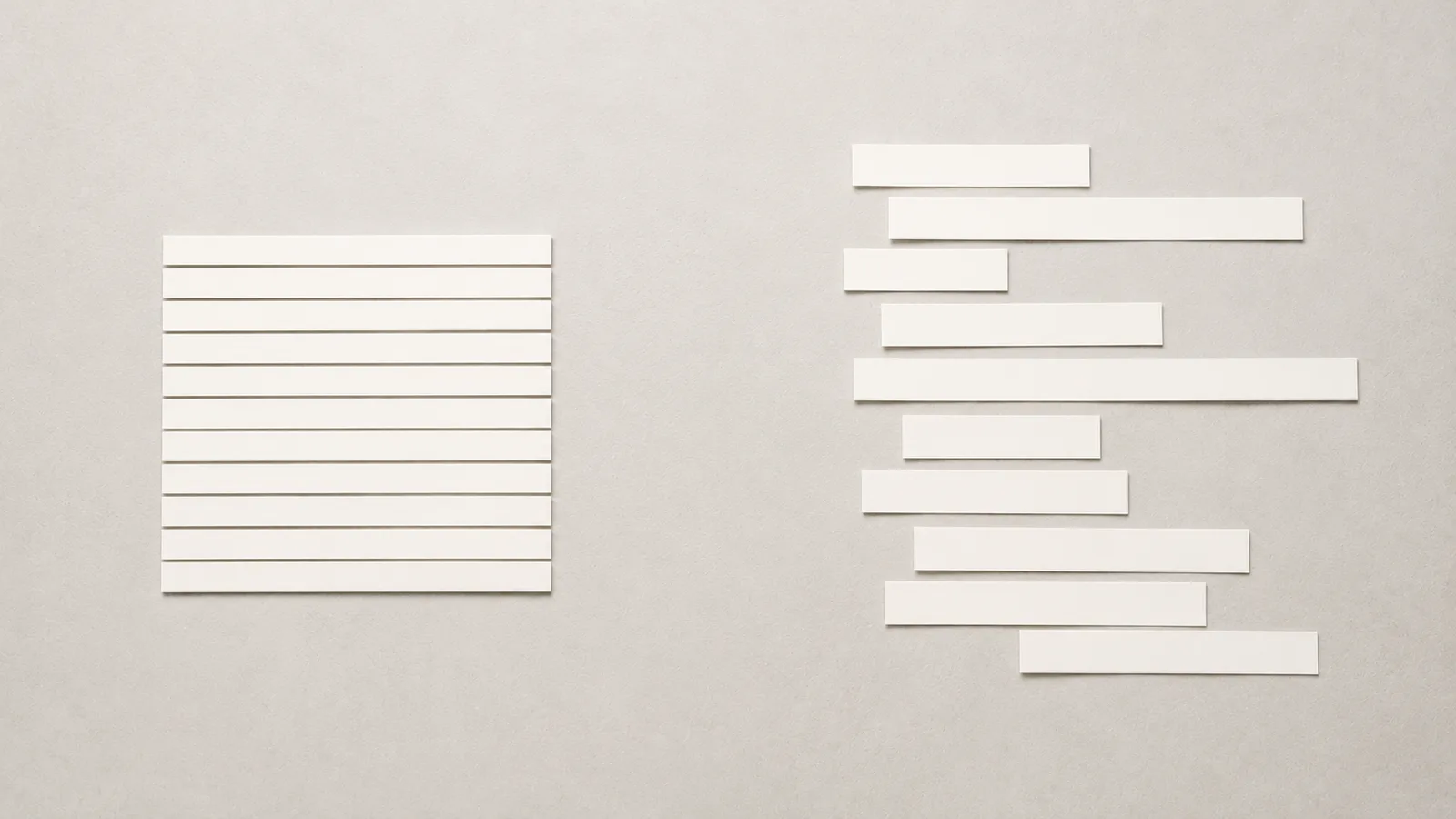
The left is a default draft: every sentence the same length. The right is how a person actually writes.
Burstiness first, because detectors literally measure it. Uniform rhythm reads as generated; varied rhythm reads as human. After you draft, scan a paragraph and ask whether the sentences are mostly the same length. If they are, fuse two into one long one and chop another into a short punch. You're not adding words, you're varying the pace.
Specificity is the other half, and it does double duty. Concrete details make writing less predictable to a detector and more useful to a reader at the same time. "It can be wrong" is weak and generic; "it insisted 9.11 is bigger than 9.9" is specific, human, and more informative. Every section you write should carry at least one detail a machine working from averages wouldn't produce. If you're editing an AI draft and there are no such details, that's the real problem, not the punctuation.
Make ChatGPT do more of it upfront
You can stop most tells before they appear by telling ChatGPT what to avoid, which saves editing later. It won't remove everything, so you still read the draft, but you start from a far cleaner place than the default.
The lever is a custom instruction, or a line at the top of your prompt. Something like this, which works well on GPT-5 and the current free model:
Write in plain, direct English, the way a knowledgeable person talks. No em dashes. No buzzwords like delve, leverage, seamless, robust, or 'it's important to note'. Vary sentence length: mix short punchy sentences with longer ones. Use contractions. Include specific examples, real numbers, and concrete detail. Do not answer everything as a bulleted list, use prose for connected ideas.
That single instruction removes maybe two-thirds of the work. Compare the outputs. Ask ChatGPT for "three benefits of meal planning" with no instruction and you get a bulleted list of generic sentences of identical length. Ask with the instruction above and you get prose, varied rhythm, and at least an attempt at specifics. Neither is finished, but the second is editable in minutes and the first needs a rewrite.
For the underlying skill, this is really just prompting well, and writing a sharper prompt covers the general version. If prompting is new to you, the prompt engineering basics guide is the place to start.
Do the humanizer tools work?
Humanizer tools polish a draft faster than you can by hand, but they will not reliably do what the bypass-focused ones advertise, and the honest ones admit it. If your goal is genuinely better writing, they're a convenience; if your goal is beating a detector, they're a trap.
The mainstream tools, Grammarly's AI humanizer and Quillbot's, rewrite for clarity and flow. That's useful, and it's what they're built for. Grammarly is explicit that its version is not designed to bypass detection, which is the responsible position. The other camp, the ones whose whole homepage is "bypass Turnitin" and "100 percent human score," has a different problem: to fool a detector they scramble word choice and sentence structure, which often damages your meaning, and they still lose to updated detectors within weeks. You end up with writing that's worse and no more "undetectable" than before.
A humanizer also can't add what isn't there. It can smooth a sentence; it can't give your draft the real example, the actual number, or the point of view that makes writing yours. That part is on you. If you want tools for the writing itself rather than for disguising it, the free AI writing tools worth using is the honest roundup.
One more step tools skip: proofreading for accuracy. ChatGPT invents facts, so before anything goes out, check it for made-up facts, names, stats, and quotes that sound confident and aren't. A humanizer will happily make a false claim read beautifully.
If you're a student writing in English as a second language
The detector panic falls hardest on non-native English writers, and the fix is not a bypass tool, it's understanding that the detectors are the unreliable part. The Stanford finding, 61 percent of non-native essays falsely flagged, means an honest essay in careful second-language English can trip a checker with no AI involved at all.
That cuts two ways. If you wrote it yourself and a detector flags it, that's the tool's known bias, not proof of anything, and it's worth keeping your drafts and version history to show your work. If you used AI to help, the honest path is the same as anywhere: use it to draft and organise, then genuinely rewrite in your own words and add your own understanding, and disclose the assistance if your institution requires it. Rewriting to learn and to sound like yourself is real work. Running an essay through a bypass tool to hide it is the thing that actually gets people in trouble, and it teaches you nothing.
What this post does not cover
This is a guide to making ChatGPT writing read as human because it's better writing. It is not a guide to defeating academic-integrity systems, and it doesn't endorse passing AI work off as your own where that's against the rules. It also isn't a ranked review of humanizer products.
Which specific detector a given institution uses, and how to "guarantee" a pass, are deliberately out of scope, because no honest guide can promise that and the tools that do are lying. Model behaviour and detector accuracy both change often, so treat the specifics here as current to July 2026 and the principle, write well rather than write to the checker, as the part that lasts.
Sources
- New AI classifier for indicating AI-written text, OpenAI (announcement and the note that the classifier was discontinued on 20 July 2023 for low accuracy)
- GPT detectors are biased against non-native English writers, Liang et al., Stanford, 2023
- AI detection tools falsely accuse international students of cheating, The Markup, 2023
- AI humanizer positioning and integrity note, Grammarly
Frequently asked questions

Written by
Tapabrata Biswas
Tech Researcher
I test AI productivity tools and research home-automation gear the way most people use them. Not in a lab, but on an ordinary desk with an ordinary internet connection. The only test that matters: does it save you time?
Share the Post with Your Besties
Get the plain-English tech brief
One email a week on AI tools and smart-home tech. No jargon, no hype.