34 Gemini Prompts for College Students (2026 Guide)
34 Gemini prompts for literature reviews, essays and problem sets, plus the research on why its citations are the one thing to check before you submit.

Researched with AI assistance, reviewed and edited by Tapabrata Biswas.
In this article
- 01What the research says about Gemini and academic citations
- 02Gemini chat or Gemini Notebook, and which one your task needs
- 03How to shape a college prompt
- 04Reading papers you do not have time to read
- 05Literature reviews and comparing sources
- 06Essays, arguments and structure
- 07Problem sets and technical subjects
- 08Seminars, presentations and group work
- 09Editing your own draft
- 10Checking what it told you
- 11Planning a semester
- 12Where the line sits in assessed work
- 13What this post does not cover
- 14Sources
College work is assessed on something school work mostly is not: how well you handle other people's published research. Literature reviews, cited arguments, synthesis across readings, critique of a methodology. That shift is why a generic list of study prompts stops being much use around first year, and it's also why the most heavily marketed AI research feature is the one worth trusting least.
The research on that is unusually clear, so this guide leads with it rather than burying it under a prompt dump.
What the research says about Gemini and academic citations
Citation fabrication is the documented weak point of AI research tools, and it gets worse in the tools built specifically for research. Delip Rao, Eric Wong and Chris Callison-Burch tested commercial models and deep research agents on two benchmarks, 53,090 citation URLs from one and 168,021 from another spanning 32 academic fields, in work posted to arXiv on 3 April 2026. Between 3 and 13 percent of citation URLs were hallucinated, meaning they had no Wayback Machine record and in all likelihood never existed. Between 5 and 18 percent did not resolve at all.
The finding that should change how you work is the comparison between tool types. Deep research agents generated more citations per query than search-augmented chatbots, and hallucinated at higher rates while doing it. More citations, less reliable. Google puts Deep Research near the front of its own student materials, which makes this the gap between what gets marketed and what gets measured.
Risk also varies by what you study. Non-resolving rates ran from 5.4 percent in Business to 11.4 percent in Theology, so a politics student and a chemistry student are not exposed equally.
And this is not a problem that only catches undergraduates in a hurry. Samar Ansari analysed 100 fabricated citations found in papers accepted to NeurIPS 2025, published on arXiv on 5 February 2026. Those citations sat in 53 published papers, roughly 1 percent of everything accepted, and every one of them had passed three to five expert reviewers. The largest category in Ansari's taxonomy, at 66 percent, was labelled Total Fabrication. If specialist reviewers at a top-tier venue miss them, a reader of your essay at eleven at night is not going to catch them either.
The useful conclusion is narrow. Gemini is genuinely good at the thinking parts of college work, and it's unreliable at precisely the part your degree is marked on. So the prompts below are organised around keeping those two things apart.
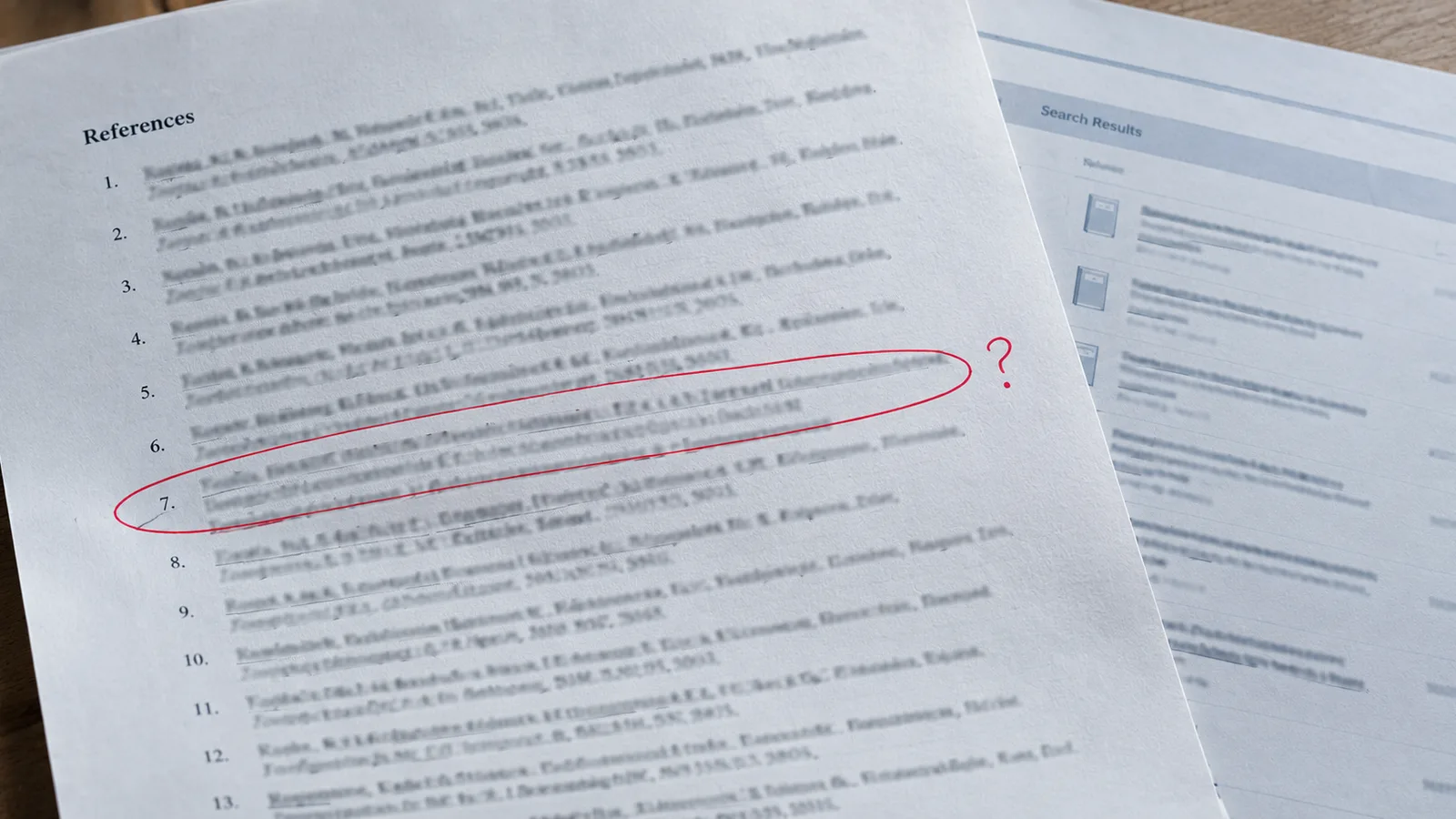
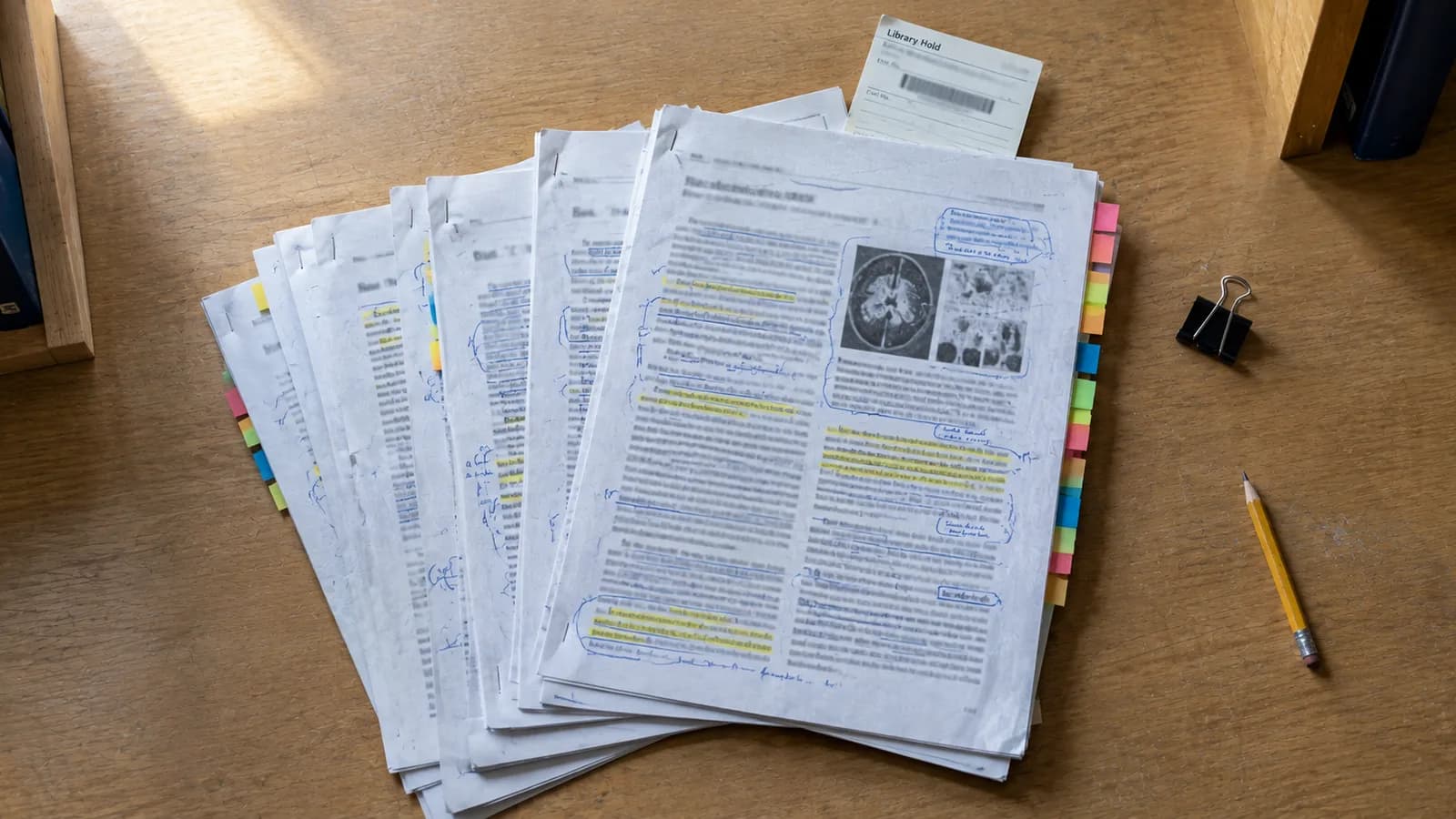
Reference seven is the one that has to be opened. Nothing about a fabricated citation looks wrong on the page, which is why the check has to be mechanical rather than instinctive.
Gemini chat or Gemini Notebook, and which one your task needs
Gemini Notebook is Google's research tool that answers only from the sources you upload into it, rather than from its training data or a web search. It was called NotebookLM until 16 July 2026, when Google renamed it. Josh Woodward's announcement describes it as remaining "a standalone product focused on being your premier research tool", and it now syncs with the Gemini app. Notebooks are not in Google Search yet; Google says AI Mode access is coming.
That rename matters more than a rename normally would, because almost every student guide still calls it NotebookLM, and the name on the box is how you find the thing.
The split between the two tools is the single most useful habit to build:
| Your task | Gemini chat | Gemini Notebook |
|---|---|---|
| Understanding a concept you are stuck on | Right tool | Overkill |
| Finding sources for an essay | Avoid, this is where fabrication happens | Not its job either, use your library |
| Comparing papers you already have | Weak, it has not read them | Right tool |
| Anything that needs a traceable citation | Avoid | Right tool |
| Pressure-testing your own argument | Right tool | Fine if grounded in readings |
The middle row is the one people get wrong. Neither tool is for finding sources. Your library's databases do that, and no prompt below asks Gemini for a reading list.
How to shape a college prompt
A college prompt needs four things, and leaving any of them out is why the answer comes back sounding like a textbook summary. It needs your level and discipline, because the expected depth of a second-year sociology answer and a final-year engineering answer have nothing in common. It needs the actual task, stated as the verb your assignment brief uses. It needs the material, pasted or uploaded rather than described. And it needs the output shape, because the default is always a tidy summary, and a tidy summary is the least useful thing for work you'll have to defend.
Fill in the brackets below. Treat every first answer as a draft to argue with.
Reading papers you do not have time to read
Explanation is what these models do well, which makes dense reading the safest high-value use.
1. Get the argument before the detail
I am a [year] [subject] student. I am pasting the abstract and introduction of a paper below. Tell me what the authors are arguing, what they are arguing against, and what I would need to accept for their conclusion to hold. Do not summarise the methods yet.
2. Translate the methodology section
Explain this methodology section to a [year] [subject] student who has done one statistics course. Tell me what they actually did, in order, and what each choice was meant to rule out.
3. Find the weak joint in the argument
Here is the discussion section of a paper. Identify the places where the authors' claims go further than their results support, and quote the specific sentence each time. If you think the claims are well supported, say so instead of inventing a criticism.
4. Rebuild the paper as a structure
Turn this paper into a one-page structure: the question, the gap it claims to fill, the method, the key result, and the limitation the authors admit. Keep it to phrases, not sentences, so I can use it as a reading note.
5. Decode the terminology that is blocking you
I keep stalling on these terms from my [subject] reading: [list]. For each one, give me the definition as it is used in this field specifically, and one sentence on how it differs from the everyday meaning.
Literature reviews and comparing sources
Upload the readings into Gemini Notebook for this section. A literature review is marked on whether you represented real arguments fairly, so every claim needs to point at a passage you can open.
6. Build a comparison across papers
Using only the sources in this notebook, build a comparison table across methodology, sample, main finding, and stated limitation. Add a column for the position each author takes on [specific question]. Cite the passage behind each cell.
7. Find the real disagreement
Based only on these sources, where do these authors genuinely disagree with each other, as opposed to studying different things? Quote the conflicting passages side by side.
8. Group the literature into positions
Group the sources in this notebook into schools of thought on [topic]. For each group, name the shared assumption that holds it together and list which sources belong to it. Flag any source that does not fit cleanly.
9. Trace how the debate moved
Put these sources in chronological order and describe how the argument about [topic] changed over that period. Identify which paper each later author is responding to, using only what the sources themselves say.
10. Locate the gap honestly
From these sources only, what does this literature not address? Distinguish between gaps the authors name themselves and gaps you infer, and label which is which.
Essays, arguments and structure
The thinking work, where the tool is strongest and where nothing needs a citation yet.
11. Turn a brief into a real question
My assignment brief is: [paste brief]. Give me four different research questions I could answer within it, each with a one-line note on what evidence it would require. Do not pick one for me.
12. Stress-test the thesis before you write
My thesis is: [thesis]. Give me the three strongest objections a marker in [subject] would raise, in the order they would raise them. For each, tell me what I would need to address it rather than how to dodge it.
13. Argue the other side properly
Make the strongest possible case against my position that [position]. Steelman it, do not caricature it. Then tell me which part of it I cannot easily answer.
14. Plan the structure around the argument
I am arguing [thesis] in a [word count] essay for [subject]. Propose a section structure where each section does one job in the argument. Say what each section has to establish before the next one works.
15. Fix a paragraph that is not landing
Here is a paragraph from my essay. Tell me what claim it is making, what evidence it offers, and where the link between them is weak. Do not rewrite it for me, I want to know what is broken.
Problem sets and technical subjects
Showing the method matters more than the answer, since the answer is the part you can check.
16. Work a problem as a method, not a solution
I am a [year] [subject] student. Walk me through how to approach this type of problem: [problem]. Give me the method and the reasoning at each step, and stop before the final numerical answer so I can finish it.
17. Find your own mistake
Here is my working for this problem and the answer I got. The correct answer is [answer]. Tell me where my reasoning first went wrong, not just what the right method is.
18. Build variations to practise on
Generate five problems of the same type and difficulty as this one, varying the setup rather than just the numbers. Give the answers separately at the end so I can attempt them first.
19. Check whether you understand it or memorised it
Ask me questions one at a time about [topic] in [subject], starting easy and getting harder. Do not give me the answer. When I am wrong, ask a question that exposes the gap instead of correcting me.
Seminars, presentations and group work
20. Prepare to be asked
I am presenting on [topic] to a [year] [subject] seminar. List the questions most likely to come from the floor, including the awkward ones, and tell me which of them my argument currently does not answer.
21. Cut a presentation to its spine
Here are my presentation notes. I have [number] minutes. Tell me which points are essential to the argument and which are detail I can drop, and say what the audience loses with each cut.
22. Prepare a seminar reading for discussion
Using only this reading, give me three discussion questions that cannot be answered with a summary of it, plus the passage each question comes from.
23. Split a group project honestly
Our group project is [description] with [number] people and [time] left. Propose a division of work where each part can be done independently, and name the points where we have to agree before anyone starts.
Editing your own draft
Reverse-engineering your own writing is more useful than asking for a grammar fix, which spellcheckers have done for thirty years.
24. Reverse-outline what you actually wrote
Read my draft and give me a one-sentence summary of each paragraph's main point, in order. Do not fix anything. I want to see whether the argument I think I made is the one on the page.
25. Check the brief against the draft
Here is my assignment brief and here is my draft. Go through the brief requirement by requirement and tell me where the draft meets it, where it partly meets it, and where it does not address it at all.
26. Hunt the unsupported claims
Go through my draft and list every factual or empirical claim that currently has no source attached. Do not suggest sources, just list the claims so I can find them myself.
27. Cut without losing the argument
My draft is [current count] words and the limit is [limit]. Identify what can go without weakening the argument, ranked by how little is lost. Tell me what each cut costs.
28. Read it as the marker would
Here is my draft and the marking rubric for [subject]. Assess it against each rubric criterion, quoting the part of my draft that earns or loses on that criterion. Be specific about what is missing.
Checking what it told you
These three exist because of the research at the top, and they are the ones to actually use every time.
29. Force the uncertainty into the open
For the explanation you just gave, separate it into what is well established in [subject], what is contested among researchers, and what you are least confident about. Be explicit where you are uncertain.
30. Verify a reference before you cite it
For each source you just named, give me only the author, year, exact title, and DOI or publisher. Do not describe the contents. If you are not certain a source exists as stated, say so rather than filling in the fields.
31. Check the source actually says it
I am pasting the real abstract of the paper you cited for [claim]. Tell me whether it supports that claim, partly supports it, or does not address it. Quote the sentence you are relying on.
Planning a semester
32. Turn a syllabus into a workload map
Here is my syllabus with deadlines. Build a week-by-week plan that works backwards from each deadline, and flag the weeks where two pieces of work collide so I can see the pressure points in advance.
33. Scope a long project realistically
My [dissertation or project] is due in [time] and the scope is [description]. Break it into stages with the output each stage has to produce, and tell me which stage students most often underestimate.
34. Recover a plan that has slipped
I am [time] behind on [project] with [time] left. Tell me what to drop rather than how to work faster, and what the consequence of each cut is for the final piece.
Where the line sits in assessed work
Two things decide whether any of this is allowed, and neither is a prompt.
The first is your institution's policy, which you have to read yourself. Programmes differ sharply, sometimes between modules in the same department, and "everyone uses it" isn't a defence that survives a panel. Google's own student materials say to follow your school's and your professors' rules, which is a fair place for Google to leave it and no help at all when you're the one who needs the answer.
The second is detection, and it cuts in a direction worth understanding before you are the one being accused. AI detectors get used heavily in higher education and they aren't accurate enough to treat as evidence. A 2023 Stanford study found that seven detectors flagged essays by non-native English speakers as AI-generated most of the time while almost never flagging native-speaker control essays, which means the tool is least fair to the students with the least room to argue. Our piece on whether AI detectors are accurate covers what a percentage score means and what it does not.
Both of those are about permission. The citation research at the top of this page is about something else, and it's the part that will cost you marks even where AI use is fully allowed. A fabricated reference is wrong whether or not you were permitted to use the tool that produced it. Ansari's NeurIPS finding is the one to keep in mind: those citations were not caught by three to five expert reviewers, so your own second read isn't going to catch them either. Open the DOI. Every time.
If you want the broader version of this guide, the general Gemini prompts for students article covers revision, flashcards, exam technique and the free student plans. Medicine and nursing have their own research findings and their own guides, in Gemini prompts for medical students and Gemini prompts for nursing students. For the reasoning behind how these prompts are built, see prompt engineering for beginners, and why AI invents things explains the mechanism behind the citation problem described above.
What this post does not cover
- Whether your course permits AI in assessed work, which only your own programme's academic integrity policy answers
- Finding sources, which belongs to your library's databases rather than to any chatbot
- Referencing style mechanics for APA, MLA, Harvard or Chicago, which your institution specifies and frequently amends
- Postgraduate research methods, since these prompts assume undergraduate coursework
- Any claim that a prompt will produce a particular grade, since the output depends on your material and your own judgement
Sources
- Detecting and Correcting Reference Hallucinations in Commercial LLMs and Deep Research Agents, Delip Rao, Eric Wong and Chris Callison-Burch, arXiv, 3 April 2026 (3 to 13 percent of citation URLs hallucinated, 5 to 18 percent non-resolving, deep research agents hallucinating at higher rates than search-augmented models, and the 5.4 to 11.4 percent domain spread)
- Compound Deception in Elite Peer Review: A Failure Mode Taxonomy of 100 Fabricated Citations at NeurIPS 2025, Samar Ansari, arXiv, 5 February 2026 (100 fabricated citations across 53 accepted papers, each past three to five reviewers, with Total Fabrication the largest category at 66 percent)
- NotebookLM is now Gemini Notebook, Josh Woodward, Google, 16 July 2026 (the rename, the standalone-product statement, Gemini app syncing, and AI Mode access described as still to come)
- GPT detectors are biased against non-native English writers, Liang et al., Patterns, 2023 (the detector bias finding referenced in the assessed-work section)
Frequently asked questions

Written by
Tapabrata Biswas
Tech Researcher
I test AI productivity tools and research home-automation gear the way most people use them. Not in a lab, but on an ordinary desk with an ordinary internet connection. The only test that matters: does it save you time?
Share the Post with Your Besties
Get the plain-English tech brief
One email a week on AI tools and smart-home tech. No jargon, no hype.