
ChatGPT Prompts for Product Managers: 34 for PRDs, Roadmaps & Standups (2026)
34 copy-ready ChatGPT prompts for product managers: PRDs, user stories, roadmaps, stakeholder updates, feedback synthesis, and how to prompt well.

Researched with AI assistance, reviewed and edited by Tapabrata Biswas.
In this article
- 01How to prompt as a PM
- 02Discovery and user research
- 03Writing PRDs and specs
- 04User stories and acceptance criteria
- 05Roadmaps and prioritisation
- 06Stakeholder updates and communication
- 07Turning feedback and data into decisions
- 08Launch and go-to-market
- 09Where not to let ChatGPT lead
- 10What this post does not cover
- 11Sources
Most PM prompt lists hand you a template about a hypothetical product and leave you to figure out the rest. The problem is that a generic prompt gives you generic output, and a generic PRD is worse than no PRD, because now you have to unpick it. The prompts below are built the other way round: each one has a clear job, a place to drop your real context, and an output format you can actually use. Fill in the brackets, and most of them produce a usable first draft in one pass.
These come from real product work, not a hypothetical. They cover the jobs a PM does every week, from discovery through to launch, and they work the same in ChatGPT, Claude, or Gemini. Model behaviour and features shift over time, so treat the tool notes as current to September 2026.
How to prompt as a PM
The difference between a prompt that saves you time and one that wastes it comes down to four things: role, context, task, and format. Tell the model who to be, give it the real details it can't see, say exactly what you want, and specify how the answer should be shaped. Miss the context and it fills the gap with invention, which is the same problem behind writing a clearer prompt in any field.
Here is the difference in practice. The vague version:
Write a PRD for a new notifications feature.
And the version that actually helps, same idea with role, context, task, and format:
Act as a senior product manager. We are adding a notifications centre to a B2B analytics dashboard used by data teams. The goal is to cut missed alerts, the main constraint is that engineering has two sprints. Write a PRD draft with these sections: problem statement, goals and non-goals, target user, user stories with acceptance criteria, key flows, risks, and open questions. Flag anything you had to assume.
The first gives you a bland template. The second gives you a draft you can edit. Every prompt below is written in that second style, and the single habit that matters most is replacing the brackets with your real product before you hit enter.
Discovery and user research
Discovery is where the wrong prompt does the most damage, because a leading question hands you the answer you were hoping for instead of the truth. These help with both halves of the job: running interviews that stay honest, and turning the mess of notes afterwards into themes you can act on without over-weighting the one person who spoke loudest.
Act as a senior product manager preparing discovery interviews with [target persona] about [problem area]. Draft a 45-minute discussion guide: a warm-up, five open questions that avoid leading the user, two follow-up probes each, and a closing question. Keep it non-leading and focused on their real behaviour, not our solution.
Here are my raw notes from a user interview: [paste]. Pull out the top pain points ranked by how strongly the user felt them, the jobs they were trying to do, any workarounds they mentioned, and three quotes worth keeping. Flag anything that contradicts what I expected to hear.
I have five interview transcripts about [problem area]: [paste]. Synthesise them into themes: for each theme give a short name, how many of the five raised it, a representative quote, and what it implies for the product. List anything only one person said separately so I don't over-weight it.
Act as a product researcher. Turn this feature idea, [describe], into three testable assumptions and, for each, the cheapest way to validate it before we build anything. Rank them by how badly we'd be hurt if the assumption is wrong.
Write a five-question survey to test whether [target user] actually has the problem of [problem]. Use a mix of one screening question, two behaviour questions about what they do today, and two on willingness to change. Avoid questions that lead them toward yes.
Writing PRDs and specs
A PRD is mostly assembly work, pulling scattered decisions into one structured place, which is exactly what the model is good at, as long as you make it flag the gaps rather than paper over them. Start from your real notes instead of a blank page, and use the review prompt to catch the ambiguity before an engineer or designer does.
Act as a senior PM. Convert these messy notes from a brainstorm into a structured PRD: [paste]. Sections: problem statement, goals and non-goals, target user, user stories with acceptance criteria, key flows, dependencies, risks, and open questions. Where the notes are silent, add an open question rather than inventing an answer.
Here is a draft PRD: [paste]. Review it like a skeptical staff engineer and a skeptical designer. List the parts that are ambiguous, the edge cases that are missing, the acceptance criteria that can't be tested, and any scope that looks bigger than the stated goal needs.
Write a one-page feature brief for [feature] aimed at an exec audience. Cover the problem, who it's for, the proposed solution in three sentences, the expected impact, and what we are explicitly not doing. Plain language, no jargon, under 300 words.
Turn this PRD into a set of open questions for a spec review: [paste]. Group them by area (scope, design, technical, data, launch) and, for each, note who most likely owns the answer. Keep the list short enough to get through in a 30-minute meeting.
Draft the non-goals section for a PRD about [feature]. Given the goal is [goal] and the constraint is [constraint], list six things we are deliberately not doing in this version and one sentence on why each is out of scope, so nobody assumes it later.
User stories and acceptance criteria
Stories are where vague requirements go to cause sprint pain. The value in these is forcing a testable shape, real acceptance criteria and the edge cases nobody thought about, before the work reaches an engineer who would otherwise fill the gaps with a guess. Ask the model to flag its own assumptions so you catch the holes early.
Rewrite this requirement as user stories: [paste]. Use the format: As a [user], I want [goal], so that [benefit]. For each story add acceptance criteria as a short checklist, and flag any assumption you had to make to write it.
Write acceptance criteria for this user story in Given/When/Then form: [paste story]. Cover the happy path, at least two edge cases, and one error state. Keep each criterion independently testable.
This story feels too big for one sprint: [paste]. Split it into smaller stories that each deliver something usable on their own, in a sensible build order, and tell me which one is the thinnest slice we could ship to learn the most.
Act as a QA engineer. Given this feature, [describe], list the test cases you'd want before release: functional, edge, permissions, and one or two nasty real-world scenarios a user might actually hit. Group them and mark which are must-pass for launch.
Roadmaps and prioritisation
Prioritisation is judgment, not arithmetic, so treat these as a way to structure the argument rather than settle it. A RICE table looks objective, but the scores are only as honest as the numbers you feed in, which is why every prompt here makes the model show its working and name its least confident guess. You still make the call.
Here is a list of candidate features with rough notes: [paste]. Score each with RICE (reach, impact, confidence, effort), show the numbers you used and the assumptions behind them, and rank the list. Call out any score you're least confident in so I can sanity-check it.
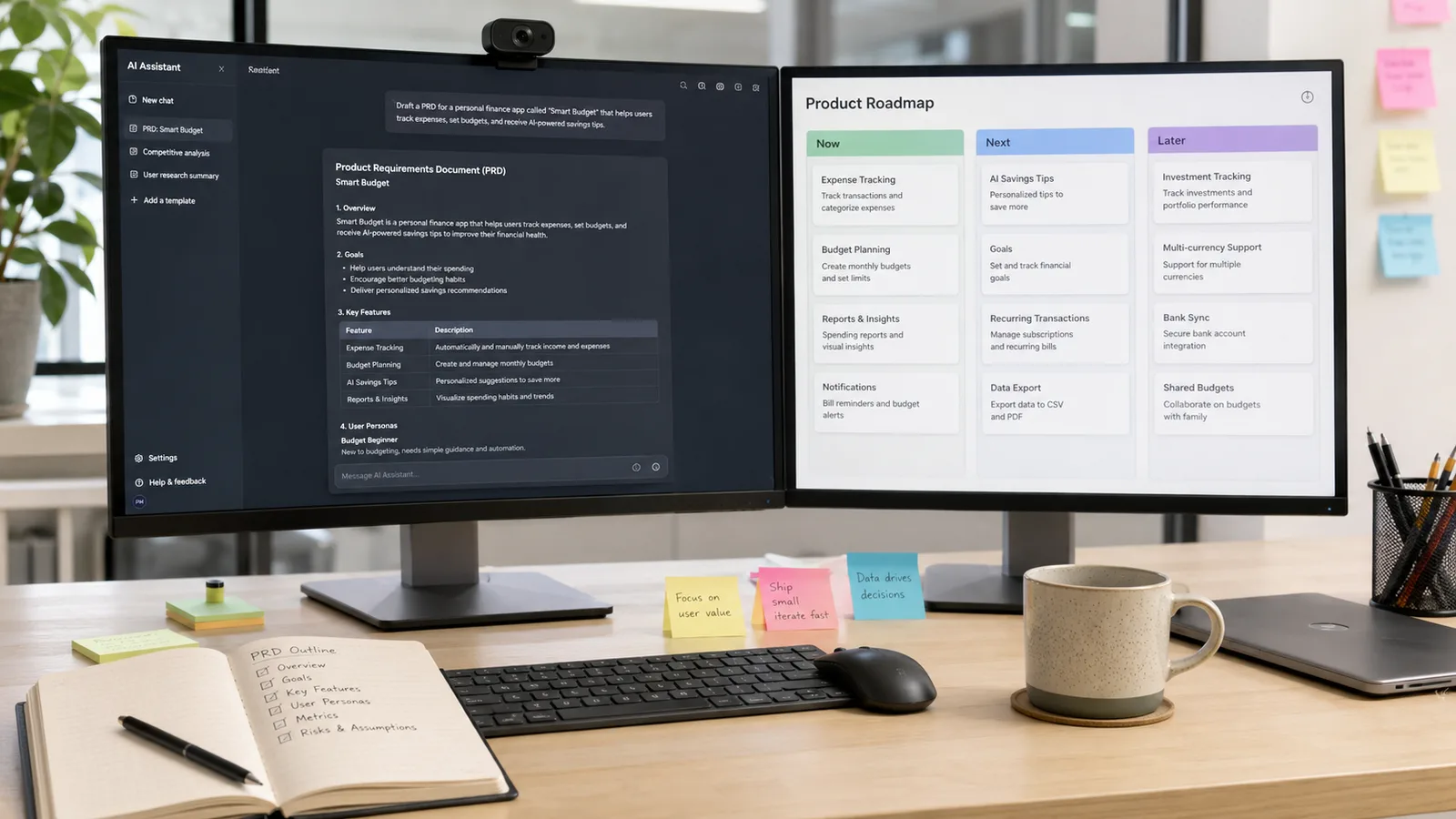
Act as a product manager. Sort these initiatives into a Now / Next / Later roadmap: [paste]. Base it on [our goal this quarter] and [our main constraint], explain the reasoning for anything you put in Now, and note what would have to change to promote something from Later.
Help me build a quarterly roadmap narrative. Product: [name]. This quarter's goal: [goal]. Engineering capacity: [capacity]. Known initiatives: [paste]. Draft a one-paragraph theme for the quarter, the three or four bets that ladder up to it, and what we're saying no to.
I need to defend a prioritisation decision. We chose [feature A] over [feature B] because [reason]. Write a short, honest rationale I can share, including the trade-off we accepted and what would make us revisit it. No spin, just the real reasoning.
Act as a devil's advocate on this roadmap: [paste]. Argue the strongest case that we're focused on the wrong things, name the opportunity we might be missing, and point out any item that looks like it's there for internal reasons rather than user value.

Stakeholder updates and communication
Half of product management is telling people what is happening without either burying the bad news or drowning them in detail. These keep updates short, honest, and shaped for the person reading them, an exec wants the impact, a team wants the blockers, and both want to trust that you are not spinning. The slip message is the one worth saving, because you will need it more than you would like.
Write a monthly product update for stakeholders from these notes: [paste]. Structure: what shipped, what's in progress, what's next, and any risks or asks. Confident but honest about slippage, under 250 words, skimmable with short bullets.
Turn these standup notes into a two-line async update for the team channel: [paste]. Lead with anything blocked or at risk, then progress, then what I need from anyone. Keep it plain and scannable, no filler.
I need to tell stakeholders a launch is slipping by [time] because [reason]. Draft a short, straight message: what changed, the impact, the new date, and what we're doing about it. Own it without over-apologising, and end with the one thing I need from them.
Rewrite this technical update for a non-technical exec: [paste]. Cut the jargon, lead with the business impact, and keep any detail only if it changes a decision. Three short paragraphs at most.
Draft talking points for a roadmap review with leadership. Context: [paste]. Anticipate the three hardest questions they'll ask, and for each give me a straight answer and the one number or fact that backs it up.
Turning feedback and data into decisions
Feedback and data arrive as noise, and the job is turning them into a decision without fooling yourself along the way. These cluster, rank, and interpret, but each one keeps the raw counts and the assumptions visible so you can catch a grouping that quietly flattened something important, or a result the sample was never big enough to support.
Here is a batch of customer feedback from [source]: [paste]. Group it into themes, rank them by frequency and by severity separately, and for each theme suggest whether it points to a bug, a missing feature, or a UX problem. Keep the raw counts so I can check your grouping.
Summarise these support tickets into a weekly product signal: [paste]. What's trending up, what's new this week, and which one issue, if fixed, would remove the most tickets. Flag anything that looks urgent.
I ran an experiment: [describe setup, variants, and results with numbers]. Help me interpret it. What does the data support, what does it not support, what could confound it, and what's the honest next step? Tell me if the sample looks too small to conclude anything.
Act as a data-literate PM. Given these metrics, [paste], write three plausible explanations for the change in [metric], and for each, the one query or check that would confirm or kill it. Don't pick a favourite until the checks are done.
Turn this pile of feature requests into a decision-ready summary: [paste]. Cluster similar asks, estimate rough demand from how often each shows up, and separate the ones that fit our strategy from the ones that don't, with a one-line reason each.
Launch and go-to-market
Launches rarely fail on the feature. They fail on the unglamorous parts, the enablement nobody wrote, the support team caught off guard, the release note that oversells a small change. These cover the checklist and the messaging so the launch itself is boring, which is exactly what you want on the day.
Draft a go-to-market checklist for launching [feature] to [audience]. Cover positioning, the messaging in one line, docs and support prep, internal enablement, the rollout plan, and the success metric we'll watch in week one. Mark anything that must be done before we flip it on.
Write release notes for [feature] in two versions: a short in-app note for users and a longer changelog entry. Lead with the benefit, not the mechanism, keep the tone plain and friendly, and avoid overselling a small change.
Act as a product marketer. Give me three positioning angles for [feature], each with the core benefit, who it lands best with, and the one-sentence pitch. Then tell me which angle is strongest for [our main audience] and why.
Draft an internal launch brief so sales and support aren't surprised: [paste feature details]. Include what it does, who it's for, the top three questions customers will ask with answers, and what to say if someone asks for something it doesn't do yet.
Where not to let ChatGPT lead
Here is the honest part, and it comes from using these daily. ChatGPT is very good at the writing around product management and unreliable at the judgment inside it. It will produce a confident RICE table, but the scores are only as good as the numbers you gave it, and it will happily invent a market size if you let it. So the rule I hold to is simple: it drafts, I decide.
Keep three things off it entirely. Final prioritisation and strategy calls, because those are the actual job and they need your context and your accountability. Live facts and figures, since it guesses when it doesn't know, which is covered in the basics of prompting. And anything confidential, because pasting unreleased plans or customer data into a consumer chat is a risk that is not worth the time saved. Used inside those lines, it is the fastest junior teammate you have ever had. Outside them, it is a liability with a confident voice.
If you are weighing which assistant to standardise on, how the tools compare covers the differences that actually matter for this kind of work.
What this post does not cover
This is a working set of prompts and how to use them, not a course in product management or a guide to AI product tools like Jira or Productboard copilots. The prompts are starting points to adapt, not fixed templates, and they assume you will paste your own real context and check the output. Nothing here removes the need for your judgment on scope, priorities, and anything you put in front of a customer.
Sources
- ChatGPT for product teams, OpenAI Academy (official use-cases and prompt patterns for product work)
- Prompt engineering guide, OpenAI (the role, context, task, and format principles behind the prompts here)
Frequently asked questions

Written by
Tapabrata Biswas
Tech Researcher
I test AI productivity tools and research home-automation gear the way most people use them. Not in a lab, but on an ordinary desk with an ordinary internet connection. The only test that matters: does it save you time?
Share the Post with Your Besties
Get the plain-English tech brief
One email a week on AI tools and smart-home tech. No jargon, no hype.