
ChatGPT Prompts for Consultants: 34 for Discovery, Decks & Frameworks (2026)
34 copy-ready ChatGPT prompts for consultants: client discovery, SOWs, frameworks, executive decks, stakeholder comms, and where AI shouldn't lead.

Researched with AI assistance, reviewed and edited by Tapabrata Biswas.
In this article
- 01How to prompt as a consultant
- 02Client discovery and diagnostics
- 03Proposals and SOWs
- 04Frameworks and analysis
- 05Research and synthesis
- 06Executive decks and storylining
- 07Stakeholder management and communication
- 08Implementation and delivery
- 09Business development and thought leadership
- 10Where not to let ChatGPT lead
- 11What this post does not cover
- 12Sources
Most consulting prompt lists hand you a template about a fictional client and stop there. The trouble is that consulting is judgment work, and a generic prompt gives you a generic answer, which is the one thing a client is not paying for. ChatGPT earns its place in a consultant's week not by having the ideas, but by taking the drafting and structuring off your plate: the discovery guide, the SOW, the research synthesis, the slide storyline, the stakeholder note. The prompts below are built for that, each with a clear job, a place to drop your real (anonymised) context, and an output you can shape into the real thing.
They run across the arc of an engagement, from discovery through frameworks, decks, and delivery, and they work the same in ChatGPT, Claude, or Gemini. There is also an honest section on where AI has no business leading, because in consulting that line is the difference between a useful tool and a professional liability.
How to prompt as a consultant
A prompt that saves you time and one that wastes it differ by four things: role, context, task, and format. Tell the model who to be, give it the real details it can't see, state exactly what you want, and specify how the answer should be shaped. Leave the context out and it fills the gap with consulting-flavoured platitudes, the same problem behind writing a clearer prompt in any field.
Here is the difference. The vague version:
Give me a growth strategy for a client.
And the version that actually helps, with role, context, task, and format:
Act as a senior strategy consultant. My client is a mid-size regional bakery chain (anonymised) whose revenue has been flat for two years while costs rose. The goal is to find three credible growth options, the constraint is limited capital for new locations. Give me three distinct growth directions, each with the core idea, why it fits this situation, the main risk, and the one thing we'd need to validate. Lay it out as a table, and flag anything you assumed.
The first gives you a McKinsey-shaped horoscope. The second gives you three directions you can actually pressure-test. Every prompt below is written in that second style, and the habit that matters most is replacing the brackets with your real, anonymised context before you hit enter.
Client discovery and diagnostics
Discovery is where an engagement is quietly won or lost, and it is exactly the structured-preparation work ChatGPT is good at. Use it to build sharper guides before the call and to synthesise what you heard afterwards, but keep the actual listening and probing human, because that is where the real signal lives.
I am a [type] consultant meeting a prospective client in [industry] about [problem area]. Design a discovery call framework: 5 opening questions to understand the current situation, 5 diagnostic questions to find root causes, 3 questions about what they've already tried, 2 about organisational readiness, and 1 closing question about their real decision criteria. Keep the questions open and non-leading.
Here are my notes from a client discovery session (anonymised): [paste]. Pull out the stated problem versus the likely underlying problem, the top three root-cause hypotheses, the constraints and politics I should respect, and the two questions I still need answered before scoping the work.
Act as a diagnostic consultant. Given this situation, [describe anonymised], build a simple diagnostic framework: the three or four areas I should assess, what 'good' versus 'broken' looks like in each, and the evidence I'd need to gather to judge it. Keep it something I could run in a two-week diagnostic.
Turn this vague client ask into a sharp problem statement: [paste]. Rewrite it as a single, specific question the engagement will answer, name what's in and out of scope, and list the assumptions baked into how they framed it that we should test.
Draft a stakeholder interview guide for a [type] project. I'll speak to [roles]. For each role, give me three tailored questions that get at their real priorities and concerns, and one question designed to surface disagreement between functions.
Proposals and SOWs
The proposal and the SOW are where good intentions meet scope creep, so precision here saves pain later. ChatGPT is quick at the structure, but you set the boundaries: make it spell out what is out of scope and what you are assuming, because that is exactly the part clients and delivery teams both conveniently forget.
Draft a statement of work for a [type] engagement based on these notes (anonymised): [paste]. Include objectives, scope and explicit out-of-scope items, approach and phases, deliverables, timeline, roles, and assumptions. Make the out-of-scope and assumptions sections thorough, since that's where scope creep starts.
Write a proposal narrative for [client situation, anonymised]. Structure it as: their problem in their words, why it matters now, our approach in three phases, what they'll walk away with, and why us. Confident and specific, no filler, and lead with their problem, not our credentials.
Help me structure a phased approach for solving [problem]. Break it into a diagnostic phase, a design phase, and an implementation-support phase, and for each give the key activities, the output, and the decision the client makes at the end of it before we proceed.
I need to explain my pricing to a client who thinks the fee is high. The engagement is [describe]. Draft a value-based rationale that ties the fee to the outcome and the cost of not solving the problem, acknowledges it's an investment, and stays confident without being defensive.
Frameworks and analysis
This is where ChatGPT is most useful and most dangerous at once. It's excellent at imposing a clean structure on a messy problem, and it will invent supporting data without blinking. Use it to build the scaffolding, MECE trees, hypotheses, framework choices, and bring your own verified facts to fill it.
Break this problem into a MECE issue tree: [describe the problem]. Structure it as mutually exclusive, collectively exhaustive branches down two levels, and for each bottom branch note the analysis or data I'd need to resolve it. Tell me if any branch overlaps or if I've missed a whole area.
Act as a strategy consultant. Turn this question, [paste], into three or four testable hypotheses, and for each give the 'so what' if it's true, the fastest way to test it, and what evidence would prove it wrong. Rank them by which would most change the recommendation.
Which framework fits this problem best: [describe]? Suggest two or three relevant strategy frameworks, explain in one line why each fits or doesn't, and warn me where forcing the framework would distort the actual situation. I want the right tool, not the most impressive-sounding one.
Structure a [market entry / cost reduction / growth] analysis for [situation, anonymised]. Lay out the key questions to answer in order, the analyses under each, and the decision the whole thing builds toward. Leave the numbers to me; I just want the skeleton of the argument.
Help me build a simple options analysis. The decision is [describe], and the options are [list]. For each option, structure the upside, the downside, the cost, and the key risk, then suggest the two or three criteria that should actually decide it. Don't pick a winner; help me compare fairly.
Research and synthesis
Research is where ChatGPT saves real hours and where it will quietly mislead you. It is strong at structuring a briefing and pulling themes out of your own notes, and it will fabricate a market size or a benchmark without hesitation, so keep it to organising what you feed it and verify anything that looks like a hard fact before it travels into a deliverable.
Act as a research analyst. Give me a structured briefing on [industry or topic] for a client project: the way the industry makes money, the main players and their positioning, the forces reshaping it, and the open debates. Mark clearly where you're confident versus where I must verify with a current source, and do not invent figures.
Synthesise these expert interview notes into findings (anonymised): [paste]. Give me the points of consensus, the genuine disagreements, the non-obvious insights, and the implications for our recommendation. Keep who said what separable so I can trace a claim back.
Here is a pile of research and notes for [project]: [paste]. Distil it into the five things that actually matter for the client's decision, drop the interesting-but-irrelevant, and flag the single biggest gap in what we know so far.
Turn this raw data description into a set of insights, not just observations: [describe the data and any figures I provide]. For each pattern, tell me the 'so what' for the client and what it would mean for the recommendation. Only use the numbers I give you.
Executive decks and storylining
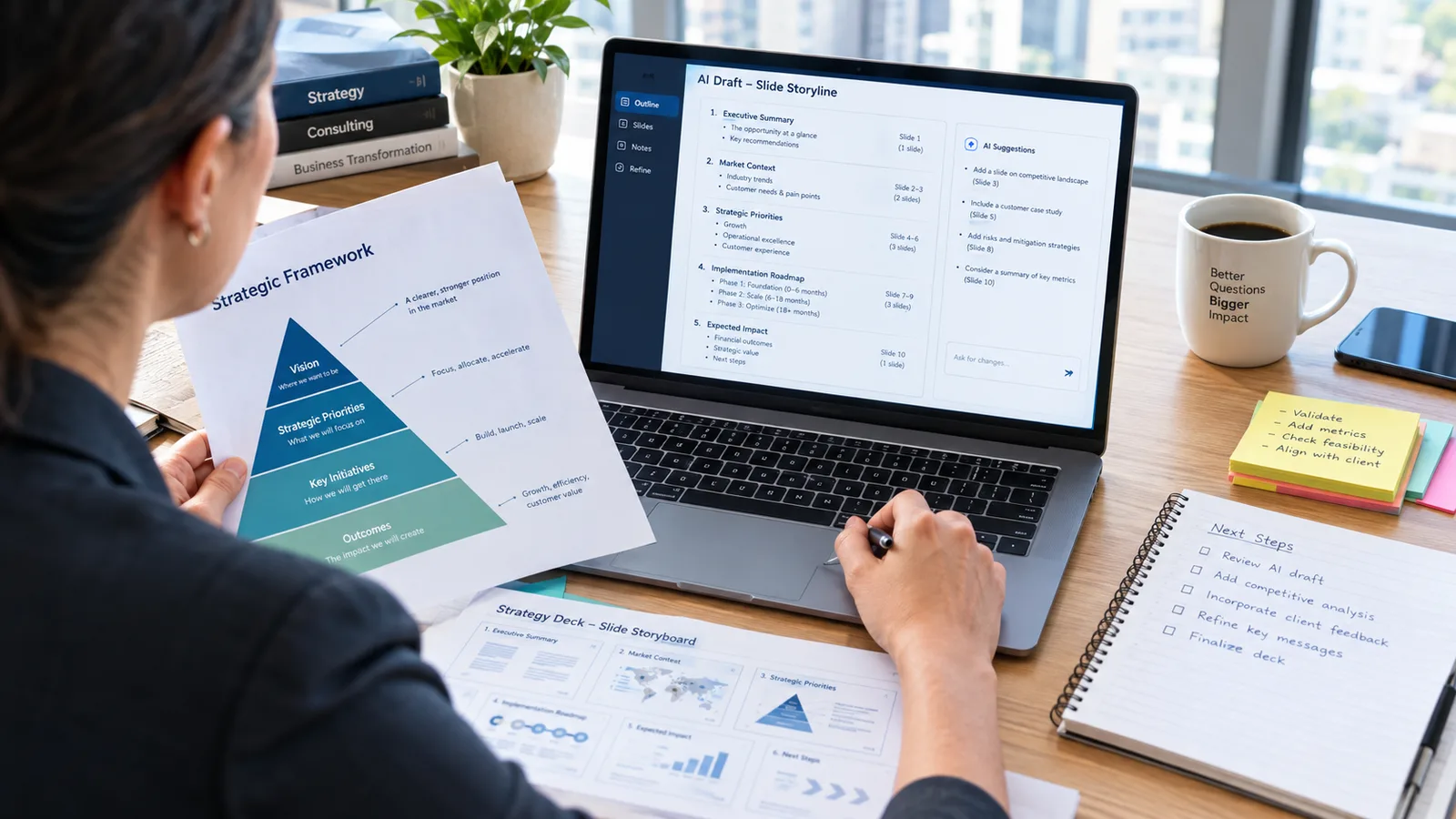
A consulting deck lives or dies on its storyline, and structuring that story is exactly what ChatGPT does well. Give it your message and evidence and let it build the flow where every headline advances the argument, then you own the analysis behind each slide and the craft of the deck itself.
Build a slide-by-slide storyline for a client deck. The core recommendation is [state it], the audience is [describe], and the supporting evidence is [list]. Use a pyramid structure where each slide headline is a full sentence that tells part of the story, so the headlines read as a coherent argument on their own. Give me the headline and the point of each slide.
Turn this long report or analysis into a tight executive summary: [paste]. One page, leading with the recommendation and the three reasons behind it, then the key risks and the ask. Written for a busy executive who will read only this page.
Rewrite these weak slide headlines so each one states a point instead of a topic: [paste headlines]. A good headline should be a sentence a reader could agree or disagree with, not a label like 'Market Overview'. Keep them tight and skimmable.
I have 40 slides and 20 minutes. Here's the deck outline: [paste]. Tell me which slides carry the argument and belong in the main flow, which should move to an appendix, and the tightest path through the story if I'm cut to ten minutes.
Draft the 'so what' and the recommended next steps to close a deck about [topic]. Make the next steps specific, owned, and time-bound, and make the closing land as a clear decision for the client to make, not a vague summary.
Stakeholder management and communication
Build a stakeholder map for this engagement: [describe the players and dynamics, anonymised]. For each stakeholder, note their likely position, what they care about, their influence, and how I should engage them. Flag who could quietly kill the project and how to bring them along.
Draft a weekly client update from these notes: [paste]. Structure it as progress, what's next, decisions or input needed, and any risks. Confident and honest about anything slipping, skimmable, and written so a busy sponsor gets it in thirty seconds.
I need to deliver an unwelcome finding to a client who is invested in the current approach: [describe]. Help me frame it so the message is clear but not an attack, grounded in evidence, and paired with a path forward, so they can hear it without getting defensive.
Help me build the case for change to win over a skeptical leadership team. The change is [describe], the resistance is [describe]. Draft the argument in their terms, addressing their specific objections, with the one point most likely to move each holdout.
Implementation and delivery
Recommendations that never get implemented are where consulting earns its bad reputation, and the delivery artefacts are high-volume, structured work ChatGPT handles well. Use it to draft the plan and the workshop, then adapt both to the real politics of the room.
Draft an implementation roadmap for [initiative]. Break it into phases with the key workstreams, owners, milestones, dependencies, and the early wins to build momentum. Flag the two or three points most likely to stall and what would keep them moving.
Design a half-day client workshop to [objective, e.g. align on priorities]. Give me the agenda with timings, the exercises and how to run each, the outputs, and how to handle a dominant voice or a stalled discussion. Make it participatory, not a presentation.
Draft a lightweight change-management plan for [change]. Cover who's affected and how, the communication plan, the likely resistance and how to address it, and how we'll know it's actually sticking. Keep it practical for a mid-size organisation, not a textbook.
Turn this project into a clear RACI and status structure: [describe the workstreams and people]. Lay out who's responsible, accountable, consulted, and informed for each workstream, and flag any activity where accountability is unclear or doubled up.
Business development and thought leadership
Help me sharpen my consulting positioning. I help [who] achieve [what] by [how]. Rewrite it into a clear one-line positioning, three proof points, and a short 'who this is not for', so it repels bad-fit clients as much as it attracts good ones.
Turn this engagement into a case study for my site (anonymised): [paste the situation, my approach, and the result]. Structure it as challenge, approach, outcome, focus on the decisions and the impact, and keep every claim honest with no invented metrics.
Draft a LinkedIn post sharing one genuine insight from my consulting work on [topic]. Lead with a specific, slightly contrarian observation, back it with reasoning, and end with a question. Sound like a practitioner with a point of view, not a brochure.
Where not to let ChatGPT lead
Here is the honest part, and in consulting it matters more than the prompts. ChatGPT is a fast drafter and a strong structurer, and it is not a consultant, so the judgment stays entirely yours.
Keep three things firmly in your own hands. The diagnosis and the recommendation, because that judgment is exactly what a client pays for, and it depends on context and accountability the model doesn't have. The facts and figures, because it will generate a confident market size, benchmark, or citation that is simply invented, and a made-up number in a client deliverable is a professional liability, not a time-saver, so verify every one. And confidential client material, because pasting names, financials, or unreleased strategy into a consumer chatbot can breach both confidentiality and your engagement terms; anonymise, generalise, and use a firm-sanctioned tool for anything sensitive. Used inside those lines, it clears the drafting so you can spend your hours on the thinking and the relationships. Outside them, it produces a polished deck built on sand. For an adjacent set that overlaps on decks and stakeholder work, our prompts for product managers pair well with these.
What this post does not cover
This is a working set of prompts and how to use them safely, not a course in consulting or a guide to any specific deck or analysis tool. The prompts are starting points to adapt, and they assume you'll paste your own real, anonymised context and verify every output. Nothing here replaces the judgment, the diagnosis, and the client relationships that are the actual work, and anything factual the model produces must be checked before it reaches a client. If prompting itself is new to you, the basics of prompting is the place to start.
Sources
- Prompt engineering guide, OpenAI (the role, context, task, and format principles behind the prompts here)
- The Minto Pyramid Principle, Wikipedia (the pyramid structure behind the deck-storyline prompts)
Frequently asked questions

Written by
Tapabrata Biswas
Tech Researcher
I test AI productivity tools and research home-automation gear the way most people use them. Not in a lab, but on an ordinary desk with an ordinary internet connection. The only test that matters: does it save you time?
Share the Post with Your Besties
Get the plain-English tech brief
One email a week on AI tools and smart-home tech. No jargon, no hype.