
AI Agent vs Chatbot: The Real Difference, in Plain English (2026)
AI agent vs chatbot in plain English: the real differences, everyday examples, how to spot a fake agent, and when a chatbot is the better pick.

Researched with AI assistance, reviewed and edited by Tapabrata Biswas.
In this article
- 01AI agent vs chatbot: the 30-second answer
- 02Why one talks and the other acts
- 03The 5 real differences, in plain English
- 04What each one looks like in real life
- 05Is it really an agent? How to spot "agent-washing"
- 06When a chatbot is the better choice
- 07Do you need an agent or a chatbot?
- 08The bottom line
- 09What this guide does not cover
- 10Sources
"AI agent" and "chatbot" get used as if they mean the same thing, and half the products slapping "agent" on the box are really just chatbots with a new coat of paint. So the difference is worth getting straight, in plain words, with examples you actually recognise. This guide is the neutral version: we're not selling either one, which lets it say the thing the customer-service vendors won't, that sometimes the humble chatbot is the smarter buy.
AI agent vs chatbot: the 30-second answer
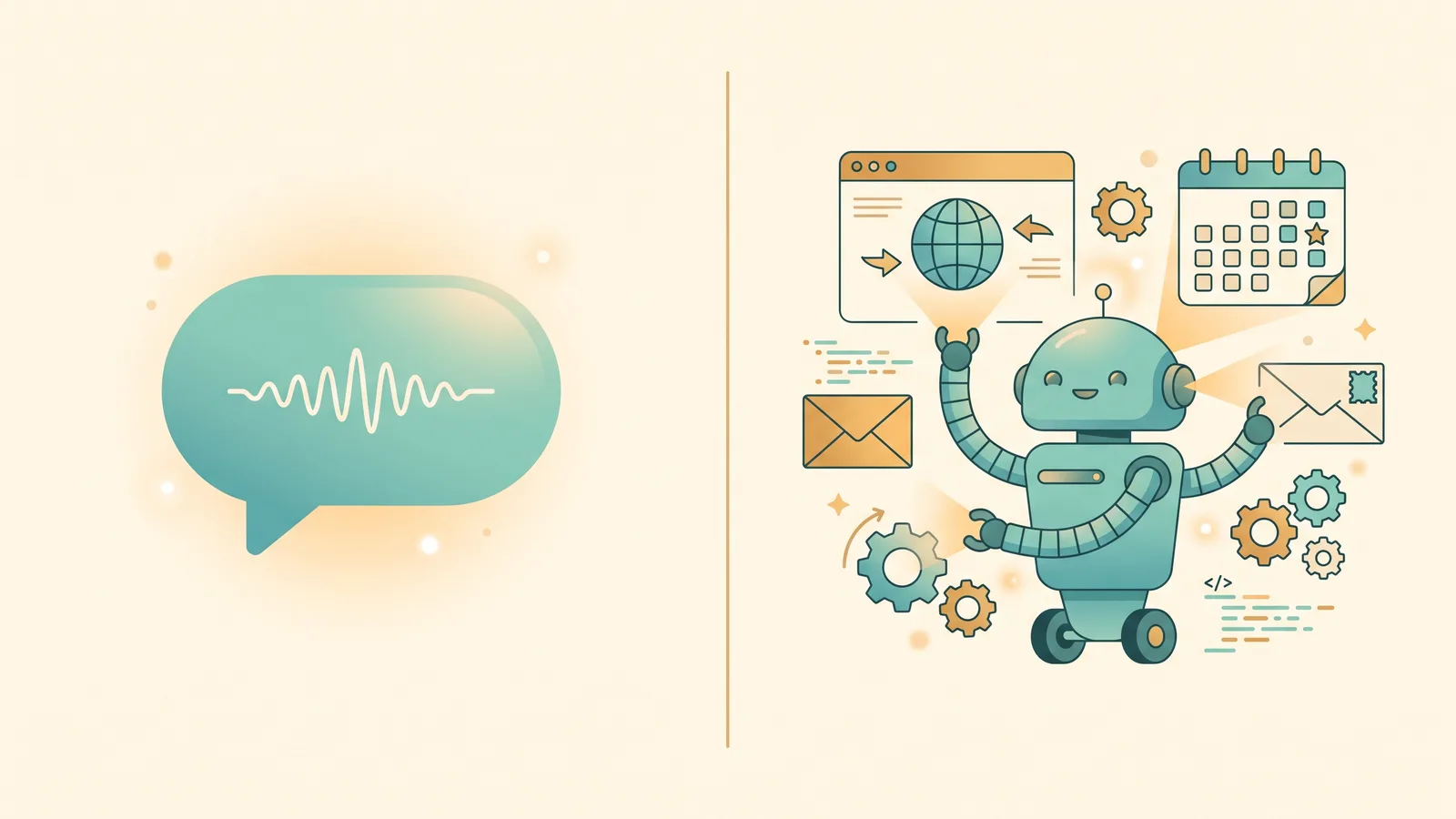
The difference in one line: a chatbot answers, an AI agent acts. You ask a chatbot a question and it replies. You hand an agent a goal and it works out the steps and carries them out.
A chatbot is a conversation. It waits for your message, gives a response, and waits again, and what it produces is almost always text. An AI agent is a worker. You give it an outcome ("book me the cheapest flight on Friday"), and it plans, uses tools, takes actions, checks how they went, and keeps going until the job is done or it gets stuck. That shift, from replying to doing, is the whole difference. Everything below follows from it.
| Chatbot | AI agent | |
|---|---|---|
| Core skill | Recognises your words and replies | Reasons about a goal and plans the steps |
| Can it take actions? | No, it talks (maybe shows buttons) | Yes, uses tools to browse, book, email, or run code |
| Steps per request | One reply at a time | Chains many steps until the goal is met |
| Memory | Usually forgets after the chat ends | Holds the thread across the whole task |
| When something changes | Follows a fixed script, or breaks | Adjusts, or asks you when it needs a decision |
| Needs a human for | Anything off-script | Anything risky or hard to undo |
| Best for | Fast answers to common questions | Multi-step jobs that span several apps |
Chatbot
- Core skill
- Recognises your words and replies
- Can it take actions?
- No, it talks (maybe shows buttons)
- Steps per request
- One reply at a time
- Memory
- Usually forgets after the chat ends
- When something changes
- Follows a fixed script, or breaks
- Needs a human for
- Anything off-script
- Best for
- Fast answers to common questions
AI agent
- Core skill
- Reasons about a goal and plans the steps
- Can it take actions?
- Yes, uses tools to browse, book, email, or run code
- Steps per request
- Chains many steps until the goal is met
- Memory
- Holds the thread across the whole task
- When something changes
- Adjusts, or asks you when it needs a decision
- Needs a human for
- Anything risky or hard to undo
- Best for
- Multi-step jobs that span several apps
Why one talks and the other acts
The behaviour gap comes from what sits underneath each. A chatbot is, at heart, a script or a single model reply: your message goes in, an answer comes out, and that's the whole cycle. An agent wraps a model in three extra things, tools it can call, a memory of what it has done, and a loop that lets it check a result and pick the next move. That loop is the line between a system that can only describe an action and one that can take it. You never see any of this as a user, but it's why no amount of clever wording turns a chatbot into an agent. The ability to act has to be built in, not written into a nicer sentence.
The 5 real differences, in plain English
Strip away the jargon and the gap comes down to five things. Each one is the same story: a chatbot talks, an agent works.
Understanding versus matching. A classic chatbot matches your words to a script and returns the closest canned answer. An agent reasons about what you actually want, even when you phrase it in a way nobody planned for.
Action versus conversation. This is the big one. A chatbot hands you words and stops. An agent can use tools, a browser, your calendar, an email connection, code, to do something in the real world, not just describe it.
Memory versus amnesia. Many chatbots forget everything the moment the chat closes. An agent holds the thread across a whole task, so at step six it still remembers what it found at step one.
One step versus many. A chatbot answers one message at a time. An agent chains steps: search, then read, then compare, then draft, then send, without you nudging it through each one.
Adapting versus following a script. Hit something unexpected and a scripted chatbot breaks or loops back to "sorry, I didn't get that." An agent notices the change and adjusts, or asks you when it genuinely needs a decision.
What each one looks like in real life
Definitions slide off the brain. Examples stick. Both types turn up in things you have probably touched this week.
Chatbots you already use: the little chat window on a shop's website that answers "where's my order," the phone menu that recognises "billing" and routes you, a basic Siri or Alexa command that sets a timer, and standard ChatGPT when you ask it to explain something and it just replies. All of these take one input and give one response. Useful, fast, and firmly a chatbot.
Agents you may have met: ChatGPT in agent mode browsing the web and filling a form to complete a task, a coding assistant that finds a bug, fixes it, and runs the test, Manus taking a goal and working through it while you watch, or a travel tool that doesn't just list flights but actually books the one you chose. The tell is always the same. It took an action, and it strung several steps together on its own.
The clearest way to feel the difference is to give both the same job. Ask a chatbot to "find a plumber and book one for Friday," and you get a helpful reply: a few names, maybe some tips on what to ask, a reminder to check reviews. The doing is still yours. Give the same line to an agent, and it searches, opens a few listings, compares the reviews, and either drafts the booking message for your approval or, in a full agent mode, sends it and reports back what it did. Same request, same words. One handed you information; the other handled the task.
One tool can be both, which is exactly why people get confused. Plain ChatGPT is a chatbot; ChatGPT in agent mode is an agent. Same app, different behaviour. For the fuller picture of the moving parts, see what an AI agent is.
Is it really an agent? How to spot "agent-washing"
Because "agent" sells better than "chatbot" right now, plenty of products wear the label without earning it. The industry has a nickname for this: agent-washing. Gartner, which flagged the term, predicted in 2025 that more than 40 percent of agentic AI projects would be scrapped by 2027, mislabeling among the reasons. You don't need a technical review to see through it.
One question does the job: can it take a real action on its own, and chain more than one step to finish a task? If the "agent" only answers questions, suggests what you could do, or needs you to click through every step, it's a chatbot with a fresh badge. A true agent does the steps. When a pricing page promises an "AI agent," ask what it actually does without you, book the meeting, update the record, send the reply, and if the honest answer is "it drafts text for you to action," you are looking at a chatbot. That one test will save you money on a subscription that promises autonomy it doesn't have.
When a chatbot is the better choice
The part the customer-service vendors, who mostly want to sell you an agent, tend to skip: an agent isn't always the right tool, and it's often the wrong one. Newer doesn't mean better for the job in front of you.
For simple, high-volume, repeatable questions, a plain chatbot wins. It's faster, it costs less, and it's far less likely to do something odd. Store hours, a password reset, tracking a parcel, answering the same five FAQs a thousand times a day: a scripted chatbot handles these cleanly, and pointing an autonomous agent at them adds cost, slowness, and a small but real chance of a confident mistake. You wouldn't hire a resourceful problem-solver to read out your opening hours a thousand times a day. A cheap, predictable script does that better, and it keeps the clever, costlier tool free for the jobs that actually need thinking. Agents earn their keep when a task is genuinely multi-step, spans more than one app, and would otherwise eat your time. Match the tool to the task, and you often find the boring option is the right one.
Do you need an agent or a chatbot?
Match it to the job, not the marketing. A quick way to decide.
Reach for a chatbot when the work is answering questions: the requests are simple and repetitive, the answer lives in a document or an FAQ, nothing needs to be changed in another system, and speed and low cost matter most. Reach for an agent when the work is getting something done: the task takes several steps, it touches more than one app or account, decisions depend on context, and you would rather hand over the outcome than babysit each click. If you find yourself copying and pasting between tools to finish a job, that's the signal an agent could help. If you just need a fast, correct answer, a chatbot is plenty. For where both sit among the wider field, our roundup of the best AI tools has the map, and the best AI chatbots covers the answer-first end specifically.
The bottom line
A chatbot answers; an agent acts. That's the difference, and once you can see it, the marketing stops working on you. When something is sold as an "AI agent," you will know to ask the only question that matters: what does it actually do on its own? The honest answer tells you which one you are really buying, and whether you needed the more expensive one at all.
What this guide does not cover
This is a plain-English comparison of AI agents and chatbots, not a build tutorial, a vendor buying guide with specific product picks, or a deep dive on multi-agent systems. It also does not cover the academic "intelligent agent" taught in AI courses, which is a different, more technical topic. Pricing and product features in this space change fast, so treat any figure as accurate to July 2026 and check the official page before you rely on it.
Sources
- Google Cloud, what are AI agents and IBM, what are AI agents (definitions of agents vs conversation)
- DigitalOcean, AI agent vs AI chatbot (dimension-by-dimension differences)
- Zendesk, AI agent vs AI chatbot (autonomy and use-case split)
- Gartner, agentic AI project predictions (2025) (agent washing and the 2027 cancellation forecast)
Frequently asked questions

Written by
Tapabrata Biswas
Tech Researcher
I test AI productivity tools and research home-automation gear the way most people use them. Not in a lab, but on an ordinary desk with an ordinary internet connection. The only test that matters: does it save you time?
Share the Post with Your Besties
Get the plain-English tech brief
One email a week on AI tools and smart-home tech. No jargon, no hype.