
Zigbee vs Matter: The Real Difference, in Plain English
Zigbee and Matter sound like rivals, but they sit at different layers and one alliance runs both. What each does, how they fit, and how to choose in 2026.

Researched with AI assistance, reviewed and edited by Tapabrata Biswas.
In this article
- 01What Zigbee is
- 02What Matter is
- 03The difference that matters
- 04Zigbee vs Matter at a glance
- 05What the Alliance actually shipped in November 2025
- 06How your old Zigbee gear fits a Matter home
- 07What this means when you're shopping in 2026
- 08Where each one still struggles
- 09What this post does not cover
- 10Sources
Search "Zigbee vs Matter" and you would think you have to pick a side. You don't, and the reason is hiding in what each one is.
The comparison usually skips the best part: the same organisation runs both. The Connectivity Standards Alliance, which builds Matter, was called the Zigbee Alliance until May 2021, and it still maintains Zigbee today. So this is less a cage match and more a question of which layer of your smart home you are talking about.
Two days. That's the gap between the Connectivity Standards Alliance shipping Zigbee 4.0 on November 18, 2025 and shipping Matter 1.5 on November 20, 2025. The organisation everyone assumes is quietly retiring Zigbee in favour of Matter released major upgrades to both inside the same week, and almost every "Zigbee vs Matter" article written since has mentioned neither.
That single fact answers the question most people are really asking. Zigbee isn't being sunset. The global Zigbee market was worth USD 5.16 billion in 2025 and is forecast to reach USD 6.91 billion by 2030, growing at roughly 6% a year, according to Mordor Intelligence's ZigBee Market report, and the Alliance counts more than a billion Zigbee devices already deployed worldwide. Knowing how the two split the work is what saves you from buying the wrong thing, or buying the same thing twice.
What Zigbee is
Zigbee is a low-power wireless mesh networking protocol, built on the IEEE 802.15.4 radio standard and maintained by the Connectivity Standards Alliance, that lets battery-friendly smart-home devices form their own local network. It is one of the oldest smart-home technologies still in everyday use, and that maturity is its main selling point.
Two traits define it. First, it sips power, so a door sensor or a wall button can run for a year or more on a single coin cell. Second, it is mesh, which means every mains-powered Zigbee device, like a plug or a bulb, also relays messages for its neighbours. Add more powered devices and the network gets steadier, not slower.
Zigbee is also a full stack. It defines the radio, the network, and the language the devices speak, all in one bundle. That completeness is why a Zigbee bulb has always needed a Zigbee hub or coordinator to join, usually a small bridge or a USB stick plugged into something like a Raspberry Pi. The hub is the piece that holds the mesh together.
That requirement, Zigbee's oldest drawback, is the thing Zigbee 4.0 goes after. Through a feature called Zigbee Direct, the Alliance says users can onboard and control devices over Bluetooth LE without a hub at all, which knocks out the "but you need a hub" objection that every Matter comparison leans on. The honest caveat is the same one Matter keeps teaching us: a specification is not a shelf. Zigbee 4.0 was announced in November 2025, and a feature only exists for you once devices ship with it. The mesh itself still wants a coordinator; Zigbee Direct changes the setup and control path, not the network.
If you are weighing Zigbee against the other long-running mesh radio, we lay out Zigbee vs Z-Wave in its own guide.
What Matter is
Matter is an application-layer connectivity standard, also maintained by the Connectivity Standards Alliance, that lets devices from different brands work together over your home's existing IP network. It arrived in late 2022. Matter 1.5 landed on November 20, 2025, adding cameras, closures, and energy tariffs, and Matter 1.6 followed on June 17, 2026 with NFC setup and Joint Fabric.
The key phrase is application layer. Matter does not define a radio of its own. It rides on networks you already have: Wi-Fi, Ethernet, and Thread, the last being a low-power mesh radio that, like Zigbee, runs on IEEE 802.15.4. Matter is the shared language. The network underneath is just the road it travels on.
That design is the entire point. One Matter device can show up in Apple Home, Google Home, Amazon Alexa, and Samsung SmartThings at the same time, because the language is identical everywhere. We unpacked that promise in what the Matter protocol actually is, if you want the longer version.
The difference that matters
Zigbee is a radio and a network, while Matter is a language that can be spoken over several networks. They sit at different layers of the stack, which is the real reason pitting one against the other feels slippery.
When people type "Zigbee vs Matter," they usually mean one of two concrete questions: should I buy a Zigbee device or a Matter device for something new, or will my old Zigbee gear work in a Matter home? Those have clear answers. The straight head-to-head does not, because the two were never built to do the same job.
Zigbee is the radio and the network. Matter is the language. Comparing them head to head is a bit like asking whether you prefer roads or English.
Zigbee vs Matter at a glance
The honest side by side looks like this, and the last row is the one most comparisons leave out.
| Zigbee | Matter | |
|---|---|---|
| What it is | Radio, network, and language in one stack | A language only, carried over other networks |
| Runs on | Its own 802.15.4 radio (2.4 GHz), plus sub-GHz via Suzi | Wi-Fi, Ethernet, or Thread |
| Needs a hub | Yes for the mesh; Zigbee 4.0 adds hub-free setup over Bluetooth LE | Not always; Thread devices need a border router |
| Cross-brand control | Within Zigbee, with the occasional quirk | Built for Apple, Google, Alexa, and SmartThings at once |
| In homes since | The mid-2000s | Late 2022 |
| Latest version | Zigbee 4.0, November 18, 2025 | Matter 1.6, June 17, 2026 |
| Maintained by | Connectivity Standards Alliance | Connectivity Standards Alliance |
What the Alliance actually shipped in November 2025
Zigbee 4.0 is the answer to "is Zigbee dying," and it's a firm no. The Alliance released it on November 18, 2025, and it does four things: Zigbee Direct, which onboards and controls devices over Bluetooth LE without a hub; sleepy-to-sleepy communication through Coordinated Sample Listening, so two battery devices can talk to each other directly and sip even less power; cryptographic agility and tighter authentication, aimed at security rules that keep hardening; and a merge of traditional Zigbee with Smart Energy devices under one framework. It stays fully backward compatible with Zigbee 3.0, which the Alliance frames as continuity for the billion-plus devices already out there.
Alongside it came Suzi, a new brand for Zigbee's long-range sub-GHz mesh. Sub-GHz travels further and through more walls than 2.4 GHz, so Suzi is aimed at the parts of a property Zigbee has always struggled to reach: garage doors, gates, outbuildings, the far end of a garden. Its certification programme is planned to open in the first half of 2026, which means products, not just slides.
None of this makes Zigbee the better choice for a cross-ecosystem smart home. It does kill the idea that Matter is the Alliance's replacement plan and Zigbee is the deprecated past. An organisation retiring a standard does not ship a major version of it two days before shipping a major version of the standard that supposedly replaces it. They're maintaining two things that do different jobs, which is exactly what the layers say they are.
The catch worth repeating: announced is not available. As of mid-2026 the Zigbee 4.0 features above are a specification, and the shelf is still full of Zigbee 3.0 hardware. Matter's camera story teaches the same lesson from the other side, and we pulled that apart in what actually works with Matter cameras.
How your old Zigbee gear fits a Matter home
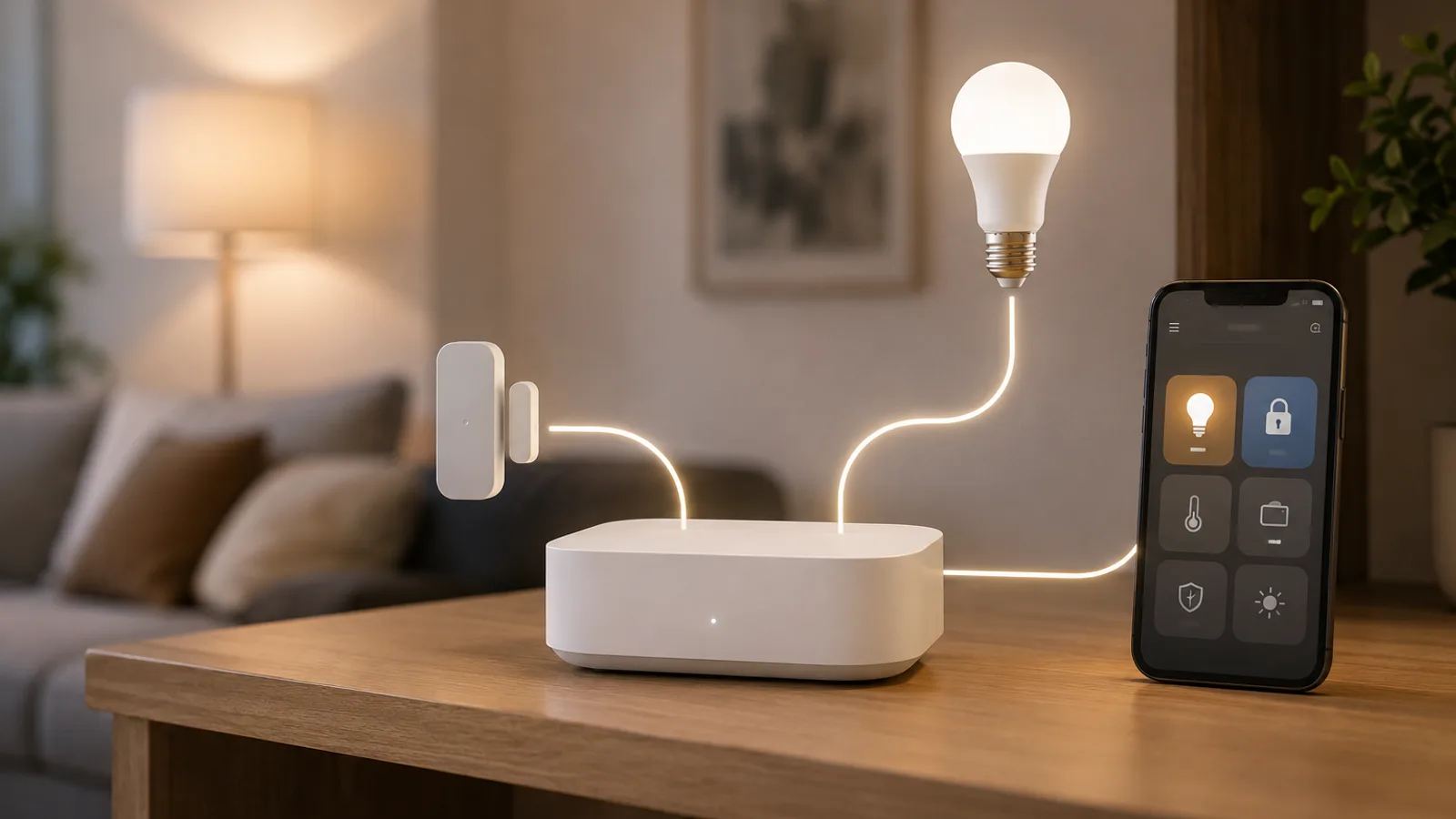
Existing Zigbee devices reach a Matter home through a bridge, a hub that translates Zigbee messages into Matter ones. Philips updated its Hue Bridge so the Zigbee bulbs already paired to it can appear as Matter devices in other apps, with no re-pairing required. Samsung's SmartThings hub and several Aqara hubs do the same job for the Zigbee gear bound to them, so check whether a bridge you already own can carry your old devices forward.
A bridge has limits worth knowing before you rely on it. It reliably carries the basics: on, off, brightness, and colour. The cleverer tricks a brand bakes into its own app, like a custom lighting scene or a sensor's fine-grained settings, often stay locked there and never make the trip across. The light turns on for everyone. The fancy scene may live in one place only.
For a setup that runs entirely on your own network, with no company's cloud deciding whether your lights respond tonight, an open hub does the heavy lifting. That's the gap the best Matter hubs for beginners are built to fill, and a platform like Home Assistant can speak Zigbee and Matter at the same time on the same box.
What this means when you're shopping in 2026
The choice in a store usually comes down to what's printed on the box and what you already run at home. A Zigbee device is often cheaper and has a longer track record, but it only works if you already keep a Zigbee hub running. A Matter device skips the brand lock-in and shares across ecosystems, though a Matter-over-Thread sensor still needs a Thread border router somewhere in the house.
You may already own that border router without knowing it. Recent Apple HomePods, Apple TVs, and Google Nest hubs include one built in, which is part of why Thread keeps quietly spreading. Thread explained covers the radio properly, including the awkward part nobody advertises: each ecosystem tends to build its own separate Thread network, so a house can end up running several that can't see each other.
The power gap is easy to make concrete. A contact sensor on a Zigbee or Thread mesh draws so little energy that one CR2032 coin cell can last a year or two. The same sensor built on Wi-Fi would flatten that cell in weeks, which is why almost nobody ships battery sensors over Wi-Fi. Low-power mesh is the reason your door and window sensors aren't forever begging for a new battery.
If you're starting fresh and want devices that move between Apple Home and Google Home without a fight, Matter over Thread is the forward-looking option. If you want the widest, cheapest catalogue of proven sensors on the shelf today and you don't mind running a hub, Zigbee still wins on sheer selection. Plenty of homes, including most serious Home Assistant setups, simply run both and stop worrying about it. You can read the 20-minute version of setting up Home Assistant to run both when you're ready.
Where each one still struggles
Neither standard is finished. Zigbee's old reputation for cross-brand quirks faded once Zigbee 3.0 unified its device types, but mixing several brands on one Zigbee network can still summon the odd compatibility gremlin. Zigbee also shares the crowded 2.4 GHz band with Wi-Fi and Bluetooth, so a coordinator parked right next to your router can drop the occasional command. Nudging the hub a foot or two away, or onto a Zigbee channel clear of your Wi-Fi, usually settles it. It's mature, not magic.
Matter has the opposite problem: it's young. It's dependable for lights, plugs, locks, and sensors, while cameras and energy hardware are still catching up. Cameras make the point sharply: the specification has covered them since Matter 1.5 in November 2025, and as of mid-2026 Samsung SmartThings is the only major platform that actually supports them. The newest premium features also tend to land in a brand's own app months before they reach the shared standard, and a device certified for an older Matter revision won't expose what a newer one defines.
The real picture is calmer than the marketing on either side. Zigbee is the proven workhorse that asks you to run a hub, and its own alliance is still actively extending it. Matter is the standard built for crossing ecosystems, still filling in its gaps. Thread, with little fanfare, is now carrying more and more of the new low-power devices Zigbee used to own outright, and if that radio is the piece you're short of, choosing a Thread border router covers the hardware.
What this post does not cover
- Z-Wave as a standalone choice, and Thread in depth, which each have their own guide (Zigbee vs Z-Wave and Thread explained)
- Step-by-step pairing for a specific hub or device brand
- Industrial or commercial mesh deployments, which is where much of Suzi is aimed
- Hands-on testing: this guide is built from the Alliance's own specifications and announcements, not our own lab
Sources
- Connectivity Standards Alliance: Zigbee 4.0 and Suzi announcement
- Connectivity Standards Alliance: Zigbee overview
- Connectivity Standards Alliance: Matter overview
- Connectivity Standards Alliance: Matter 1.5 introduces cameras, closures, and energy management
- Connectivity Standards Alliance: Matter 1.6 release
- Connectivity Standards Alliance: CHIP is now Matter (rebrand announcement)
- Mordor Intelligence: ZigBee Market report
- Home Assistant: Matter integration documentation
Frequently asked questions

Written by
Tapabrata Biswas
Tech Researcher
I test AI productivity tools and research home-automation gear the way most people use them. Not in a lab, but on an ordinary desk with an ordinary internet connection. The only test that matters: does it save you time?
Share the Post with Your Besties
Get the plain-English tech brief
One email a week on AI tools and smart-home tech. No jargon, no hype.