
Matter Hub: What It Is, Whether You Need One, and the Best for 2026
What a Matter hub is, whether you even need to buy one, a hub-vs-bridge explainer, and the strongest 2026 options compared, including Z-Wave picks.

Researched with AI assistance, reviewed and edited by Tapabrata Biswas.
In this article
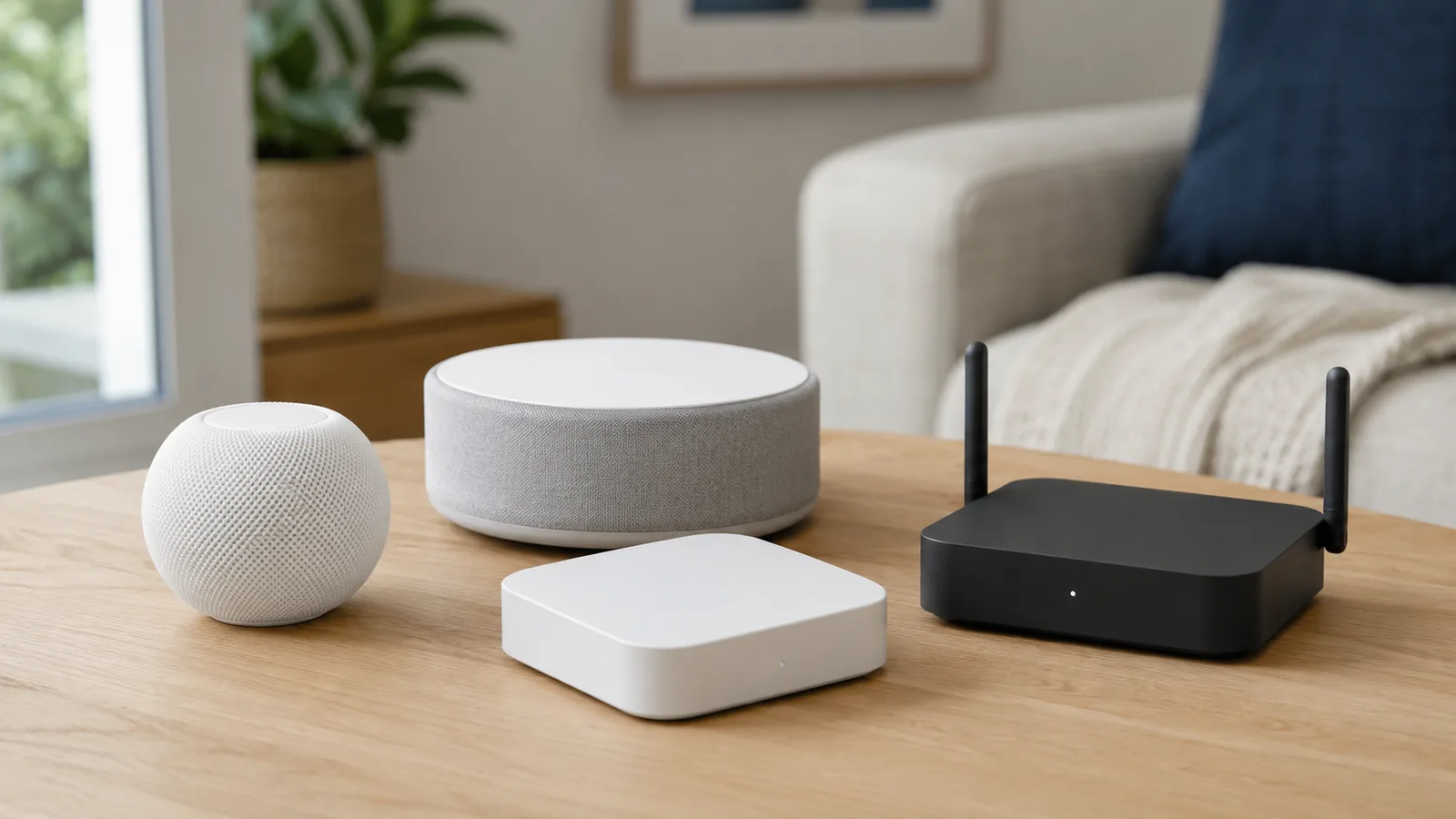
The good news about Matter hubs is that you might already own one. The confusing news is that "Matter hub" describes at least four different kinds of device, and the right one depends almost entirely on which voice assistant you already use.
A quick note on how this guide works: the picks below come from published specs, independent reviews, and owner feedback, not from a lab test we ran ourselves. We don't own every unit here, and we don't earn anything if you buy one. The aim is to help you choose the right hub for your setup, with the trade-offs laid out plainly.
$54, $99, $159.99. Those are three prices we found for the same Aqara Hub M3 while researching this guide: a marketplace listing, a rival roundup's figure, and the number on Aqara's own US store. Every buying guide quotes one confident price for this hub. None of them agree, and the spread is nearly three to one.
That's worth knowing before any recommendation lands, because it changes the shape of the advice. Treat every price here as a starting point to check, not a fact. And the harder question comes first anyway: whether you need a dedicated hub at all, or whether the speaker already on your shelf does the job.
What a Matter hub is
A Matter smart hub is the device that commissions and controls your Matter devices, and in most cases it also acts as a Thread border router that connects low-power Thread gadgets to your home network. Those are two separate jobs, and three distinctions decide what you buy.
The controller is the brain: it pairs devices, runs automations, answers voice commands. The Thread border router is the bridge that lets battery-powered sensors and locks reach your network. Most hubs do both, but not all: some Amazon and Google Wi-Fi routers are a border router without being a controller, so they extend the radio network without running your home. And a hub is not a bridge. A bridge translates non-Matter gear, usually older Zigbee or Z-Wave, into your Matter app, and it carries only the basics, on, off, and brightness, while the cleverer features stay stuck in the device's own app.
Three guides cover the layers underneath, so this page stays on the buying question: what the Matter protocol actually is, Thread explained for the radio and why homes end up with several separate Thread networks, and choosing a Thread border router if the radio is the only piece you're short of.
Do you even need to buy one?
Often, no. This is the first thing to check, because it can save you the purchase entirely. If you own a recent Apple HomePod mini, a Google Nest Hub, a fourth-generation Amazon Echo, or a Samsung SmartThings hub, you likely already have a working Matter controller, and several of those double as a Thread border router. For a lot of people, the cheapest good Matter hub is the one already plugged in.
You'd buy a dedicated hub for one of three reasons: you want a single hub that works across more than one ecosystem, you want local control that does not lean on a company's cloud, or you want to bridge older Zigbee devices into Matter. If none of those apply, start with what you own.
How to choose: the five things that decide it
Picking the right Matter hub comes down to five questions, in rough order of importance.
First, which ecosystem do you already use? Apple Home, Google Home, Amazon Alexa, and Samsung SmartThings each have their own hubs, and matching your hub to the assistant on your phone is the single biggest factor. A hub from the wrong camp still works through Matter, but you lose the smooth parts.
Second, do you need a Thread border router? If you plan to buy battery-powered Thread devices, yes, and most modern hubs include one. If you only run Wi-Fi plugs and bulbs, you can skip it. If you do need one, check it's certified to Thread 1.4: that's the version that lets a border router join a Thread network you already have instead of starting a second, separate one, and industry reporting on the Thread Group's certification programme says new border routers can only be certified against 1.4 from January 2026. Older stock on a shelf may still be 1.3. We unpack that whole mess in choosing a Thread border router.
Third, how much do you care about local control? A hub that runs automations locally keeps working when your internet drops and keeps your data off a vendor's servers. Apple's hubs and Home Assistant lead here.
Fourth, do you have old Zigbee or Z-Wave devices to reuse? Only some hubs bridge them into Matter. The Aqara M3 handles Zigbee, and the Hubitat Elevation C-8 Pro adds Z-Wave 800 on top, which saves you replacing a drawer of sensors. This matters more than it used to: Aeotec's Smart Home Hub V4, released in 2025, dropped Z-Wave entirely, so a retrofit household has fewer bridges to choose from. We compared the standards in Zigbee vs Matter.
Fifth, price. The spread runs from free, if you already own a compatible speaker, to around $180 for a wall-mounted panel or a local-first Z-Wave hub.
The comparison at a glance
The table maps the main options against those five questions. Prices are approximate US figures for 2026 and shift often.
| Hub | Best for | Thread border router | Zigbee / Z-Wave | Local control | Approx US price |
|---|---|---|---|---|---|
| Aqara Hub M3 | All-rounder, mixed setups | Yes | Zigbee | Strong | $54 to $160, see note |
| Aqara Hub M200 | Best value all-in-one | Yes, and mesh extender | Zigbee | Strong | Around $70 |
| Homey Pro (2026) | Power users who want every radio | Yes | Zigbee + Z-Wave Plus | Maximum | $400 and up |
| Hubitat Elevation C-8 Pro | Z-Wave retrofit, local privacy | No, add a separate one | Zigbee + Z-Wave 800 | Maximum | $179 |
| Apple HomePod mini | Apple Home households | Yes | No | Strong | $99 |
| Apple TV 4K | Apple Home, plus media | Yes, Ethernet model only | No | Strong | $129 |
| Google Nest Hub (2nd gen) | Google Home households | Yes | No | Partial | $100 |
| Amazon Echo Hub | Alexa, wall panel | Yes | No | Partial | $180 |
| SmartThings Hub or Station | Samsung households | Yes | Zigbee | Partial | $90 to $130 |
| Home Assistant + Thread radio | Local-first, tinkerers | Via add-on | Zigbee, Z-Wave via stick | Maximum | $100 and up |
| Aqara Hub M100 | Budget Thread + Matter | Yes | No | Strong | Around $30 |
Best for
- Aqara Hub M3
- All-rounder, mixed setups
- Aqara Hub M200
- Best value all-in-one
- Homey Pro (2026)
- Power users who want every radio
- Hubitat Elevation C-8 Pro
- Z-Wave retrofit, local privacy
- Apple HomePod mini
- Apple Home households
- Apple TV 4K
- Apple Home, plus media
- Google Nest Hub (2nd gen)
- Google Home households
- Amazon Echo Hub
- Alexa, wall panel
- SmartThings Hub or Station
- Samsung households
- Home Assistant + Thread radio
- Local-first, tinkerers
- Aqara Hub M100
- Budget Thread + Matter
Thread border router
- Aqara Hub M3
- Yes
- Aqara Hub M200
- Yes, and mesh extender
- Homey Pro (2026)
- Yes
- Hubitat Elevation C-8 Pro
- No, add a separate one
- Apple HomePod mini
- Yes
- Apple TV 4K
- Yes, Ethernet model only
- Google Nest Hub (2nd gen)
- Yes
- Amazon Echo Hub
- Yes
- SmartThings Hub or Station
- Yes
- Home Assistant + Thread radio
- Via add-on
- Aqara Hub M100
- Yes
Zigbee / Z-Wave
- Aqara Hub M3
- Zigbee
- Aqara Hub M200
- Zigbee
- Homey Pro (2026)
- Zigbee + Z-Wave Plus
- Hubitat Elevation C-8 Pro
- Zigbee + Z-Wave 800
- Apple HomePod mini
- No
- Apple TV 4K
- No
- Google Nest Hub (2nd gen)
- No
- Amazon Echo Hub
- No
- SmartThings Hub or Station
- Zigbee
- Home Assistant + Thread radio
- Zigbee, Z-Wave via stick
- Aqara Hub M100
- No
Local control
- Aqara Hub M3
- Strong
- Aqara Hub M200
- Strong
- Homey Pro (2026)
- Maximum
- Hubitat Elevation C-8 Pro
- Maximum
- Apple HomePod mini
- Strong
- Apple TV 4K
- Strong
- Google Nest Hub (2nd gen)
- Partial
- Amazon Echo Hub
- Partial
- SmartThings Hub or Station
- Partial
- Home Assistant + Thread radio
- Maximum
- Aqara Hub M100
- Strong
Approx US price
- Aqara Hub M3
- $54 to $160, see note
- Aqara Hub M200
- Around $70
- Homey Pro (2026)
- $400 and up
- Hubitat Elevation C-8 Pro
- $179
- Apple HomePod mini
- $99
- Apple TV 4K
- $129
- Google Nest Hub (2nd gen)
- $100
- Amazon Echo Hub
- $180
- SmartThings Hub or Station
- $90 to $130
- Home Assistant + Thread radio
- $100 and up
- Aqara Hub M100
- Around $30
The strongest options
Once you know your ecosystem, the pick falls out of the table. The main choices break down by household, and the independent reviews back the same handful.
The Aqara Hub M3 is the closest thing to a universal pick. It's a Matter controller, a Thread border router, and a Zigbee 3.0 bridge in one mains-powered box, with wired Ethernet, PoE, and a 360-degree IR blaster for controlling old TVs and air conditioners. Aqara's own specs put it at up to 127 Thread and Zigbee devices with 8GB of encrypted local storage, and there's no microphone or camera in it at all, which is a quiet privacy advantage over any hub that doubles as a speaker. In a three-month review, PCWorld pointed to its local automation and broad device support as what justifies the premium over simpler hubs.
The price is the caveat. Aqara's own US store lists it at $159.99, while third-party listings run as low as $54 and rival roundups quote around $90 to $99. At $54 it's an easy recommendation, at $160 the M200 below is the better buy, and which one you're looking at depends entirely on the day and the seller.
The Aqara Hub M200 is the value pick, and it's the notable absence from most 2026 roundups. Launched in November 2025 at around $70, it does the same three jobs as the M3 (Matter controller, Thread border router, Zigbee bridge) with PoE or USB-C power, a 360-degree IR blaster, and a 90dB speaker for alerts. The trade against the M3 is capacity: Aqara rates it for 40 Zigbee plus 40 Thread devices rather than 127, and it drops the M3's local storage. For a normal house that never approaches 80 devices, that's a limit you'll never touch, and it's roughly half the M3's list price.
At the far end, the Homey Pro (2026) is the one to know about if you want every radio in one box. It carries seven: Matter, Thread, Zigbee, Z-Wave Plus, Wi-Fi, Bluetooth LE, and infrared, with a fully local automation engine and no subscription. Smart Home Explorer's aggregated verdict puts it at 8 out of 10 across five expert reviews, with Android Authority rating its software 8.5. The catches are the price, around $400, and a detail worth knowing before you order: wired Ethernet needs a separate $29 adapter. It's the hub for someone consolidating a genuinely mixed house, not a first purchase.
If you already live in Apple Home, you may not need to buy anything. A HomePod mini or an Apple TV 4K works as a Thread border router and a local controller for HomeKit, so any Thread device routes through it. For an iPhone household, that's the cheapest and fastest path to a working smart home.
Google Home users get the same convenience from a Nest Hub (2nd gen), or wider Thread coverage from a Nest Wifi Pro across a larger home. Alexa households can use a compatible Echo as a controller, or the wall-mounted Echo Hub, which ships on the newer Matter 1.5 firmware. Samsung owners have the SmartThings Hub or Station, which add a Zigbee radio on top of Matter and Thread.
For anyone who wants maximum control and privacy, a Home Assistant setup paired with a Thread radio is the most flexible option here. It runs everything locally, speaks Matter, Thread, and Zigbee at once, and answers to no company's cloud. The trade is setup time, which we walked through in its own guide.
If your walls are full of older Z-Wave switches, the Hubitat Elevation C-8 Pro is the pick worth knowing about. At around $179 it runs Z-Wave 800, Zigbee 3.0, and Matter 1.5 entirely on the box, so automations survive an internet outage and your Z-Wave gear finally shows up alongside your Matter devices. It's the answer several 2026 roundups reach for on the retrofit question, and it asks far less setup than Home Assistant. One caveat: it isn't a Thread border router, so if you also run Thread devices you'll pair it with a separate one.
On a tight budget, the Aqara Hub M100 covers the essentials, a Thread border router and Matter controller, for around $30, which is the cheapest honest way into a Thread setup. At the other end, the Echo Hub is worth singling out, because it's less a hub and more a wall-mounted touchscreen panel. You pay around $180 for the dashboard, not the radios. If you want a screen on the wall to run scenes, it fits. If you just need the plumbing, a cheaper box does the same job out of sight.
A note on Matter versions
Not every hub runs the same version of Matter, and it shows. As of 2026, the Amazon Echo Hub, the SmartThings Hub, and the Hubitat C-8 Pro are on Matter 1.5, the Aqara M3 runs Matter 1.4, and Home Assistant is certified for Matter 1.3 with newer features arriving through updates. The gaps are small for everyday lights and plugs, but a newer version can mean earlier support for trickier categories.
The standard has kept moving since. Matter 1.5 arrived on November 20, 2025 and added cameras, closures like blinds and garage doors, energy tariffs, and soil sensors. Matter 1.6 followed on June 17, 2026 with NFC commissioning (setting a bulb up before it's screwed in), Joint Fabric so several controllers can co-administer one network, and thermostats that weigh incoming commands against your preferences instead of obeying them blindly. No hub on this page ships 1.6 yet.
Cameras are the cautionary tale, and they matter for hub choice. The spec has covered them since 1.5, but as of mid-2026 Samsung SmartThings is the only major platform that actually supports Matter cameras, and Ring, Nest, and Blink haven't certified any. So a hub advertising Matter 1.5 firmware tells you nothing about whether your camera will appear in it. We pulled that apart in what actually works with Matter cameras. If a specific device type is the reason you're buying, check the hub's current firmware and the platform's actual support, not the version number on the box.
If you're buying in India
Availability, not price, is the constraint in India, and it quietly rules out advice that works fine in the US. The Google Nest Hub (2nd gen) is officially sold there: Google's own India blog announced it in January 2022 at Rs 7,999 through Flipkart, Tata Cliq, and Reliance Digital, so the Google Home route is genuinely open. What isn't clear is the next generation. Google's Gemini-powered Google Home Speaker is slated for spring 2026 in the US, UK, France, Germany, Spain, and Canada, and India isn't among those launch markets.
Amazon's Echo line and Samsung's SmartThings hubs are the easiest things to buy in India with a proper warranty. Aqara's hubs are widely available through importers and marketplace sellers rather than a strong local retail presence, which is worth factoring in: an imported hub with no local warranty support is a different proposition to the same box in the US, especially for a device meant to run for years.
One practical note that never appears in US roundups. If your power is unreliable, a hub that can run from PoE or sit behind a UPS keeps your automations alive through a cut, and a hub that runs automations locally keeps working when the broadband drops rather than the whole house going dumb. Both the Aqara M3 and M200 take PoE. That's a real advantage in a lot of Indian homes and close to irrelevant in most American ones.
A few things to watch before you buy
Running across two ecosystems works, but it isn't always smooth. Matter lets a device appear in Apple Home and Google Home at once, yet sharing it through multi-admin can be fiddly, and not every feature crosses over. Picking one main app and treating the others as backups is the calmer path.
The other trap is the spec sheet. A box saying Thread-capable may be a border router only, not a controller, and a hub advertising a Matter version number tells you nothing about whether your particular device type works on that platform yet. Check the job the box does, not the badge it wears.
What this post does not cover
- Hands-on lab testing or our own measurements (this is a research-based guide)
- Step-by-step setup for a specific hub
- Whole-home Wi-Fi or mesh-router buying advice
Sources
- Connectivity Standards Alliance: Matter overview
- Connectivity Standards Alliance: Matter 1.6 release
- Home Assistant: Matter integration documentation
- Aqara: Hub M3 product page
- Aqara: Hub M200 product page
- PCWorld: Aqara Hub M3 review
- Smart Home Explorer: Homey Pro (2026) expert consensus
- Google India: the new Nest Hub, now available in India
- Matter Alpha: The complete list of Thread border routers
- Hubitat: Elevation C-8 Pro
Frequently asked questions

Written by
Tapabrata Biswas
Tech Researcher
I test AI productivity tools and research home-automation gear the way most people use them. Not in a lab, but on an ordinary desk with an ordinary internet connection. The only test that matters: does it save you time?
Share the Post with Your Besties
Get the plain-English tech brief
One email a week on AI tools and smart-home tech. No jargon, no hype.