
Best AI Home Assistant in 2026: Buy One or Build One
Alexa+, Gemini for Home, and Siri versus building your own with Home Assistant and an LLM. Honest 2026 prices, what's actually shipped, and which to pick.

Researched with AI assistance, reviewed and edited by Tapabrata Biswas.
In this article
- 01What is an AI home assistant, and why does the term mean two things?
- 02What's the best AI home assistant in 2026?
- 03Buy it: Alexa+ vs Gemini for Home vs Siri
- 04Build it: adding AI to Home Assistant (and do you even need to?)
- 05Which AI should you plug into Home Assistant?
- 06How much does it cost to run AI in Home Assistant?
- 07Which AI home assistant is the most private?
- 08So, should you buy or build?
- 09What this guide does not cover
- 10Sources
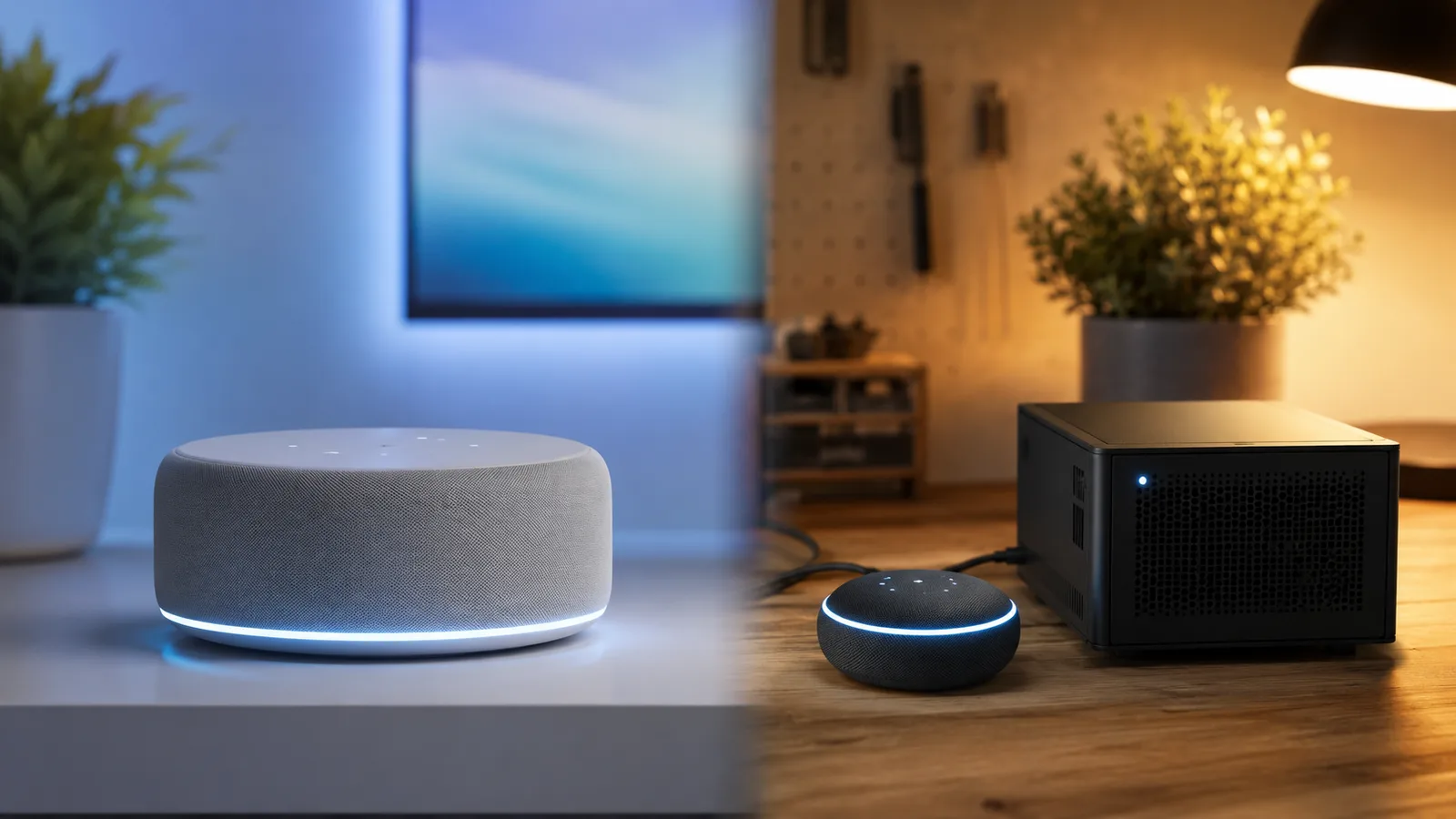
Ask for the best AI home assistant and you'll get two different answers, because the phrase hides two different things. One is a speaker you buy and switch on: Amazon's Alexa+, Google's Gemini for Home, or Apple's Siri. The other is one you build, by adding an AI model to Home Assistant, the free open-source platform. This guide covers both paths and helps you decide which one fits you.
$19.99 a month, or nothing at all. That is the gap between paying for Alexa+ and running a private assistant on hardware you already own, and it frames the whole decision. The right answer depends on what you own, what you'll pay, and how much you care about who hears your requests.
Where these picks come from is worth stating plainly: official documentation, current pricing pages, independent reviews, and owner feedback, not a lab we ran ourselves. This space changes monthly, so every figure here carries a date, and we earn nothing if you buy anything.
What is an AI home assistant, and why does the term mean two things?
An AI home assistant is a voice or text assistant that uses a large language model to understand natural, conversational requests, then controls your smart-home devices, answers questions, and handles tasks, going beyond the rigid fixed commands of older assistants. That definition covers two very different products that happen to share a name.
The first is the buy path: a finished cloud speaker from Amazon, Google, or Apple that works out of the box and sends your requests to the company's servers. The second is the build path: you run Home Assistant on a small computer and connect an AI model as its brain. One is a purchase, the other is a project. If you're comparing the chat apps you type to instead, like ChatGPT and Claude, that's our best AI chatbot guide; this piece is about assistants that control your home by voice.
What's the best AI home assistant in 2026?
For most people the best AI home assistant is Alexa+ if you already pay for Prime, or Google's Gemini for Home if you live in an Android and Nest household, since both are free at the point of use. For privacy and control without a subscription, it's Home Assistant with a local model. Apple users are stuck waiting, because the AI version of Siri has not shipped yet.
That's the short version. The rest of this guide is the reasoning, the real prices, and an honest look at what each one gets wrong.
Buy it: Alexa+ vs Gemini for Home vs Siri
The buy path means a cloud speaker that processes your requests on the maker's servers, so the trade is convenience now for a monthly fee or your data later. All three big assistants were rebuilt around large language models, but they did not arrive at the same time, and one of them still hasn't.
| Assistant | What it is | Price (2026) | Shipped? (June 2026) | Privacy |
|---|---|---|---|---|
| Alexa+ | LLM Alexa, on Amazon Nova and Anthropic models | $19.99/mo, free with Prime | Yes, US-wide since February | Cloud only; local processing removed in 2025 |
| Gemini for Home | Replaces Google Assistant on Nest devices | Free core; Premium about $10 to $20/mo | Yes, rolling out; new speaker shipped June 25 | Cloud; camera AI trained on user data |
| Apple Siri (AI) | LLM Siri, on Apple models plus a licensed Gemini | Bundled with devices | No, expected around fall 2026 | Most on-device of the three |
What it is
- Alexa+
- LLM Alexa, on Amazon Nova and Anthropic models
- Gemini for Home
- Replaces Google Assistant on Nest devices
- Apple Siri (AI)
- LLM Siri, on Apple models plus a licensed Gemini
Price (2026)
- Alexa+
- $19.99/mo, free with Prime
- Gemini for Home
- Free core; Premium about $10 to $20/mo
- Apple Siri (AI)
- Bundled with devices
Shipped? (June 2026)
- Alexa+
- Yes, US-wide since February
- Gemini for Home
- Yes, rolling out; new speaker shipped June 25
- Apple Siri (AI)
- No, expected around fall 2026
Privacy
- Alexa+
- Cloud only; local processing removed in 2025
- Gemini for Home
- Cloud; camera AI trained on user data
- Apple Siri (AI)
- Most on-device of the three
Alexa+ became available to everyone in the US in February 2026, rebuilt on a new architecture using Amazon's Nova and Anthropic's models, per Amazon's own announcement. It's genuinely more conversational and can chain actions together. It's also rough: Consumer Reports, in its December 2025 review, found the app buggy and the agentic features unreliable, and noted it still shows ads despite being a paid service. Amazon also removed on-device voice processing and the "do not send voice recordings" setting in 2025, so opting out of the cloud isn't possible anymore.
Gemini for Home replaced Google Assistant on Nest speakers and displays starting in late 2025, per Google. The core is free: smart-home control, timers, questions, reminders. The extras, like the always-on Gemini Live and AI camera descriptions, need Google Home Premium, which runs about $10 a month for the standard tier. Google also shipped its first new speaker in six years, the $99.99 Google Home Speaker, on June 25 2026, with a chip that handles some requests on the device.
Siri is the odd one out. The large-language-model rebuild of Siri had not shipped by mid-2026 and is expected around fall 2026 with iOS 27, though it has slipped before, according to reporting from Bloomberg and Apple-focused outlets. Refreshed HomePod and Apple TV hardware is reportedly built and waiting on it. Today's Siri is the most private of the three, doing more on-device, but also the least capable. My honest read: don't buy into Apple's smart home on the promise of an assistant that isn't here.

Build it: adding AI to Home Assistant (and do you even need to?)
Home Assistant's Assist is the platform's built-in, free voice pipeline, running wake word to speech-to-text to a conversation agent to text-to-speech, and it can work entirely on hardware you own. Assist ships with a rule-based brain that matches your words to actions. It's fast, local, free, and it never phones home.
Here's the part the gadget coverage skips: most people don't need an LLM bolted onto it. The rule-based agent turns off the kitchen lights the instant you ask, for nothing, offline. An AI model earns its place only when you want the fuzzy stuff, like "it's cold in here, sort it out," or compound requests, or having it write an automation for you. Home Assistant's own design reflects this. It handles what it can locally and forwards only what it can't understand to the AI, which keeps both cost and data leakage down.
The build path assumes you've already got Home Assistant running; this is the AI layer on top, not the install. If you want a physical device for it, the Home Assistant Voice Preview Edition is $69 and has a switch that physically cuts the microphone. Voice used to feel sluggish here, but a 2025 rewrite made speech start streaming back in about half a second, which is what finally made the LLM route usable.
Which AI should you plug into Home Assistant?
The best AI to connect depends on what you're optimizing for: Google's Gemini is the cheapest and has a free tier, OpenAI is strongest on general knowledge, community testing favors Claude for reliable device control, and a local model through Ollama is the only fully private option. All of them attach as a conversation agent, and any model has to support tool calling to actually control devices, plus it only sees the devices you choose to expose.
| Option | Cost | Privacy | Device control | Setup |
|---|---|---|---|---|
| Google Gemini | Free tier, then cheap | Cloud; free tier uses your data | Good | Easy, API key |
| OpenAI (gpt-4o-mini) | Per token, a few $/mo | Cloud | Good, best general knowledge | Easy, API key plus billing |
| Claude | Per token | Cloud | Most reliable at picking the right device | Easy, API key |
| Local (Ollama) | Free after hardware | Fully local and private | Varies; small models make mistakes | Hard, you self-host |
Cost
- Google Gemini
- Free tier, then cheap
- OpenAI (gpt-4o-mini)
- Per token, a few $/mo
- Claude
- Per token
- Local (Ollama)
- Free after hardware
Privacy
- Google Gemini
- Cloud; free tier uses your data
- OpenAI (gpt-4o-mini)
- Cloud
- Claude
- Cloud
- Local (Ollama)
- Fully local and private
Device control
- Google Gemini
- Good
- OpenAI (gpt-4o-mini)
- Good, best general knowledge
- Claude
- Most reliable at picking the right device
- Local (Ollama)
- Varies; small models make mistakes
Setup
- Google Gemini
- Easy, API key
- OpenAI (gpt-4o-mini)
- Easy, API key plus billing
- Claude
- Easy, API key
- Local (Ollama)
- Hard, you self-host
The local route is the purist's choice and the one with real hardware demands. A Raspberry Pi can run a tiny model, but reliable performance wants a proper GPU with roughly 8GB or more of memory, and Home Assistant recommends exposing fewer than 25 devices to a local model so it doesn't get confused. If you go cloud, the AI subscription vs API cost calculator helps you sanity-check what a paid model will actually cost you per month.
How much does it cost to run AI in Home Assistant?
Running a cloud AI in Home Assistant usually costs a few cents to about $2 a month for casual use, and it can be free. You pay per token, meaning per chunk of text in and out, so a household that asks a handful of conversational questions a day barely registers a bill. Google's Gemini has a free tier that covers light use outright, which is why it's the common starting point.
Two things keep the number tiny. First, the "prefer handling commands locally" setting lets Assist answer the simple stuff for free and only calls the paid model for the rest. Second, a local model via Ollama costs nothing per query once you own the hardware. The software itself is free either way; Home Assistant Cloud, at about $6.50 a month, adds easy remote access and managed voice, but it is optional and it is not an AI model, so you'd still bring your own.
Which AI home assistant is the most private?
A self-hosted Home Assistant with a local model is the most private option available, because your voice and your commands are processed on hardware you own and never leave your network. This is a difference of architecture, not policy. The cloud speakers send your requests to company servers by design, and no privacy setting changes that.
Among the cloud options, Apple's Siri does the most on-device, which makes it the most private of the three big speakers. Alexa+ sits at the other end: Amazon removed on-device processing and the recording opt-out in 2025, so everything goes to the cloud. If privacy is the reason you're here, the build path with a local model and the Voice Preview Edition's hardware mute switch is the honest answer, and it pairs well with a Matter hub for controlling devices across brands.
So, should you buy or build?
Match the path to who you already are. The decision is less about which assistant is smartest and more about your existing gear, your tolerance for subscriptions, and how you feel about the cloud.
- You pay for Prime and own Echo devices: get Alexa+. It's free with Prime and works with what you have, as long as the cloud trade-off doesn't bother you.
- You're an Android and Nest household: use Gemini for Home. The core is free and it's already replacing Assistant on your speakers.
- You're deep in Apple: wait for the fall-2026 Siri rather than buying on the promise, and lean on the current Siri in the meantime.
- You want privacy, no subscriptions, or you like to tinker: build it with Home Assistant and a local model. It costs more effort and some hardware, and it rewards you with control and a smart home that's also good at trimming the energy bill.
What this guide does not cover
This is a decision guide for the AI assistant itself, not a speaker sound-quality review and not a Home Assistant install walkthrough, which our beginner setup guide already covers. It doesn't rank the standalone chat apps, since those are a different job. Prices, tiers, and ship dates in this niche move fast, so treat every figure as accurate to mid-2026 and check the current page before you buy.
Sources
- About Amazon, Alexa+ availability and pricing (Alexa+ US launch, free with Prime, February 2026)
- Consumer Reports, Alexa+ review (limitations, December 2025)
- Google, The Keyword: Gemini for Home (replaces Google Assistant; Premium tiers; Google Home Speaker, 2025 to 2026)
- Home Assistant, Assist and voice control (Assist pipeline, local-first design)
- Home Assistant, OpenAI, Google Generative AI, and Ollama integrations (conversation agents, cost, local models, tool calling)
- Home Assistant Voice Preview Edition ($69, hardware mute switch)
Frequently asked questions

Written by
Tapabrata Biswas
Tech Researcher
I test AI productivity tools and research home-automation gear the way most people use them. Not in a lab, but on an ordinary desk with an ordinary internet connection. The only test that matters: does it save you time?
Share the Post with Your Besties
Get the plain-English tech brief
One email a week on AI tools and smart-home tech. No jargon, no hype.