
The Best CO2 Monitor for a Home Office (2026), and What the Numbers Mean
The best CO2 monitors for a home office in 2026: why NDIR beats fake 'eCO2', what your ppm numbers mean, and the only thing that actually lowers CO2.

Researched with AI assistance, reviewed and edited by Tapabrata Biswas.
In this article
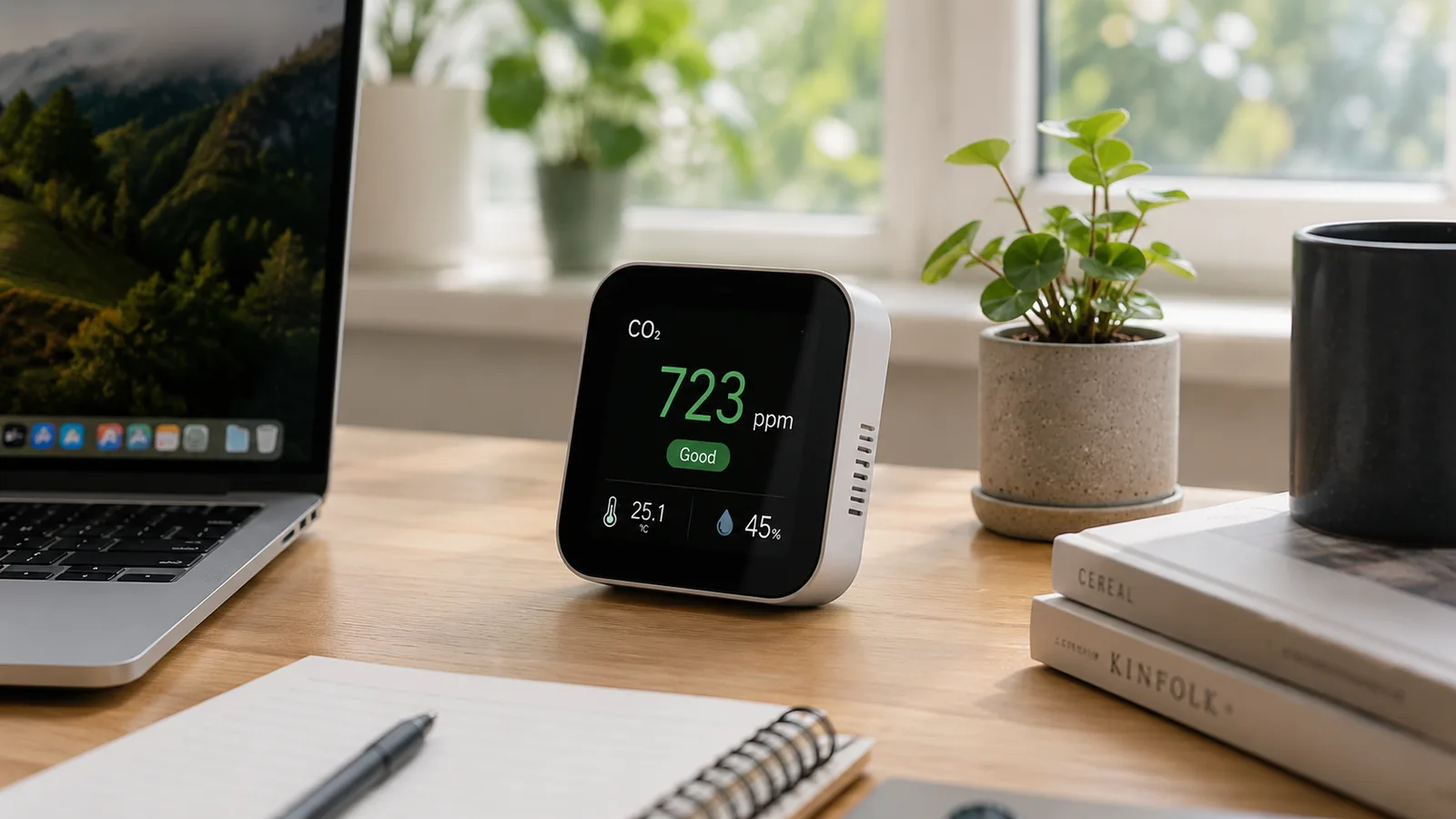
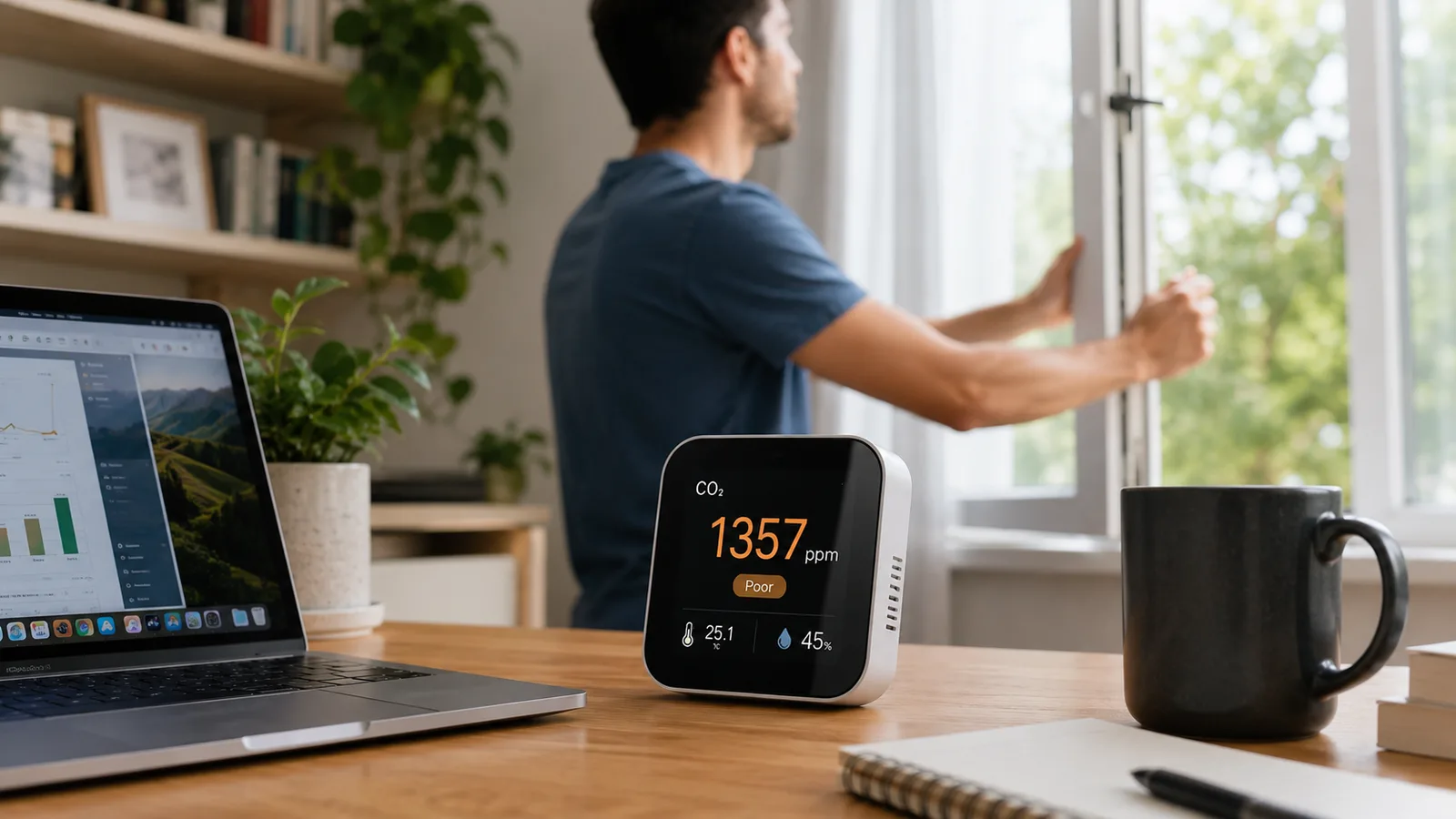
Here is the thing no one tells you about working from a spare room with the door shut: by late morning, the air is working against you. One person breathing in a small, closed office steadily pushes carbon dioxide up, and it often sails past 1,400 parts per million before lunch, which is roughly where studies start to measure a real drop in focus and decision-making. You can't see it, smell it, or feel it as anything more than a vague fog. A CO2 monitor is the cheapest way to turn that invisible drag into a number you can act on.
This is a plain-English guide to buying and reading one: the single spec that separates a real monitor from a useless one, the devices worth the money in 2026, what your numbers actually mean, and the one thing that genuinely lowers CO2. These picks come from manufacturer specs and independent coverage, not our own lab testing, and prices reflect September 2026 and move around.
Why CO2 matters in a home office
Carbon dioxide is a proxy for stale air. Outdoor air sits around 420 ppm, and the higher the number climbs indoors, the less fresh air is being exchanged, which means more of everything else you're breathing out is hanging around too. The reason to care for work specifically is cognitive: research led by Harvard's Joseph Allen found measurable declines in cognitive-function scores as CO2 rose, with the sharpest effects on higher-level thinking like strategy and information use, and the effect showing up well below the levels people assume are fine.
A home office is unusually good at trapping it. A single person in a small room with the door closed is a steady CO2 source with nowhere for the air to go, so the number climbs through the morning and peaks in the afternoon, exactly when you feel the slump. That pairs with the rest of getting a workspace right, from getting your desk lighting right to measuring what your desk draws; air is just the part you can't see.
The one spec that matters: NDIR, not "eCO2"
Before you compare prices, there is a single distinction that decides whether a monitor is worth anything: how it measures CO2. Get this wrong and the rest doesn't matter.
A real monitor uses an NDIR sensor, which shines infrared light through the air and reads how much the CO2 absorbs. It measures CO2 directly, and it's accurate and stable. A cheap monitor often uses an "eCO2" or "estimated CO2" sensor, which does not measure CO2 at all. It measures VOCs, the gases from cleaning sprays, cooking, and furniture, and then guesses a CO2 number from them. The result spikes when you spray deodorant and misses a room full of stale air completely.
So the rule is simple. Buy a monitor that clearly states an NDIR (or photoacoustic) CO2 sensor, and avoid anything that lists "eCO2" as its carbon-dioxide reading, however cheap and shiny it looks. Photoacoustic sensors, used in some newer compact monitors, measure CO2 directly too and are fine indoors; eCO2 is the only type to actively avoid.
The best CO2 monitors for a home office in 2026
These are the monitors that come up again and again across independent reviews, all using real CO2 sensors. The differences are accuracy, what else they measure, and whether you read them at a glance or through an app.
| Device | Sensor | Also measures | Rough price | The catch |
|---|---|---|---|---|
| Aranet4 Home | NDIR (real CO2) | Temp, humidity | About $200 | CO2-focused, no PM2.5; premium price |
| Airthings View Plus | NDIR + laser particle | PM2.5, VOC, radon, temp, humidity | About $299 | The priciest, and app-led rather than at-a-glance |
| Govee H5106 | NDIR (real CO2) | PM2.5/10, VOC, temp, humidity | About $50 to $70 | Looser accuracy (around ±75 ppm), leans on a cloud app |
| Airthings Wave Plus | NDIR (real CO2) | Radon, VOC, temp, humidity, pressure | About $230 | You need the app to read it properly |
| Qingping CO2 & Temp RH | NDIR (real CO2) | Temp, humidity | About $80 | Covers the CO2 basics, fewer extras |
| Cheap 'eCO2' mini-monitors | VOC estimate (not real CO2) | 'eCO2', VOC, temp, humidity | About $20 to $40 | Not a real CO2 reading, avoid for a workspace |
Sensor
- Aranet4 Home
- NDIR (real CO2)
- Airthings View Plus
- NDIR + laser particle
- Govee H5106
- NDIR (real CO2)
- Airthings Wave Plus
- NDIR (real CO2)
- Qingping CO2 & Temp RH
- NDIR (real CO2)
- Cheap 'eCO2' mini-monitors
- VOC estimate (not real CO2)
Also measures
- Aranet4 Home
- Temp, humidity
- Airthings View Plus
- PM2.5, VOC, radon, temp, humidity
- Govee H5106
- PM2.5/10, VOC, temp, humidity
- Airthings Wave Plus
- Radon, VOC, temp, humidity, pressure
- Qingping CO2 & Temp RH
- Temp, humidity
- Cheap 'eCO2' mini-monitors
- 'eCO2', VOC, temp, humidity
Rough price
- Aranet4 Home
- About $200
- Airthings View Plus
- About $299
- Govee H5106
- About $50 to $70
- Airthings Wave Plus
- About $230
- Qingping CO2 & Temp RH
- About $80
- Cheap 'eCO2' mini-monitors
- About $20 to $40
The catch
- Aranet4 Home
- CO2-focused, no PM2.5; premium price
- Airthings View Plus
- The priciest, and app-led rather than at-a-glance
- Govee H5106
- Looser accuracy (around ±75 ppm), leans on a cloud app
- Airthings Wave Plus
- You need the app to read it properly
- Qingping CO2 & Temp RH
- Covers the CO2 basics, fewer extras
- Cheap 'eCO2' mini-monitors
- Not a real CO2 reading, avoid for a workspace
For most people who just want the CO2 number to be right, the Aranet4 Home is the one to beat. It uses a genuine NDIR sensor accurate to around ±30 ppm, shows the reading on a glanceable e-ink screen with no app required, and runs about four years on two AA batteries. It costs more and only really does CO2, but for a workspace that's the number that matters. If you'd rather have one device watching everything, the Airthings View Plus adds PM2.5, VOCs, and radon, which makes it the best all-in-one at a higher price and with more reliance on its app. On a budget, Govee's NDIR models give you a real, if looser, CO2 reading with a bright display for well under half the Aranet's price. Whatever you choose, it belongs with the rest of a smart home office setup rather than as an afterthought.
What your CO2 numbers mean
A monitor is only useful if you know what to do with the reading, so here is the plain version. These thresholds line up with common building-health guidance and the cognitive research above.
| Reading | What it means | What to do |
|---|---|---|
| Under 800 ppm | Fresh, well-ventilated air | Nothing, you're good |
| 800 to 1,000 ppm | Fine for most work | Keep half an eye on it |
| 1,000 to 1,400 ppm | Getting stuffy, focus can slip | Open the door or crack a window |
| 1,400 ppm and up | Where studies see clear cognitive decline | Ventilate now, don't power through |
The useful habit is to glance at it when you feel your attention going, rather than staring at it all day. Most people are surprised how fast a closed room climbs, and how quickly opening a door brings it back down.
What actually lowers CO2 (and what doesn't)
Here is the part that saves you money on the wrong gadget. The only thing that lowers CO2 is bringing in fresh air, because CO2 is a gas you have to replace, not filter.
An air purifier does not remove CO2. It filters particles like dust and PM2.5, and some models adsorb VOCs and odours, but carbon dioxide passes straight through a HEPA filter untouched. A purifier and a CO2 monitor solve two different problems, so owning one does nothing for the other. Houseplants don't meaningfully lower CO2 in a real room either, despite the myth; you'd need a small forest.
What works is ventilation. Opening the door to the rest of the house usually drops the number within minutes, and cracking a window helps more, especially with a second opening somewhere for cross-flow. If you're in a sealed or high-rise space where opening up isn't practical, a heat-recovery or energy-recovery ventilator (HRV or ERV) brings in fresh air while keeping most of your heating or cooling, which is the permanent fix. A ceiling fan or air circulator moves air around but does not lower CO2 on its own, since it isn't bringing anything new in.
Keeping it accurate: calibration and drift
Even a good NDIR sensor drifts slowly over time, so the reading can wander by tens of ppm across months. Most consumer monitors handle this with automatic baseline calibration, which quietly assumes the lowest reading it sees over a week or two is fresh outdoor air (around 420 ppm) and corrects to it. That works as long as the room actually gets fresh air sometimes, so a monitor kept in a permanently sealed room can drift high.
The practical fix is easy. Every so often, take the monitor outside or hold it by an open window for a few minutes and check it reads somewhere near 420 ppm. If it's badly off, most devices have a manual calibration option in fresh air. You don't need to do this often, but it's worth knowing why a reading might look suspiciously high or oddly low.
What this post does not cover
This is a buyer's and user's guide to CO2 monitoring for a home office, not a full indoor-air-quality manual covering radon, mould, or whole-home HVAC design, and not medical advice. CO2 is a strong proxy for ventilation, but it isn't the only thing in your air, so if you have specific health concerns, treat a monitor as a starting signal and speak to a professional. Device models, prices, and accuracy figures change quickly, so confirm the current details on each maker's page before you buy.
Sources
- Associations of cognitive function scores with carbon dioxide and ventilation, Environmental Health Perspectives (Allen et al., the CO2-and-cognition research)
- CO2 sensors: photoacoustic vs NDIR (and why eCO2 is unreliable), AirGradient (independent sensor-technology comparison)
- Aranet4 Home, Aranet (NDIR sensor specs, accuracy, and battery life)
- Indoor Air Quality, US Environmental Protection Agency (ventilation and indoor air fundamentals)
Frequently asked questions

Written by
Tapabrata Biswas
Tech Researcher
I test AI productivity tools and research home-automation gear the way most people use them. Not in a lab, but on an ordinary desk with an ordinary internet connection. The only test that matters: does it save you time?
Share the Post with Your Besties
Get the plain-English tech brief
One email a week on AI tools and smart-home tech. No jargon, no hype.