

AI Tools for Real Estate Agents: The Free-First Stack a Solo Agent Actually Needs (2026)
The free-first AI stack a solo real estate agent needs in 2026, by job, plus the Fair Housing and AI-photo rules the vendor lists leave out.

Researched with AI assistance, reviewed and edited by Tapabrata Biswas.

In this article
- 01What are the best AI tools for real estate agents?
- 02What makes a real estate agent's stack different from a freelancer's?
- 03The best AI tools for real estate agents, by job
- 04The Fair Housing catch nobody puts in these lists
- 05What your MLS, broker, and state now require
- 06What a solo agent should skip
- 07Does an AI stack actually pay off?
- 08Will AI replace real estate agents?
- 09What this guide does not cover
- 10Sources
Search "AI tools for realtors" and you get the same thing every time: a list of 20 to 35 tools, a $12 Canva sitting next to a $1,000-a-month lead platform, and no help deciding which ones a solo agent actually needs. Worse, almost none of them mention the two things that can genuinely get you fined: Fair Housing rules on AI listing copy, and the new laws on disclosing AI-edited photos. This guide is the opposite. It's the free-first stack, organized by the job in front of you, with the compliance traps spelled out.
Most agents are already using this stuff: 72 percent report using AI in their business, per the National Association of Realtors' 2025 technology survey. So the question isn't whether to use AI, it's how to build a stack that helps you close without overpaying or breaking a rule you didn't know existed.
One note on where these picks come from: documented features, current July 2026 pricing, independent reviews, and agent consensus, not a lab we ran ourselves, and we earn no commission. This is reported information, not legal advice. Clear every AI-generated listing with your broker, and confirm your MLS's and your state's current rules before you publish.
What are the best AI tools for real estate agents?
AI tools for real estate agents are software assistants that handle the repetitive parts of the job, from writing listings and staging photos to following up with leads and pulling comps, so more of your week goes to clients and closings. There's no single best one, and any list that crowns one is selling something. You pick by the job in front of you. The honest free-first core for a solo agent is one general assistant (ChatGPT, Claude, or Gemini) for writing and research, plus free tiers for virtual staging, market research, and listing copy. That covers most of your week at close to zero.
For a solo agent doing one to three deals a month, that stack does about 80 percent of what the expensive platforms do at a fraction of the cost. You add a paid tool only when a free tier actually runs out on a job you do often. Everything below is organized that way: by job, free first.
What makes a real estate agent's stack different from a freelancer's?
If you sell your own services rather than list homes, the freelancer version of this guide fits you better; it's built around winning clients, signing contracts, and getting paid. A real estate agent's stack is a different animal, because five jobs define it that a freelancer never touches: writing MLS listing descriptions, virtual staging, lead-gen and CRM nurture, running a CMA, and reviewing contracts and disclosures.
On top of those sits a compliance layer that exists in almost no other line of work: Fair Housing law on your listing copy, MLS rules on your photos, and new state laws on AI disclosure. That layer, more than any tool, is what makes an agent's AI stack its own thing, and it's exactly what the vendor lists leave out. For the underlying assistant comparison, see which assistant to pick so this guide can stay on the real estate jobs.
The best AI tools for real estate agents, by job
The stack below goes one job at a time: the free-first pick, the real free-tier limit, the paid step-up, and the compliance flag where one applies. Start at the free pick in every row, and only move right when the limit actually gets in your way.
| Realtor job | Free-first pick | Real free-tier limit | Paid step-up | Compliance flag |
|---|---|---|---|---|
| Listing copy (MLS descriptions) | ChatGPT or Claude, free tier | Must be human-edited; it invents features and square footage | ChatGPT Plus or Claude, about $20/mo | Fair Housing: describe the property, not the buyer |
| Virtual staging and photos | REimagine Home (5 free), Remodel AI (3 free) | Free outputs are watermarked; per-image caps | About $19 to $29/mo | CA AB 723: disclose the edit and link the original |
| Lead follow-up and CRM | ChatGPT-drafted sequences plus HubSpot free CRM | Manual; no behavioral auto-nurture | Follow Up Boss from about $69/mo | TCPA and DNC rules before any AI calling |
| CMA and market research | RPR (free for NAR members), Perplexity free | Verify every number against your MLS | Cloud CMA about $25 to $30/mo, or free via many MLSs | Not a substitute for a licensed appraisal |
| Contract and disclosure review | Claude or NotebookLM, free tier | Checks presence and format, not whether terms are true | A dedicated review tool at 5-plus active files | Not legal advice; broker or attorney reviews |
| Social posts and short video | Canva free, CapCut free | AI image and video credits run out fast | Canva Pro about $15/mo | Fair Housing rules apply to captions too |
Free-first pick
- Listing copy (MLS descriptions)
- ChatGPT or Claude, free tier
- Virtual staging and photos
- REimagine Home (5 free), Remodel AI (3 free)
- Lead follow-up and CRM
- ChatGPT-drafted sequences plus HubSpot free CRM
- CMA and market research
- RPR (free for NAR members), Perplexity free
- Contract and disclosure review
- Claude or NotebookLM, free tier
- Social posts and short video
- Canva free, CapCut free
Real free-tier limit
- Listing copy (MLS descriptions)
- Must be human-edited; it invents features and square footage
- Virtual staging and photos
- Free outputs are watermarked; per-image caps
- Lead follow-up and CRM
- Manual; no behavioral auto-nurture
- CMA and market research
- Verify every number against your MLS
- Contract and disclosure review
- Checks presence and format, not whether terms are true
- Social posts and short video
- AI image and video credits run out fast
Paid step-up
- Listing copy (MLS descriptions)
- ChatGPT Plus or Claude, about $20/mo
- Virtual staging and photos
- About $19 to $29/mo
- Lead follow-up and CRM
- Follow Up Boss from about $69/mo
- CMA and market research
- Cloud CMA about $25 to $30/mo, or free via many MLSs
- Contract and disclosure review
- A dedicated review tool at 5-plus active files
- Social posts and short video
- Canva Pro about $15/mo
Compliance flag
- Listing copy (MLS descriptions)
- Fair Housing: describe the property, not the buyer
- Virtual staging and photos
- CA AB 723: disclose the edit and link the original
- Lead follow-up and CRM
- TCPA and DNC rules before any AI calling
- CMA and market research
- Not a substitute for a licensed appraisal
- Contract and disclosure review
- Not legal advice; broker or attorney reviews
- Social posts and short video
- Fair Housing rules apply to captions too
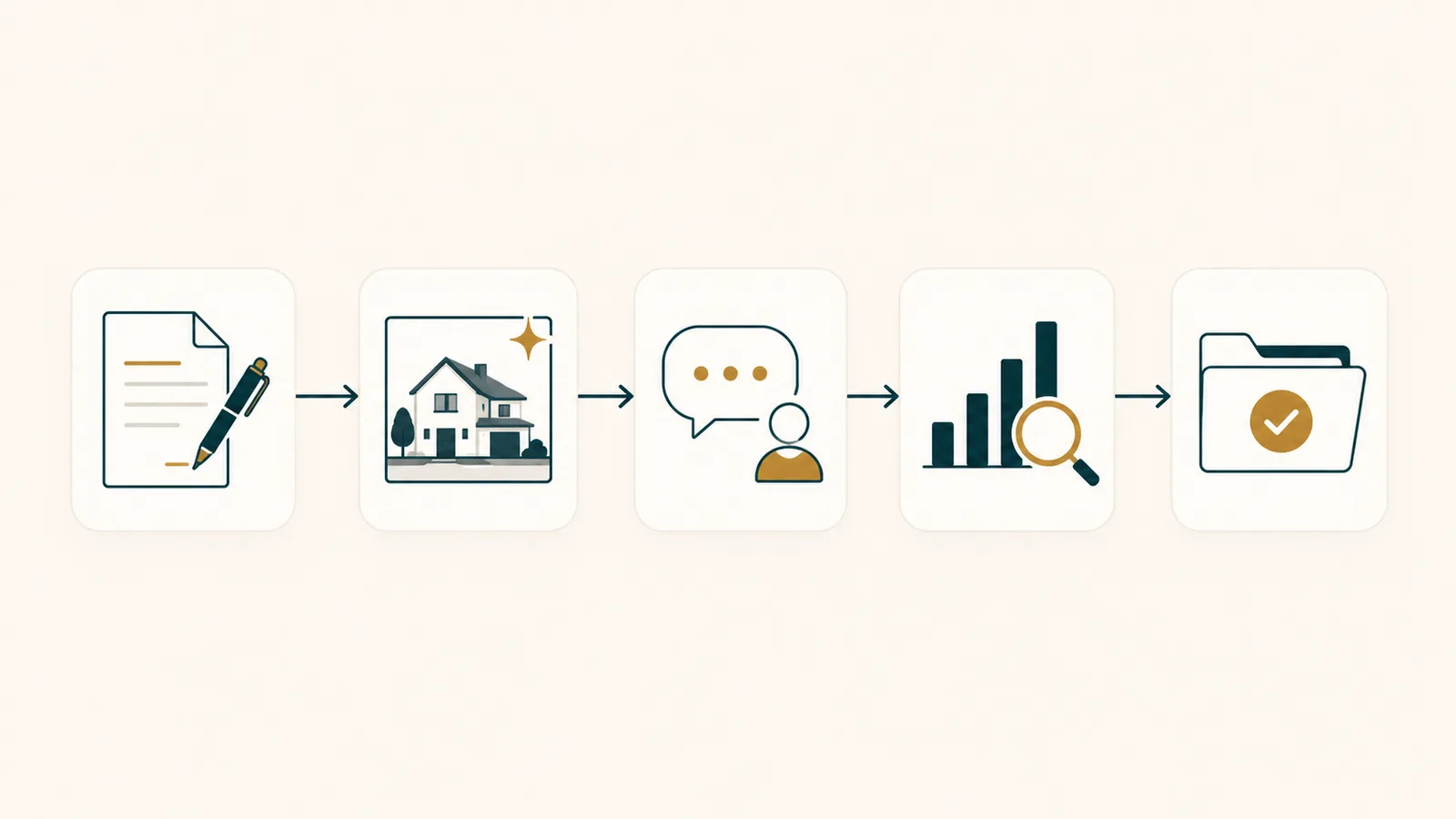
A few picks deserve a word. For a CMA, most agents overpay: RPR is free to every NAR member and holds the deepest public-record database in the business, and many MLSs hand you Cloud CMA at no cost, so check both before you pay for anything. Virtual staging is the clearest return in the whole stack; a $19-a-month tool replaces $2,000 to $4,000 in physical staging and pays for your entire toolkit on the first listing. And for listing copy, the general assistant you already have beats the niche $8-a-month "listing generator" wrappers, most of which are just ChatGPT with a real-estate prompt bolted on.
The Fair Housing catch nobody puts in these lists
This is the biggest thing missing from every "best AI tools for realtors" list, and it's the one that carries real legal risk. In April 2024, HUD confirmed that the Fair Housing Act applies to AI-generated advertising, and that you, the agent, are responsible for the content no matter what wrote it. "The AI did it" is not a defense.
The trap is that AI listing generators love steering language. Ask for a punchy description and you'll often get "perfect for growing families," "ideal for young professionals," or "quiet, established neighborhood," each of which can be an illegal reference to familial status, age, or a protected class. The rule that keeps you safe is simple: describe the property, not the buyer. Write "adjacent to a jogging trail," never "perfect for joggers." Under NAR's Code of Ethics (Articles 2 and 12), truthful, non-discriminatory advertising is on you.
So use AI for the first draft, then read every line and cut anything that describes who should live there rather than what the home is. Penalties for Fair Housing violations start around $10,000 and climb past $100,000 for repeat violations, plus civil liability and license discipline. This is the one place in your stack where the human review is not optional.
What your MLS, broker, and state now require
The rules on AI-edited photos are changing fast, and 2026 is the year they became law in the first state. California's AB 723 (effective January 1, 2026) requires that any AI-altered listing image carry a clear disclosure and a link or QR code to the unaltered original. It covers virtual staging, adding or removing furniture, changing paint, and altering landscaping; basic edits like lighting, cropping, and white balance are exempt. A willful violation is a misdemeanor. Industry analysts expect most states to adopt similar disclosure rules within about two years.
Two more layers sit under that. Your MLS almost certainly bars any edit that changes a "material fact" about the property, and you must comply with its data-license terms when you feed listing data to an AI tool. And if you use AI to call or text leads, TCPA and Do-Not-Call rules still apply in full. Before you lean on any of this, read your MLS's rules and your broker's AI policy; they may be stricter than the law.
What a solo agent should skip
The fastest way to waste money on real estate AI is buying a platform built for a team. Here's what most solo agents can safely skip until they have the volume to justify it.
- The all-in-one lead platforms, like BoldTrail (around $499 a month), Lofty (around $449), Ylopo (around $395 plus ad spend), CINC, and raia. Their behavioral lead-nurture AI is priced for a team with staff to feed it; a solo doing a few deals a month can't keep it busy enough to pay for itself.
- AI inside-sales chatbots that qualify leads around the clock, until your inbound genuinely outpaces what you can answer yourself.
- Niche "listing description" subscriptions, since the assistant you already pay for writes the same copy.
- AI avatar video tools; a talking-head clip edited from your own footage in a free tool reads as more trustworthy than a synthetic presenter, which matters in a business built on trust.
- Paid CMA tools before you've checked RPR and your MLS, both of which are likely free to you already.
Does an AI stack actually pay off?
For a solo agent, yes, and by a wide margin, because the version that helps most can cost almost nothing. A free-first stack (one assistant, RPR, a free Cloud CMA, Canva, and a virtual-staging free tier) runs $0 to about $40 a month once you add a single paid tool.
Do the math against your own time. If your hour is worth about $50 and you recover four hours a week on listing copy, follow-ups, and research, that's roughly $800 a month of time back. One virtual-staging job alone saves you the cost of physical staging. Contrast that with a $499-a-month platform, which has to generate a whole extra transaction just to break even, something a solo pipeline rarely feeds. For the tools genuinely worth paying for, our general by-job roundup of the best AI tools goes deeper, and if you run a brokerage with staff, the small-business version fits that reader better.
Will AI replace real estate agents?
No. AI is automating tasks, not representation. It can draft a description, stage a photo, and summarize a contract, but it can't price a home against a specific street, negotiate a repair credit, read a nervous first-time buyer, or carry the fiduciary duty your license requires. About 90 percent of sellers still use an agent, and nothing in the current tools changes that.
What AI does change is the gap between agents. The ones who use it recover hours and spend them on the human work that actually closes deals; the ones who ignore it fall behind on speed. Use AI to clear the busywork, and keep the judgment for yourself.
What this guide does not cover
This is a free-first, by-job guide for a solo residential agent, not a ranking of every proptech platform and not investor, commercial, or brokerage-scale software. It also isn't legal, tax, or compliance advice: Fair Housing, MLS rules, and state AI laws vary and change quarterly, so confirm your own situation with your broker and, where money or law is on the line, a qualified professional. Every price and free tier here is accurate to mid-2026; check the official page before you pay.
Sources
- NAR, artificial intelligence resources and technology survey (agent AI adoption)
- HUD guidance on the Fair Housing Act and AI advertising (2024) (agent liability for AI content)
- HousingWire, AI Fair Housing remarks checklist and Pinnacle Real Estate Academy on AI and Fair Housing (steering language)
- Barnes Walker on California AB 723 and WAV Group on California's 2026 AI laws (AI-photo disclosure)
- NAR on AI platforms and MLS policy compliance (MLS rules)
- RPR for NAR members and REimagine Home pricing (free-tier and virtual-staging cost)
Frequently asked questions

Written by
Tapabrata Biswas
Tech Researcher
I test AI productivity tools and research home-automation gear the way most people use them. Not in a lab, but on an ordinary desk with an ordinary internet connection. The only test that matters: does it save you time?
Share the Post with Your Besties
Get the plain-English tech brief
One email a week on AI tools and smart-home tech. No jargon, no hype.